
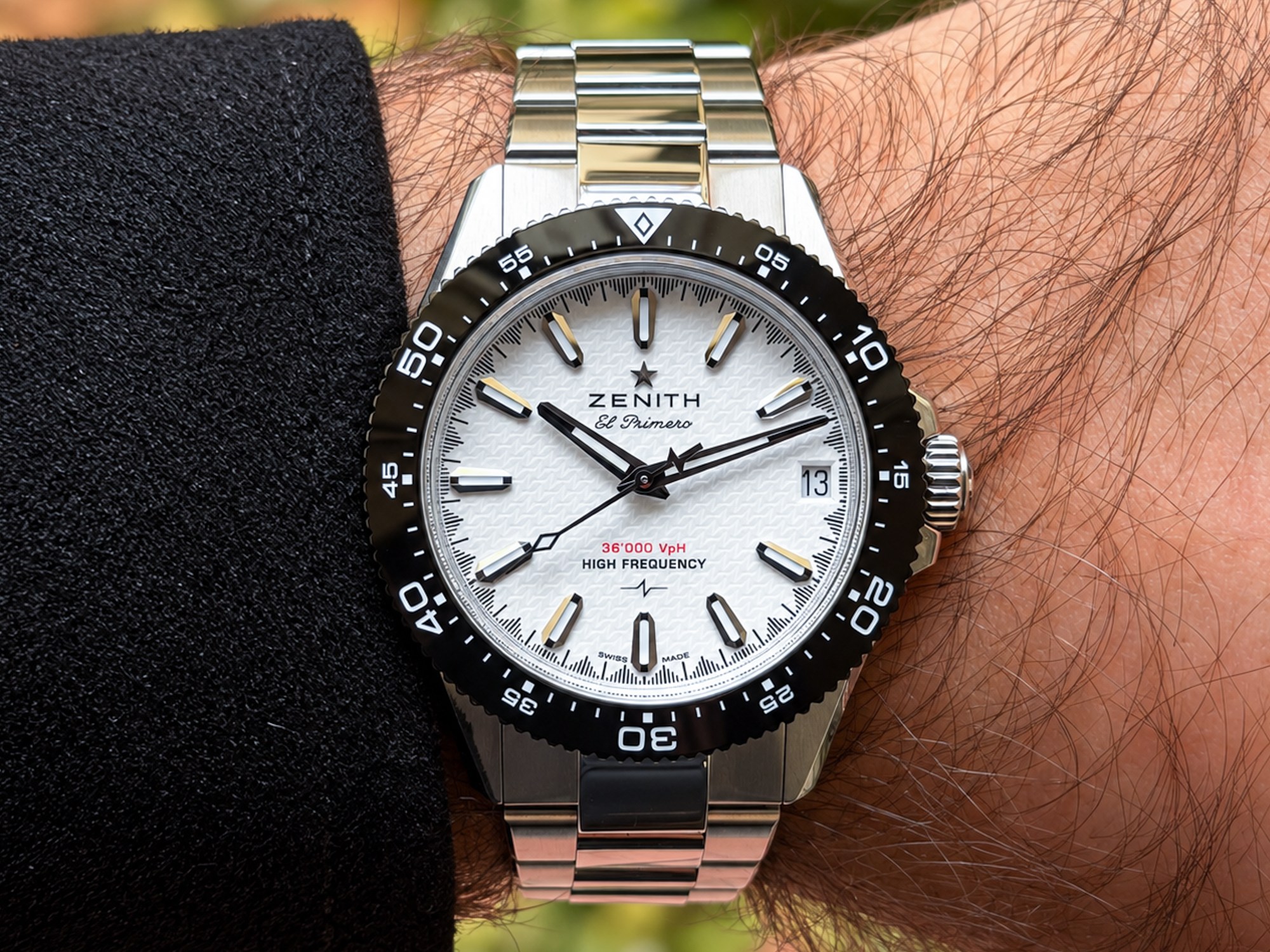
Since I started writing about watches around ten years ago, I never imagined that a decade later I would still be doing it, nor that watches would become such a significant part of my life. During those years, I have been lucky enough to handle and review an enormous variety of watches, starting with pieces costing around €100 and gradually moving all the way up to watches in the €7,000 range. Some were genuinely impressive, others disappointing, and quite a few taught me that price and quality do not necessarily increase together in a straight line.
What has changed most over those ten years is probably my relationship with watches themselves. In the beginning, I was mainly interested in the finished object: the design, how it felt on the wrist, the movement specification and, of course, photography. Over the last few years, however, that interest has developed much further into watchmaking itself. I have started learning how mechanical watches work from the inside and how to perform a complete service on mechanical watches and even clocks. Once you begin taking movements apart, cleaning them, inspecting components and trying to understand why certain technical decisions were made, you naturally start looking at watches differently. A movement specification stops being just a list of numbers.
At the same time, I had always hoped that one day I could review watches from some of the established Swiss luxury manufactures. I approached local dealers more than once over the years, hoping to get such an opportunity, but received plenty of rejections. Eventually, I more or less put that ambition in the background and concentrated on the watches I could actually get my hands on.
Then, rather unexpectedly, I got an opportunity to work with a brand that you have probably already guessed from the title: Zenith. And I really am honoured to have this opportunity. My passion for wristwatches began when I was a child, and now that I am also learning watchmaking, getting the chance to spend proper time with a Zenith feels especially meaningful. This is not simply another expensive Swiss watch arriving for photography. Zenith represents one of those names where the movement matters just as much as the logo on the dial.
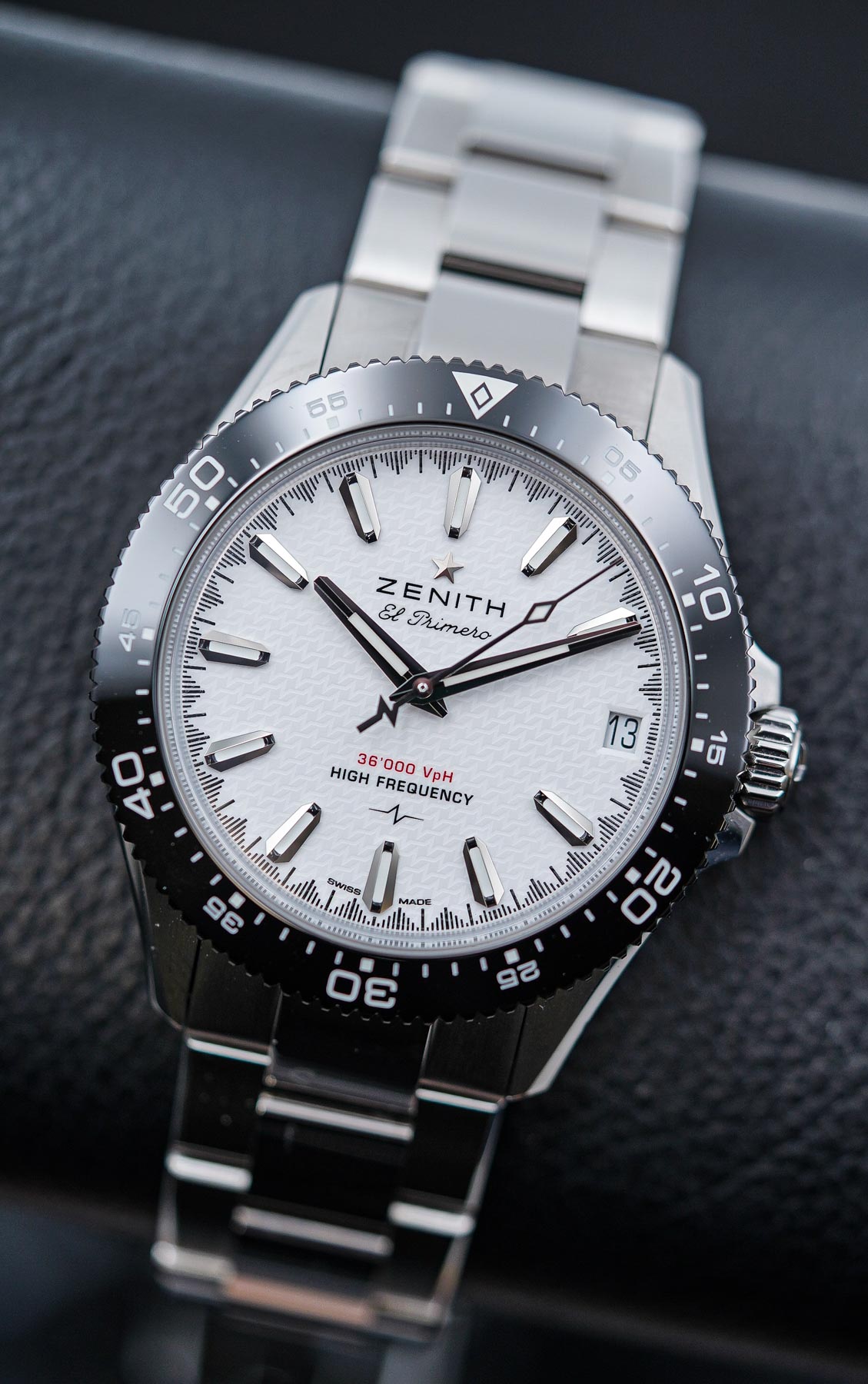
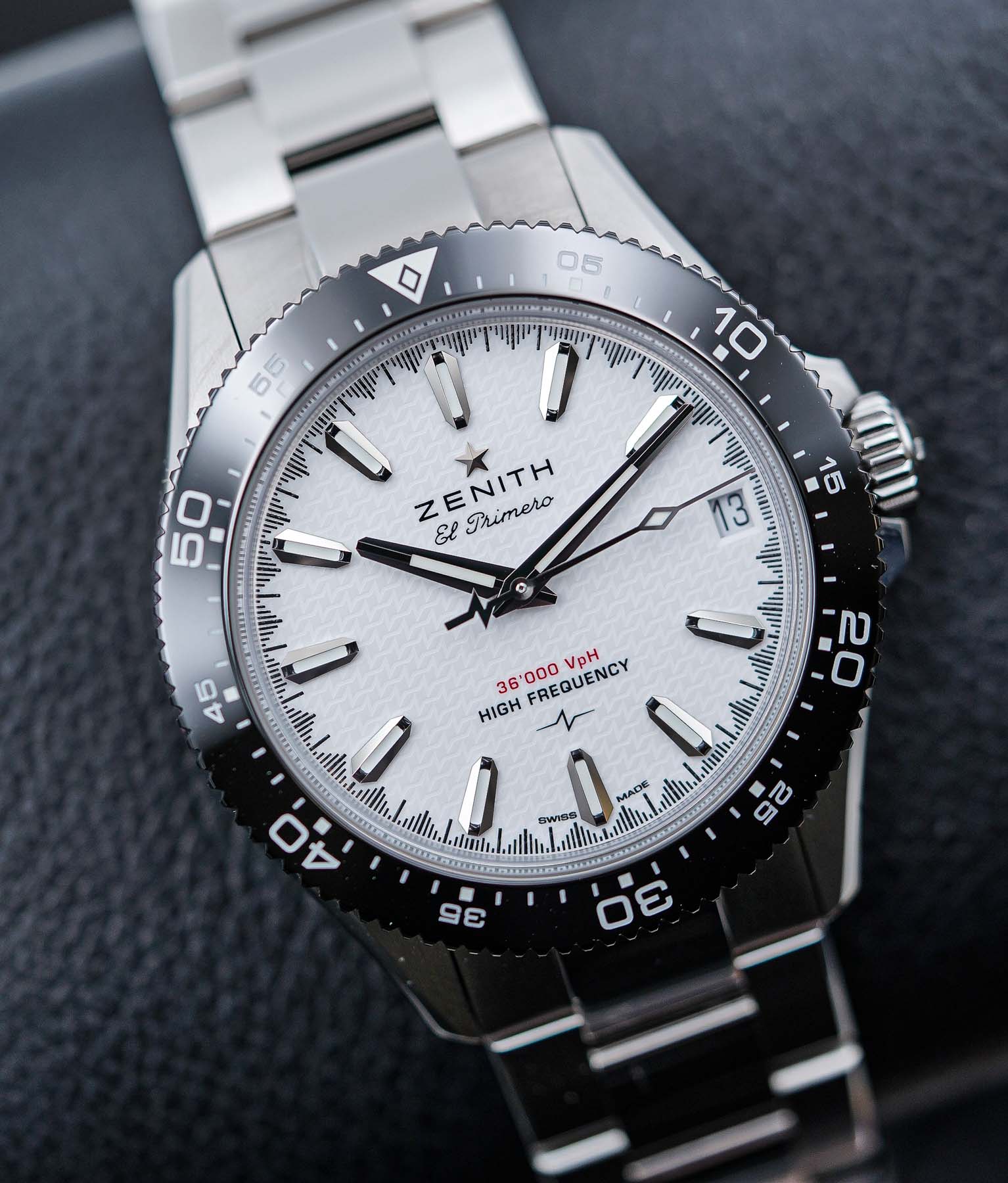
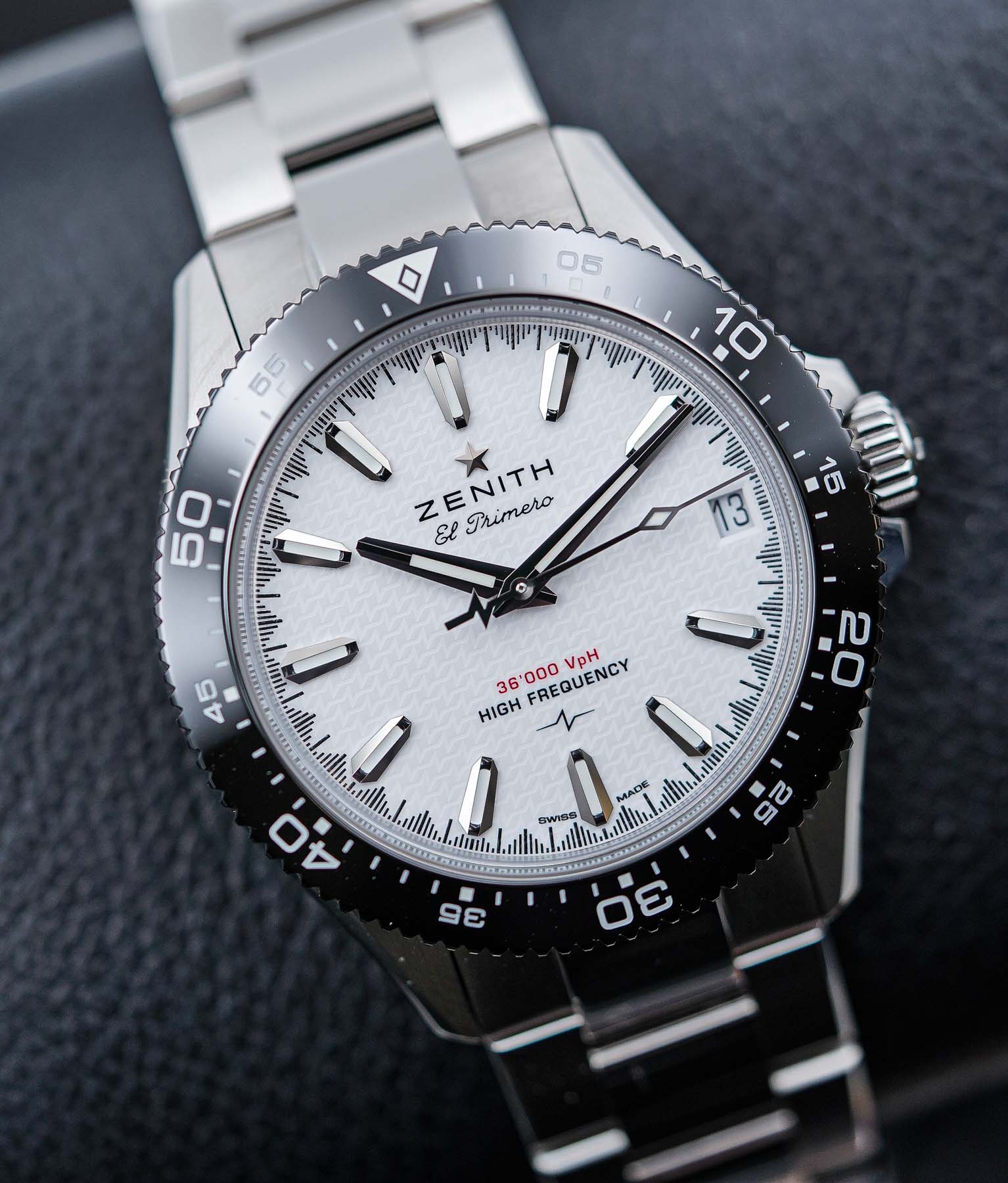
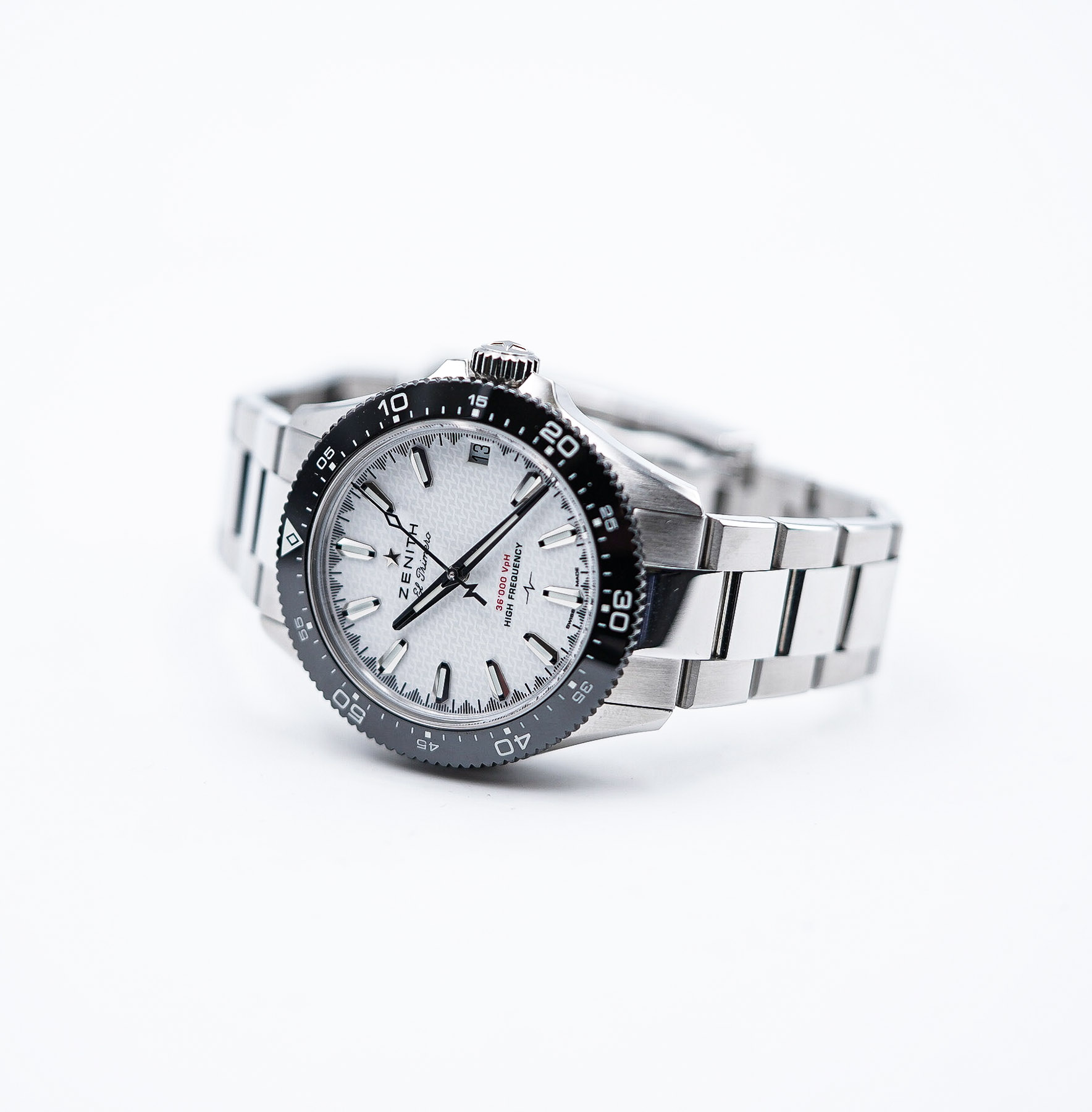
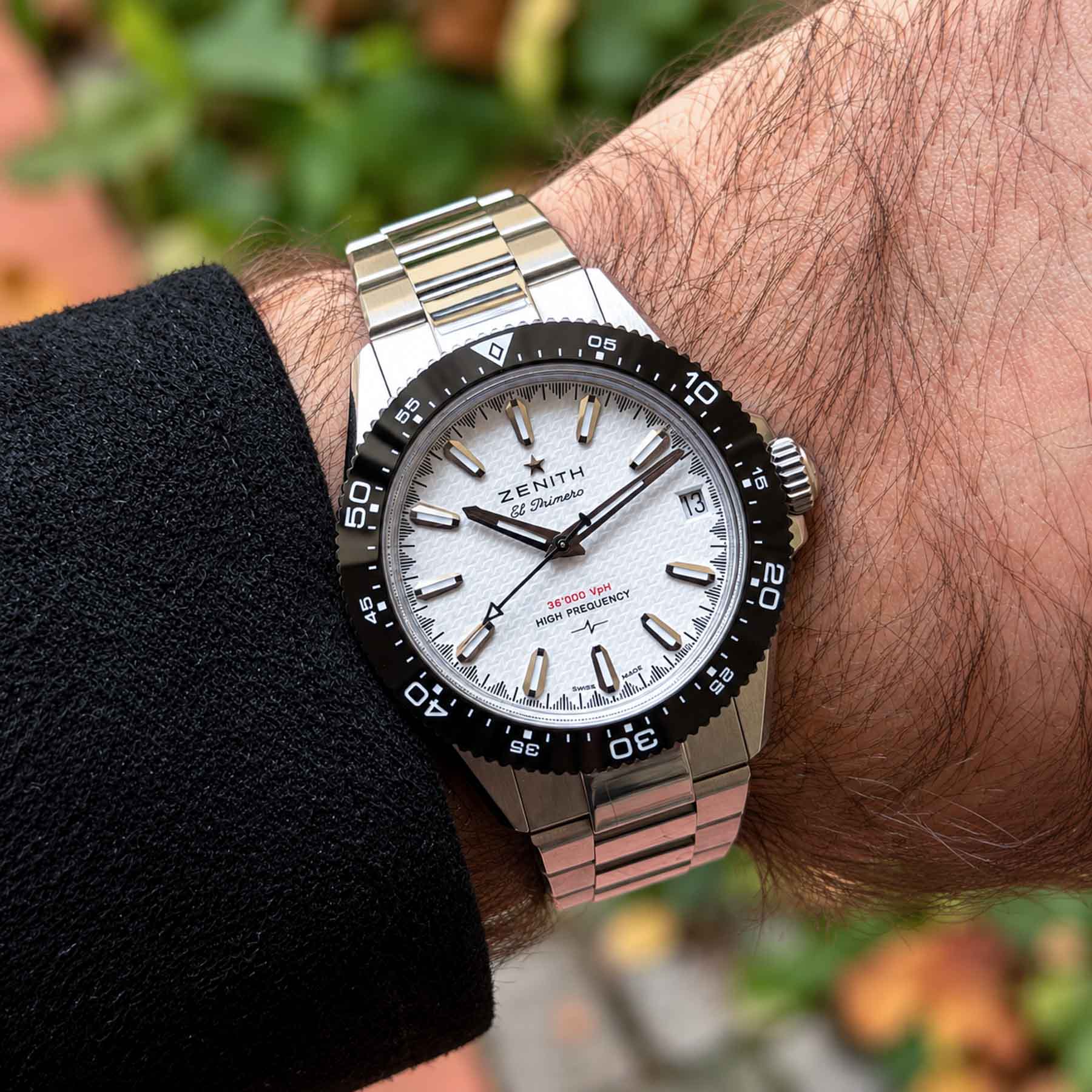
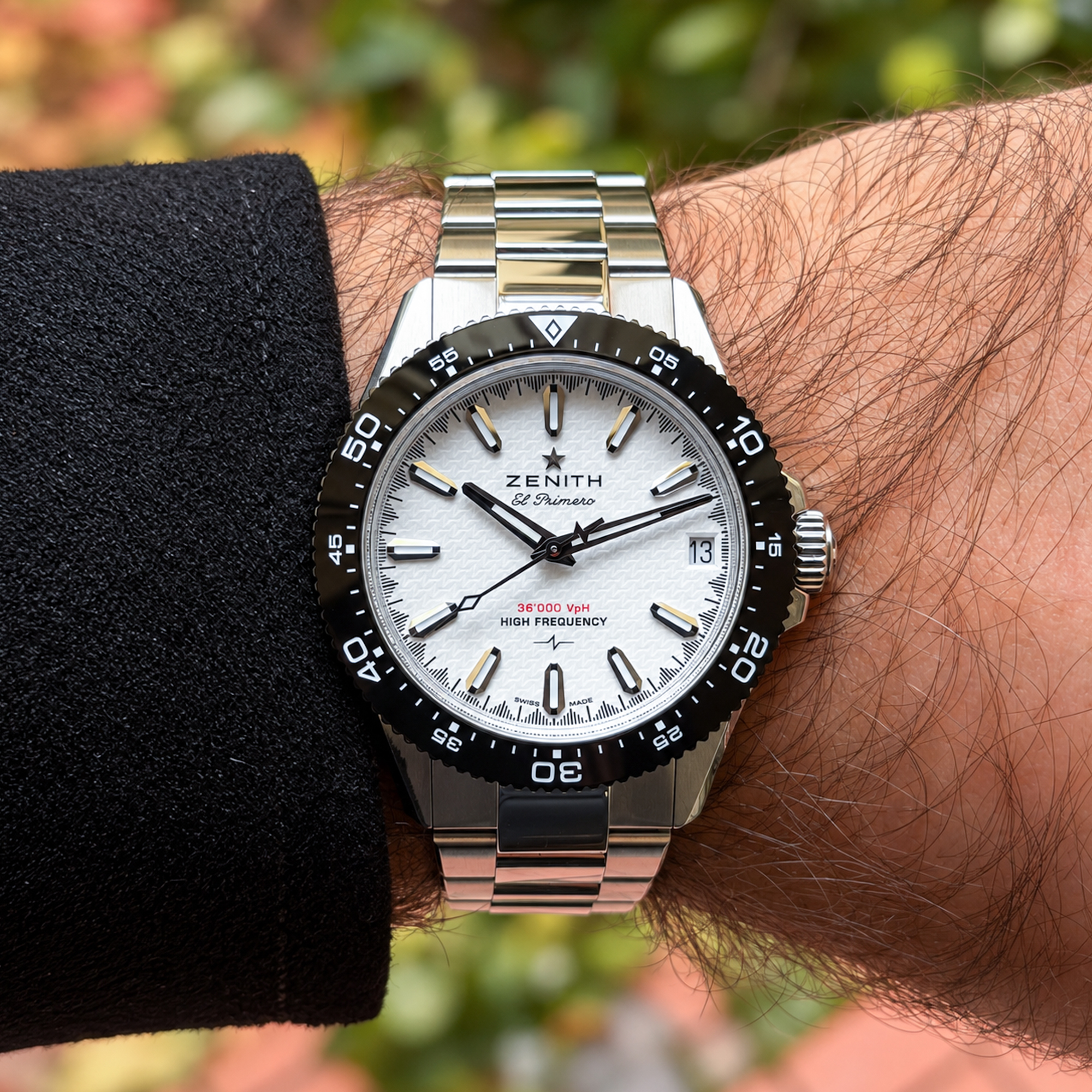
The watch we are looking at today is the new Zenith Chronomaster Solo Sport, specifically reference 03.5000.3620/69.M5000, with the white ceramic dial and contrasting black ceramic bezel. And it is an interesting watch for Zenith because, despite carrying the Chronomaster name and being powered by an El Primero, there is no chronograph here. Instead, Zenith has created what is essentially its interpretation of a luxury everyday sports watch: 40mm stainless-steel case, rotating 60-minute bezel, screw-down crown, 200 metres of water resistance, bracelet, serious lume and a three-hand El Primero movement. That combination immediately puts it into a very crowded and very difficult part of the market. Especially because the price is €10,500. That figure bothered me before the watch arrived, and it still matters after spending time with it. €10,500 is no longer simply Omega, Breitling or Tudor territory. We are basically entering Rolex Submariner money, and once you cross that line, expectations change considerably.
But specifications and retail prices are only half the story. After living with the Chronomaster Solo Sport, I also discovered that there are some things Zenith has done here exceptionally well — arguably better than some of those competitors. So the real question for me became not whether the Solo Sport is a good watch. It clearly is. The more difficult question is whether it is good enough to make €10,500 feel reasonable.
My first surprise came before I even put the watch on my wrist. When Zenith initially released the Chronomaster Solo Sport and I saw the press images, I expected it to have quite a substantial presence. It looked broad, almost slightly oversized in some photographs. In person, however, it appears noticeably more compact. At 40mm, it is hardly small, but its proportions are extremely well judged. More importantly, it does not feel like Zenith simply removed the chronograph pushers from a Chronomaster Sport and called the result a new model. Once you see it physically, the Solo Sport has quite a distinct personality. The white dial and black bezel probably make the strongest first impression of the collection for me. It has the familiar high-contrast appearance that works extremely well on a sports watch, but the textured ceramic dial prevents it from looking generic.
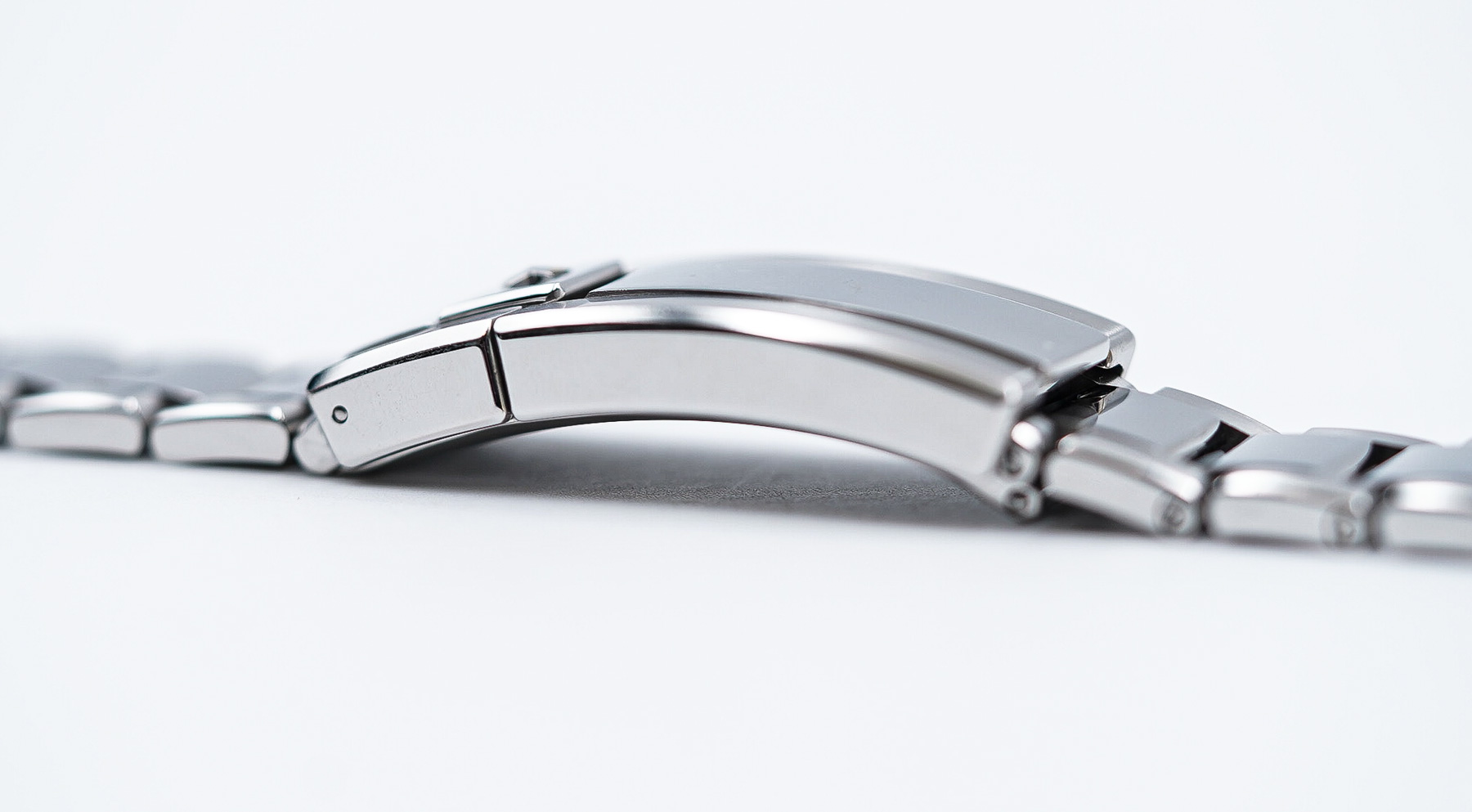
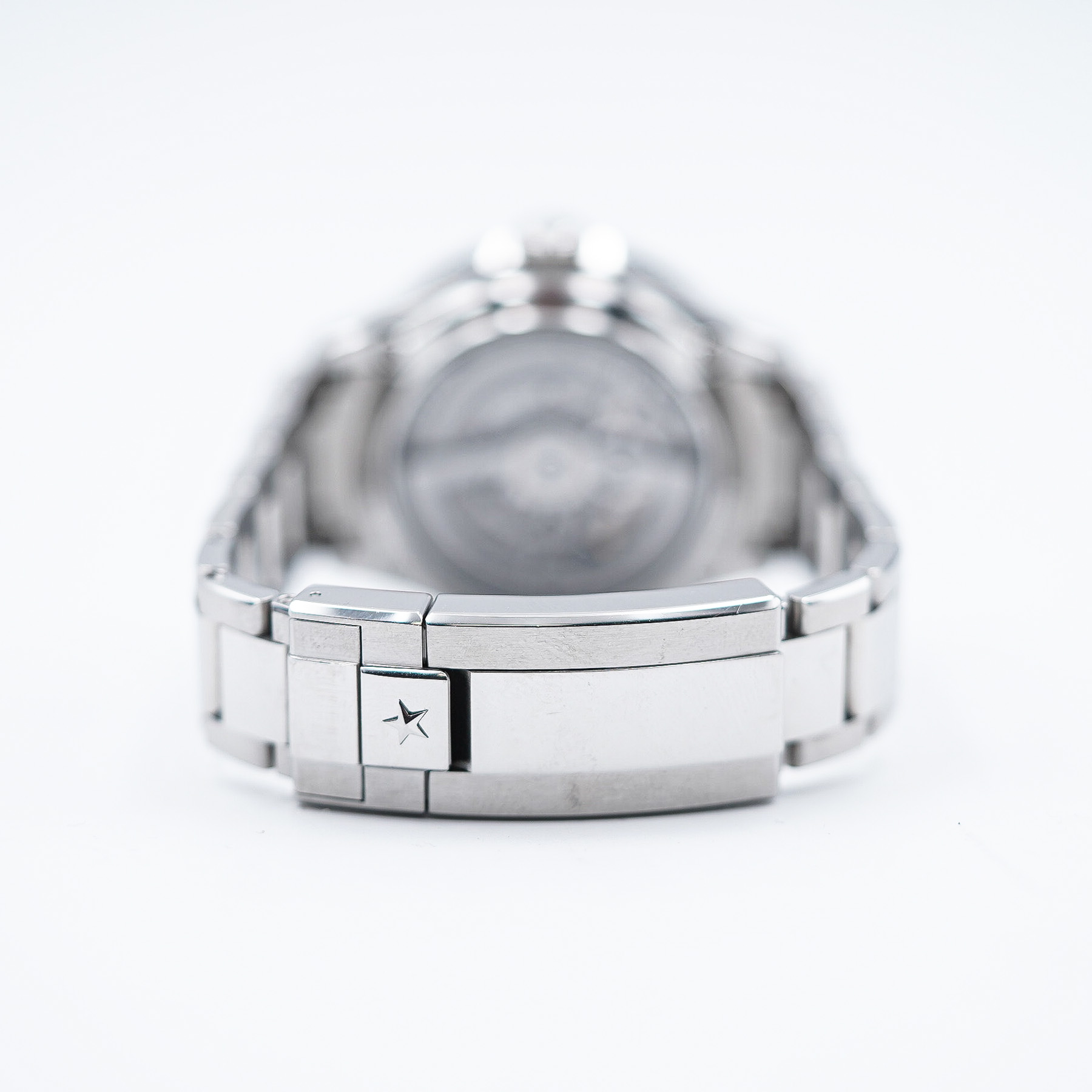
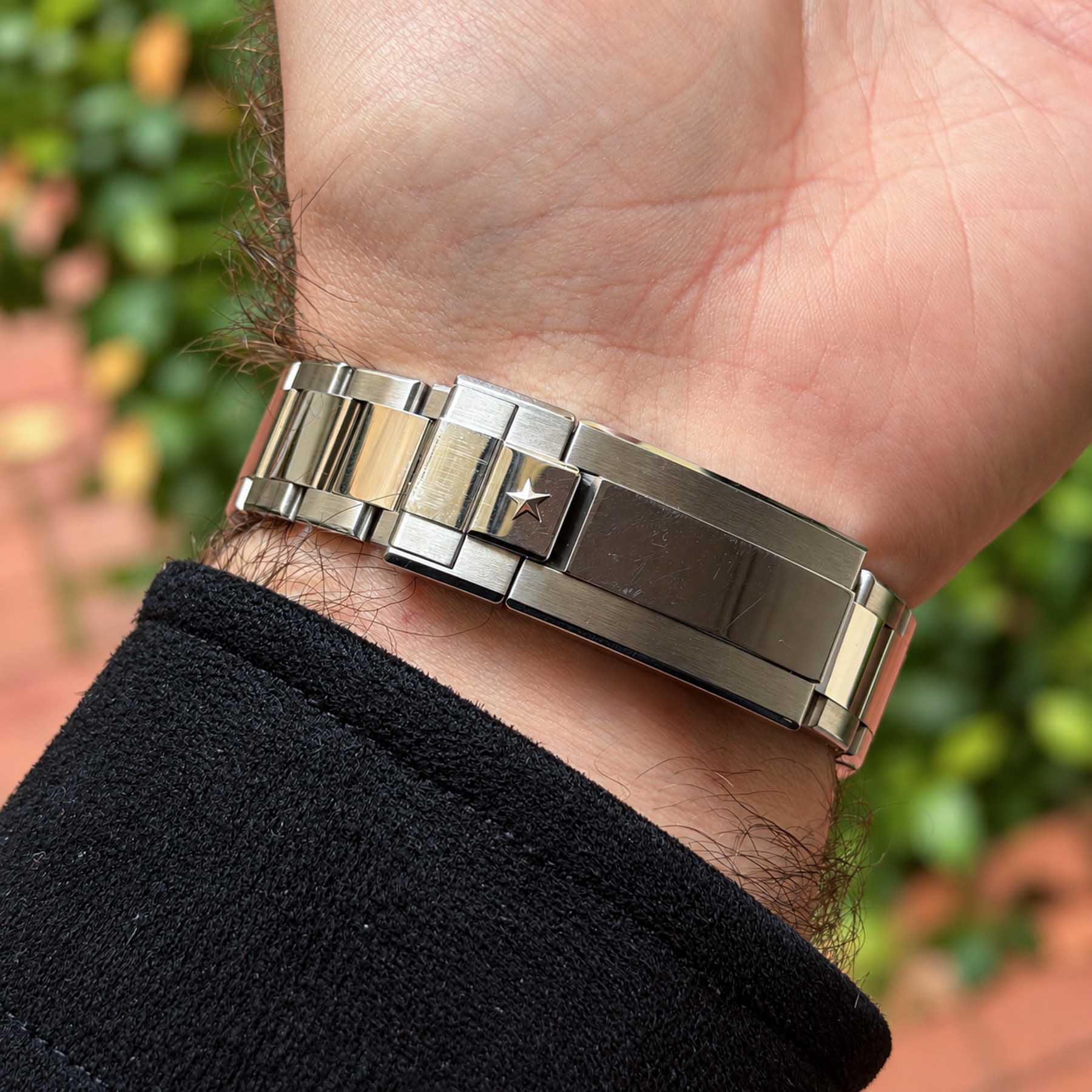
Then I opened the clasp. And honestly, that became one of the biggest surprises of the entire watch. Zenith calls the system ZENCLASP, and this is probably the first time in quite a while that I have played with a new bracelet clasp and thought someone had genuinely tried to solve small everyday problems rather than simply creating another micro-adjustment mechanism. There are complicated clasps and there are intelligent clasps. This is the latter. One tiny detail demonstrates what I mean. On most watches using a flip-lock safety system, once you open that external safety piece it becomes a loose piece of metal flapping around. Eventually it starts touching and scratching the bracelet link underneath it. I have seen this happen on watches at almost every price level. On the Zenith, the safety lock behaves differently. It has defined positions rather than simply hanging loose, meaning it does not constantly fall against the bracelet. It sounds insignificant until you own watches with these types of clasps and see what happens after months and years of use.
Even the closing procedure has been thought through. When the main clasp closes, it partially brings the safety lock into position as well, making putting the watch on noticeably quicker and more natural. The deeper you go into the mechanism, the more interesting it becomes. Zenith developed ZENCLASP over three years, and the mechanism contains 41 components, including ten ceramic balls used in its locking and positioning functions. The clasp gives 10mm of tool-free adjustment in 2.5mm increments. Zenith says it tested the system through the equivalent of 600,000 opening and closing operations. Those numbers are impressive, but what matters more is that the engineering can actually be felt when you use it. Ceramic contact elements are a particularly interesting choice because these are exactly the little parts of a clasp that repeatedly interact with one another and eventually develop wear. This is the sort of engineering I appreciate far more after becoming interested in watchmaking.
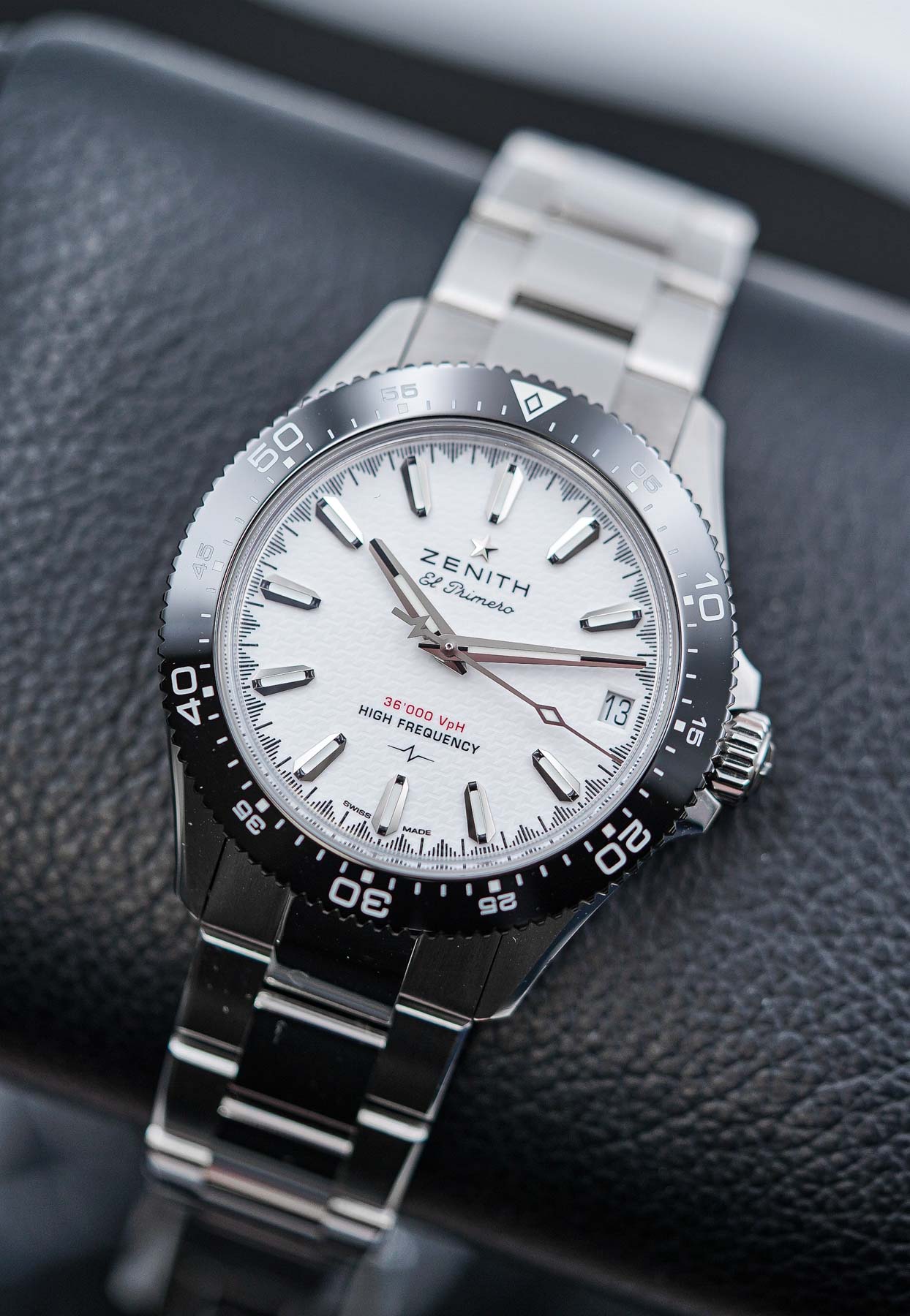
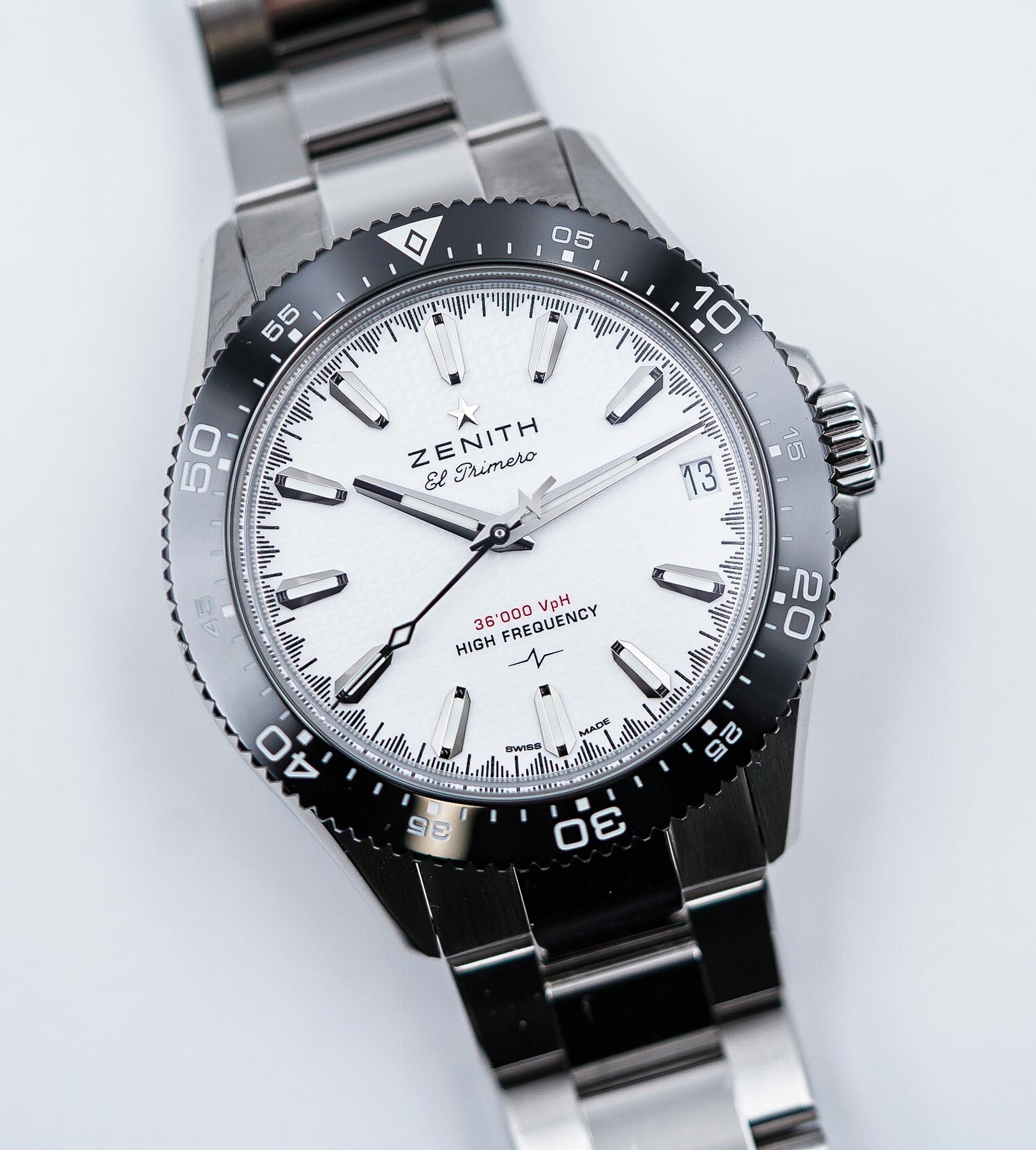
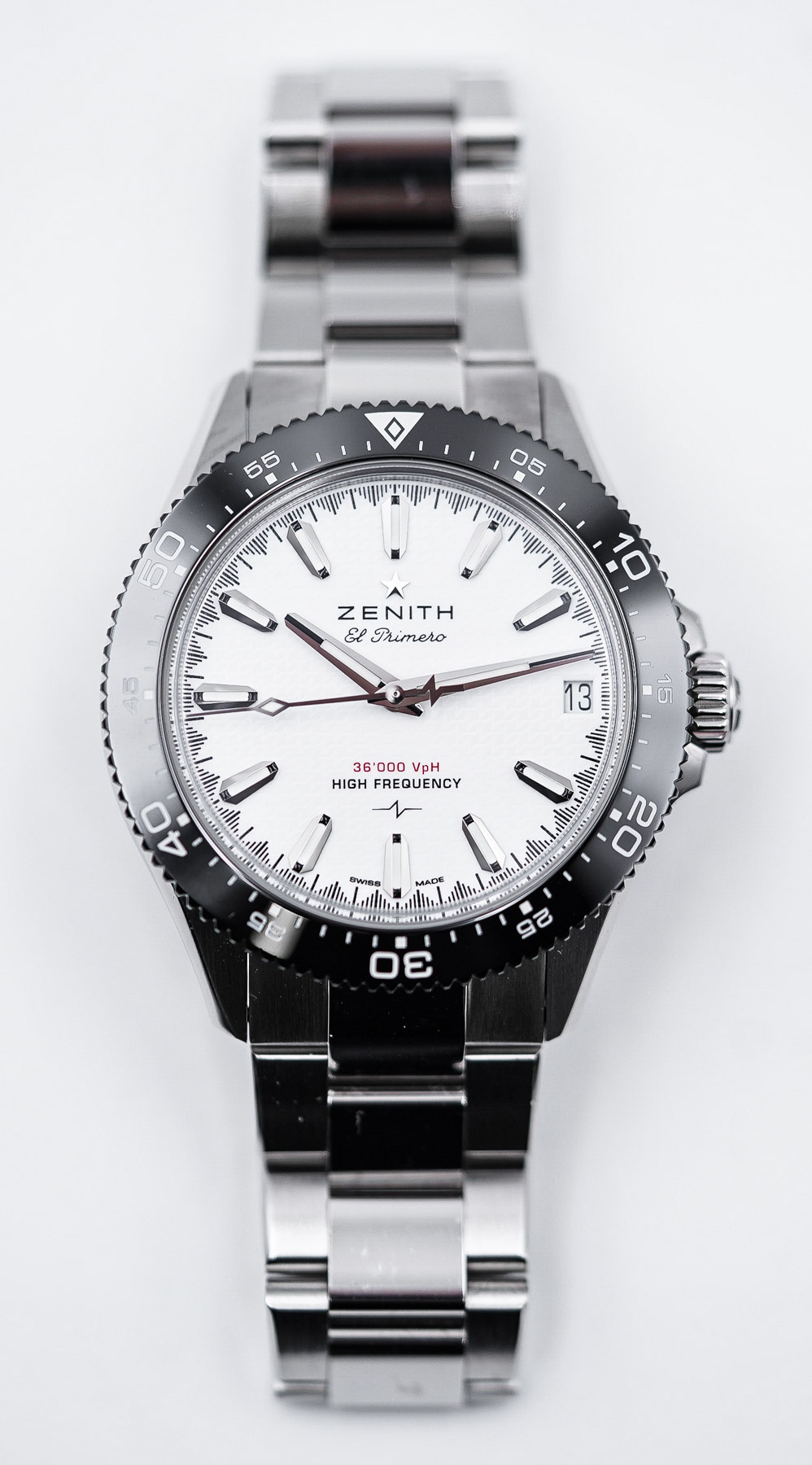
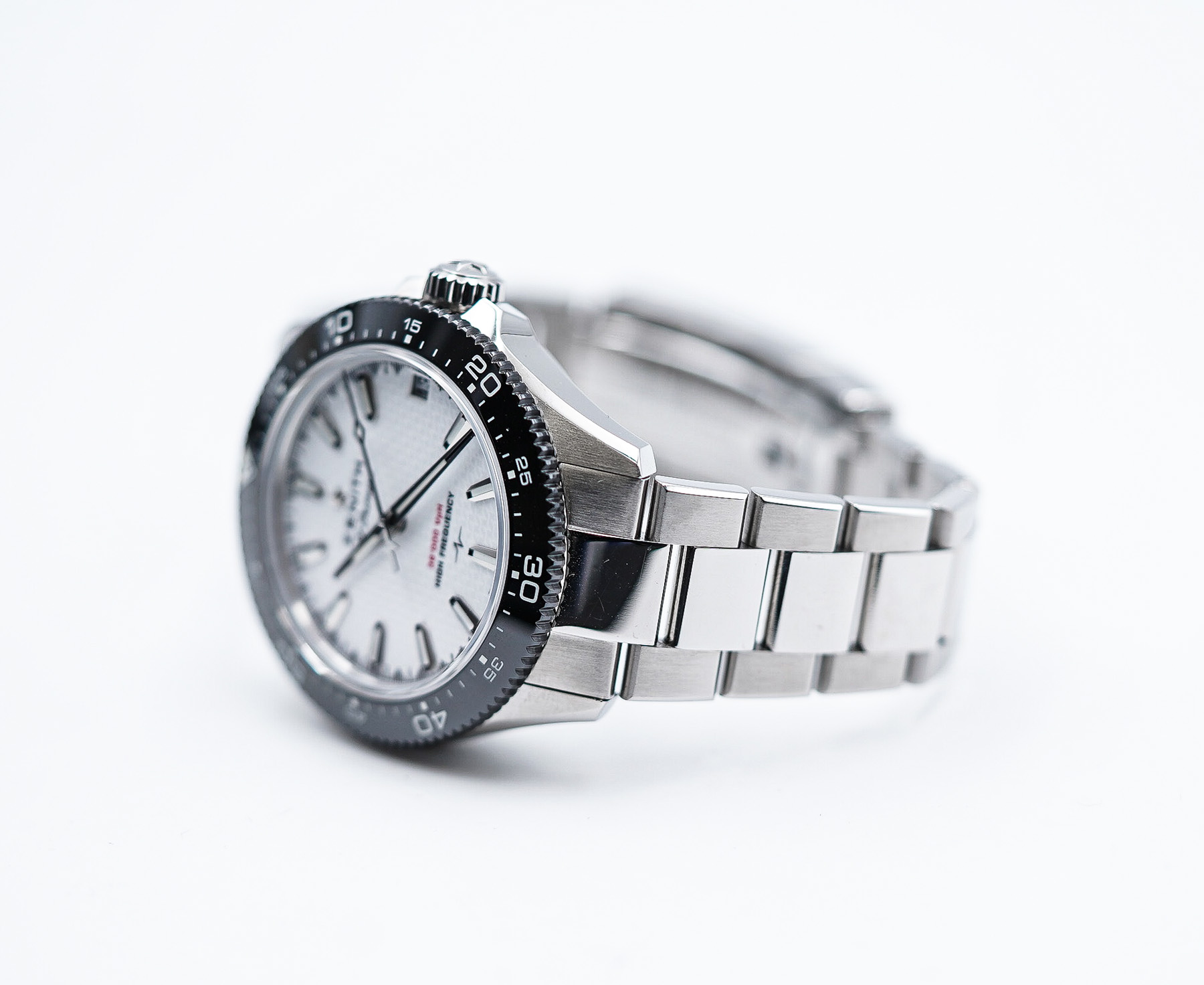
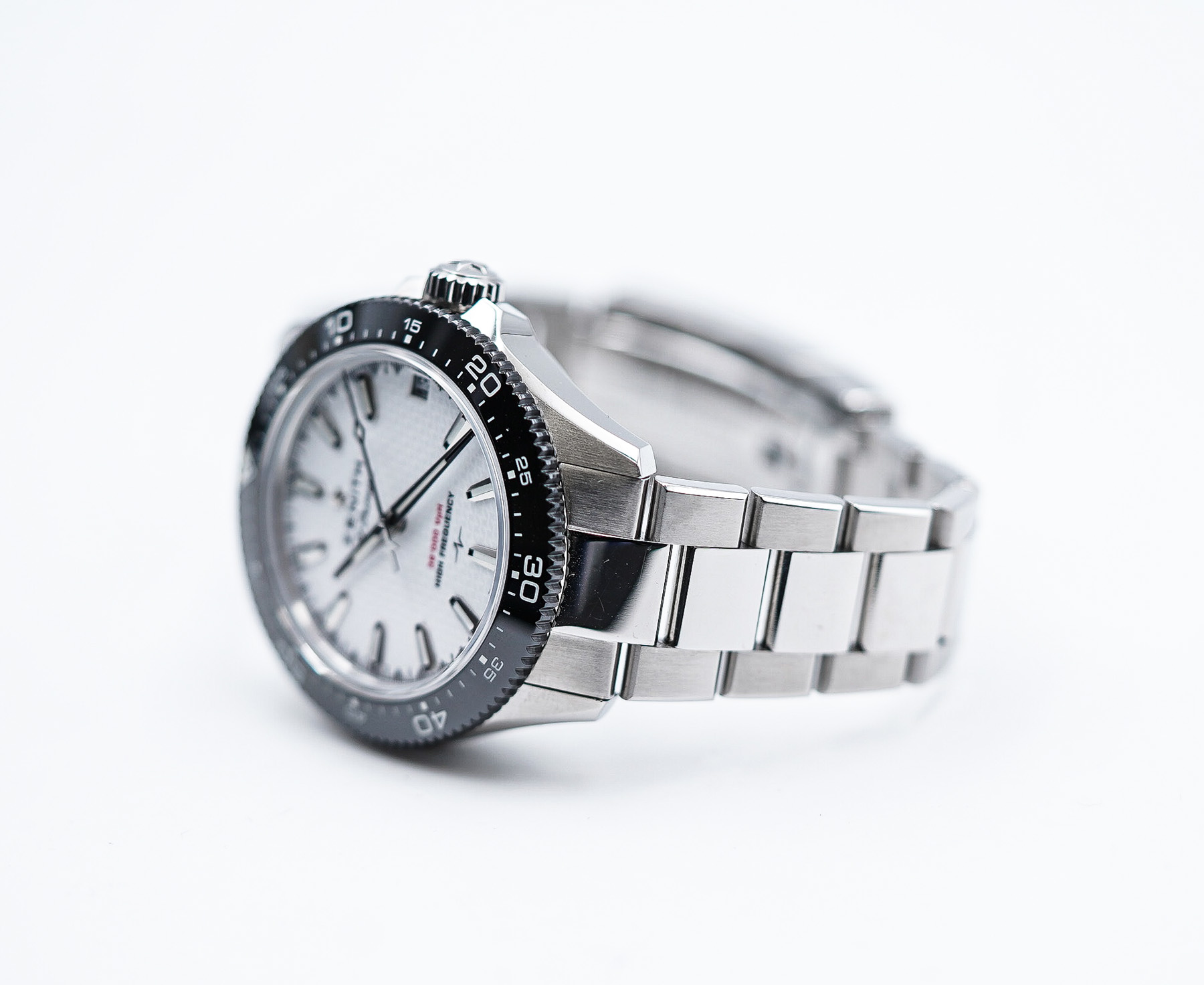
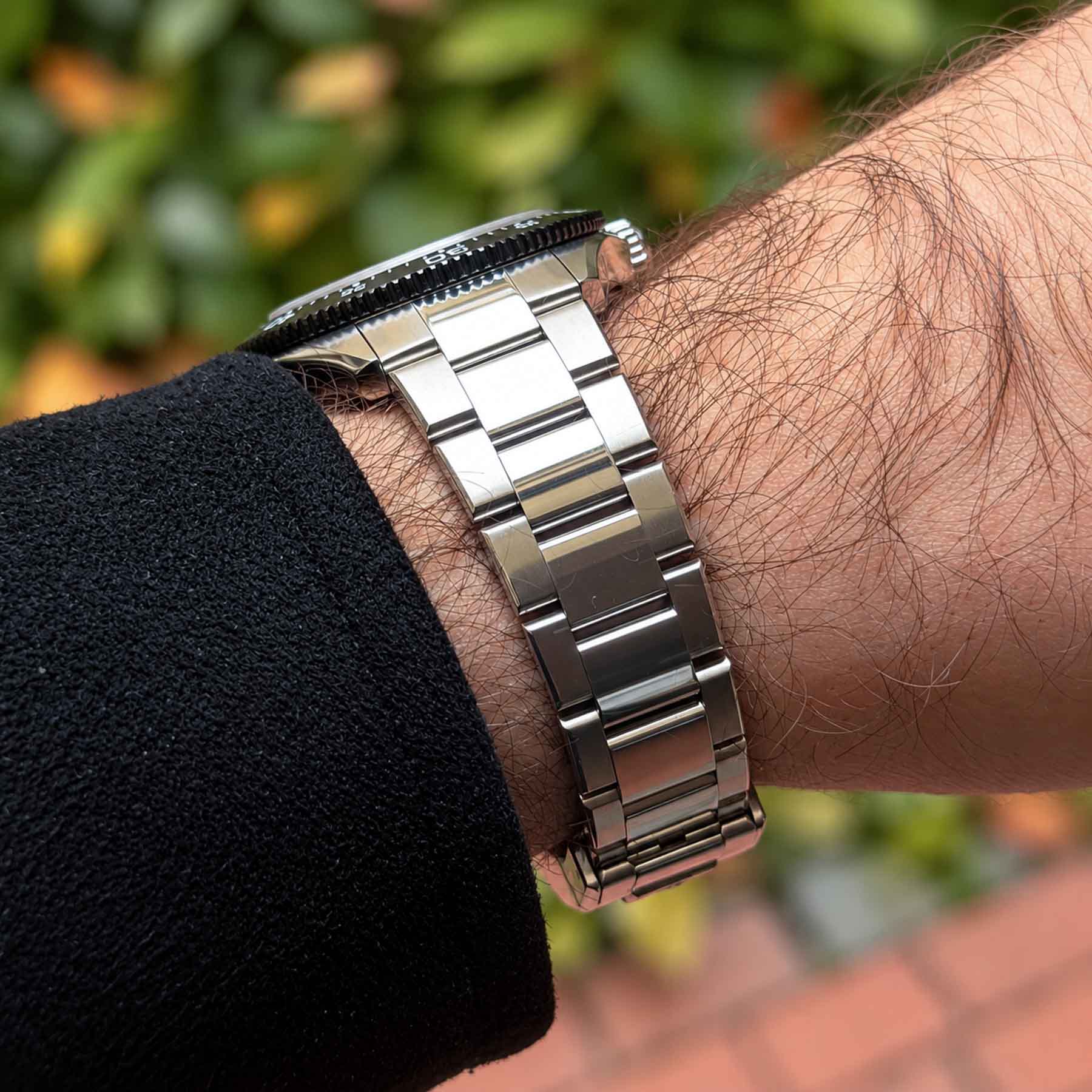
The stainless-steel case measures 40mm in diameter and approximately 46mm from lug to lug, with a thickness of just under 12mm if the protruding crystal is excluded. On paper, those are excellent dimensions, and on the wrist they work even better. This is probably one of the Solo Sport’s greatest strengths. There has been a tendency during the last decade to make sports watches bigger simply because they are sports watches. Thankfully, Zenith resisted that temptation. The Chronomaster Sport chronograph measures 41mm, while Zenith reduced the Solo to 40mm, and I think that single millimetre makes far more difference than the number suggests. Because the dial is relatively open and the bezel quite prominent, the watch still has presence. It does not feel like a vintage-sized sports watch. But the compact lug-to-lug measurement keeps everything controlled. The end links do extend the effective footprint slightly, although they curve downward rather than projecting horizontally from the case.
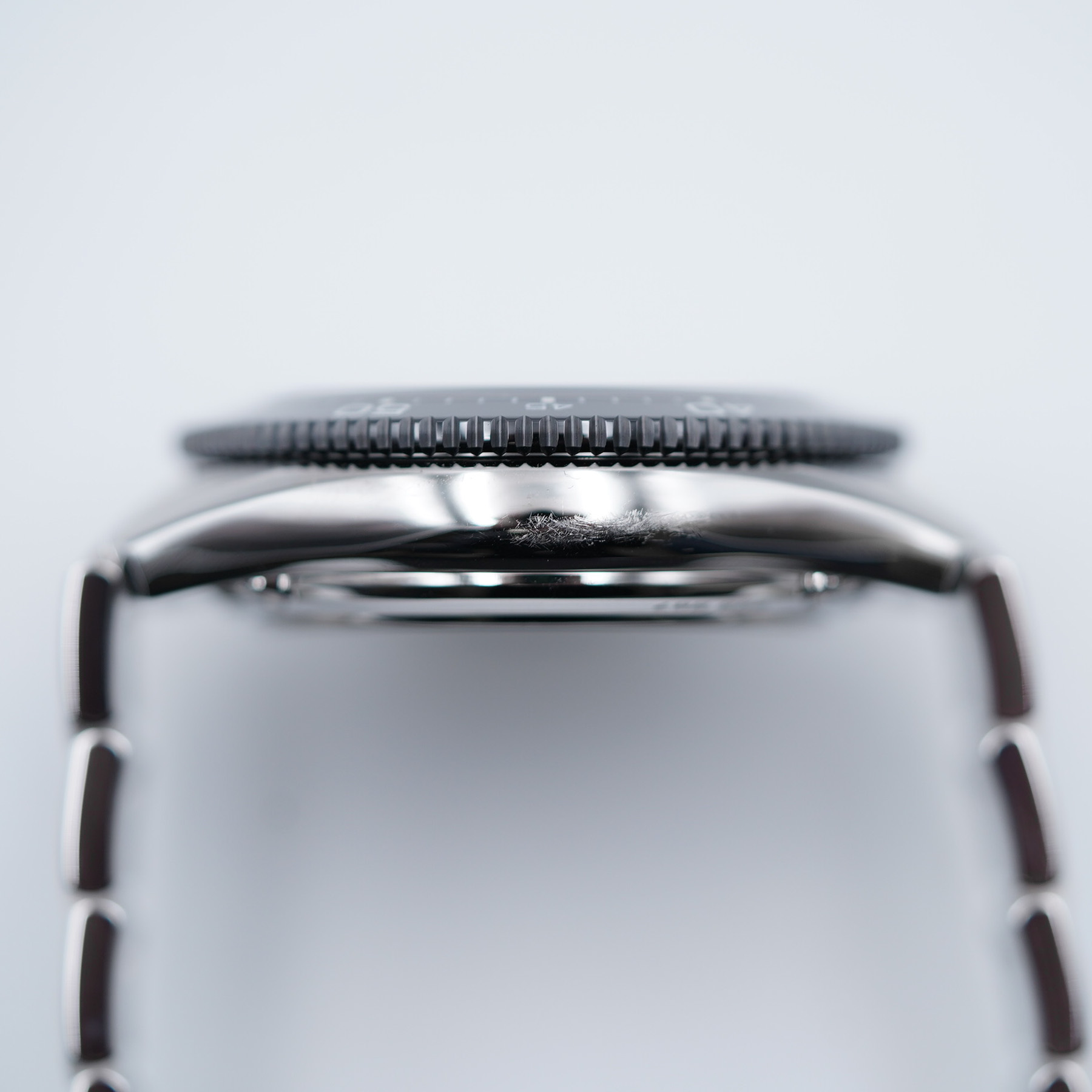
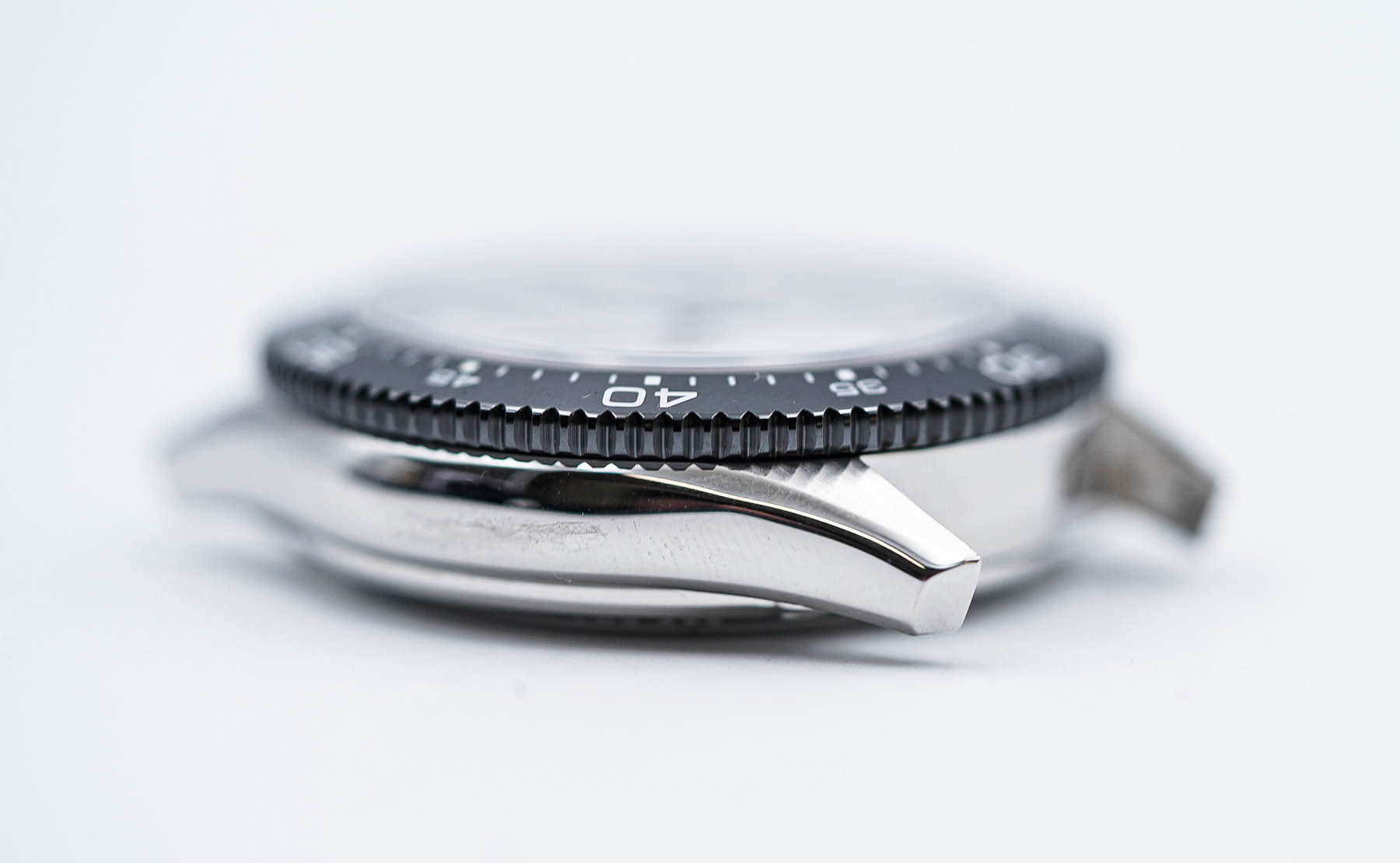
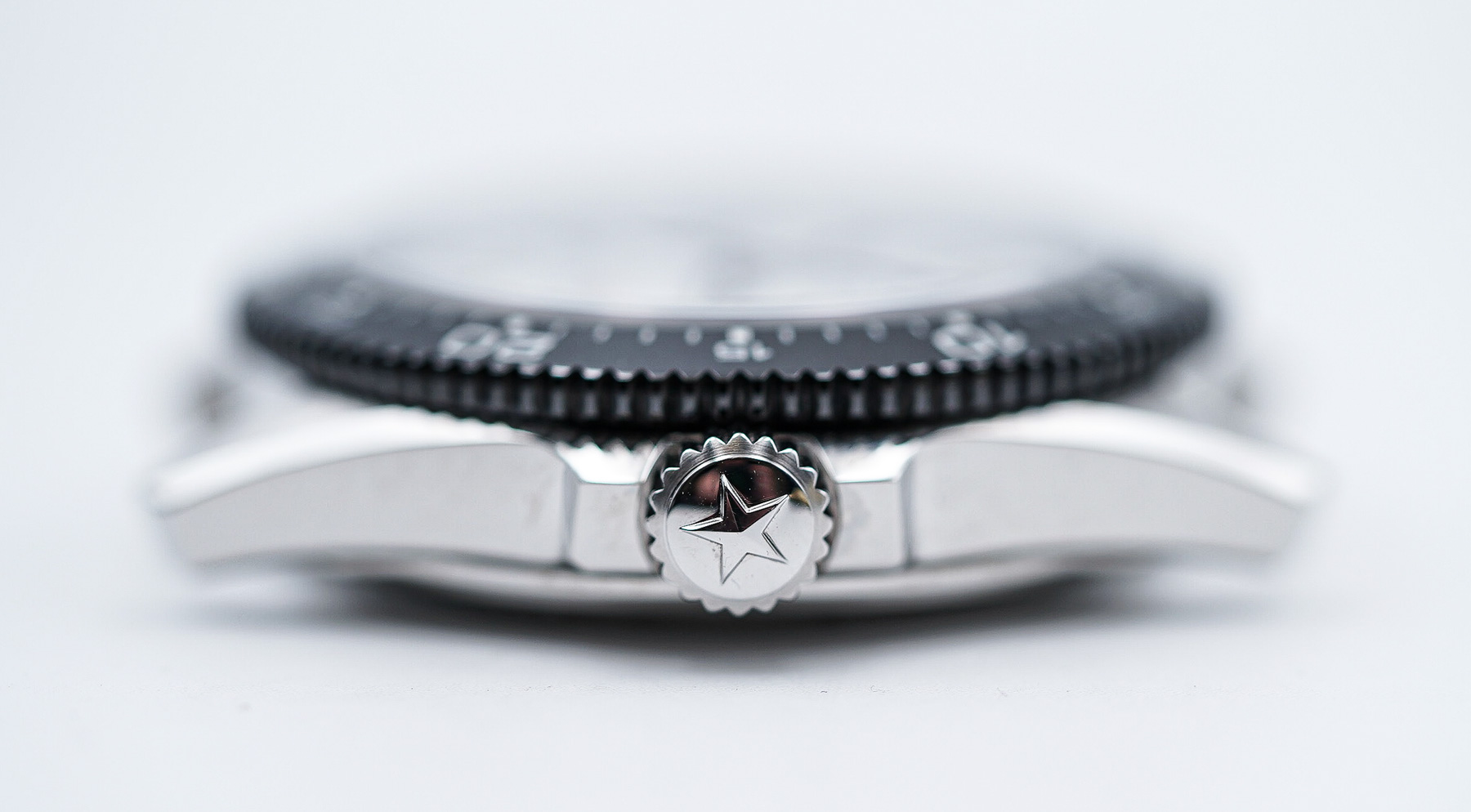
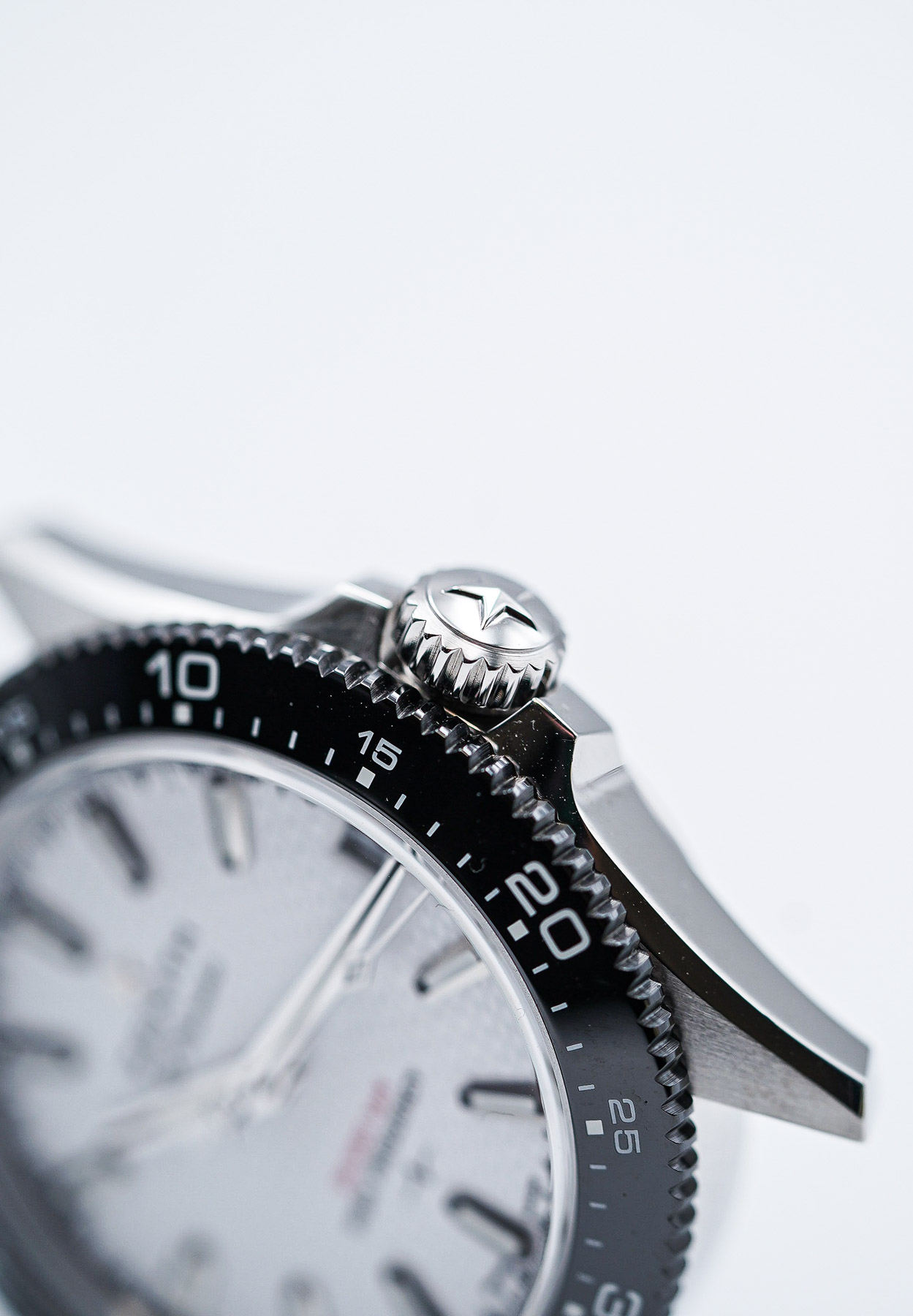
What impressed me most is the balance between visual presence and thickness. The Solo Sport feels substantial enough to justify being considered a serious sports watch, yet it remains slim enough to slide underneath a cuff. That combination is surprisingly difficult to achieve. A lot of 200-metre sports watches become slabs of steel once you look at them from the side. This one does not. The case finishing also reminds you that this is not intended to be a hardcore tool watch. Brushed and polished surfaces alternate throughout the case and bracelet, giving it considerably more refinement than something designed purely for diving. Some people will inevitably dislike the polished sections, particularly the polished centre links on the bracelet, because they collect scratches quickly. I understand that argument. If this were marketed as an uncompromising instrument watch, I would probably agree. But I don’t think that is what Zenith is trying to make. The Solo Sport exists somewhere between a dive watch, a sports watch and a luxury everyday watch. Zenith itself stops short of calling it a dedicated diver, despite giving it most of the hardware associated with one.
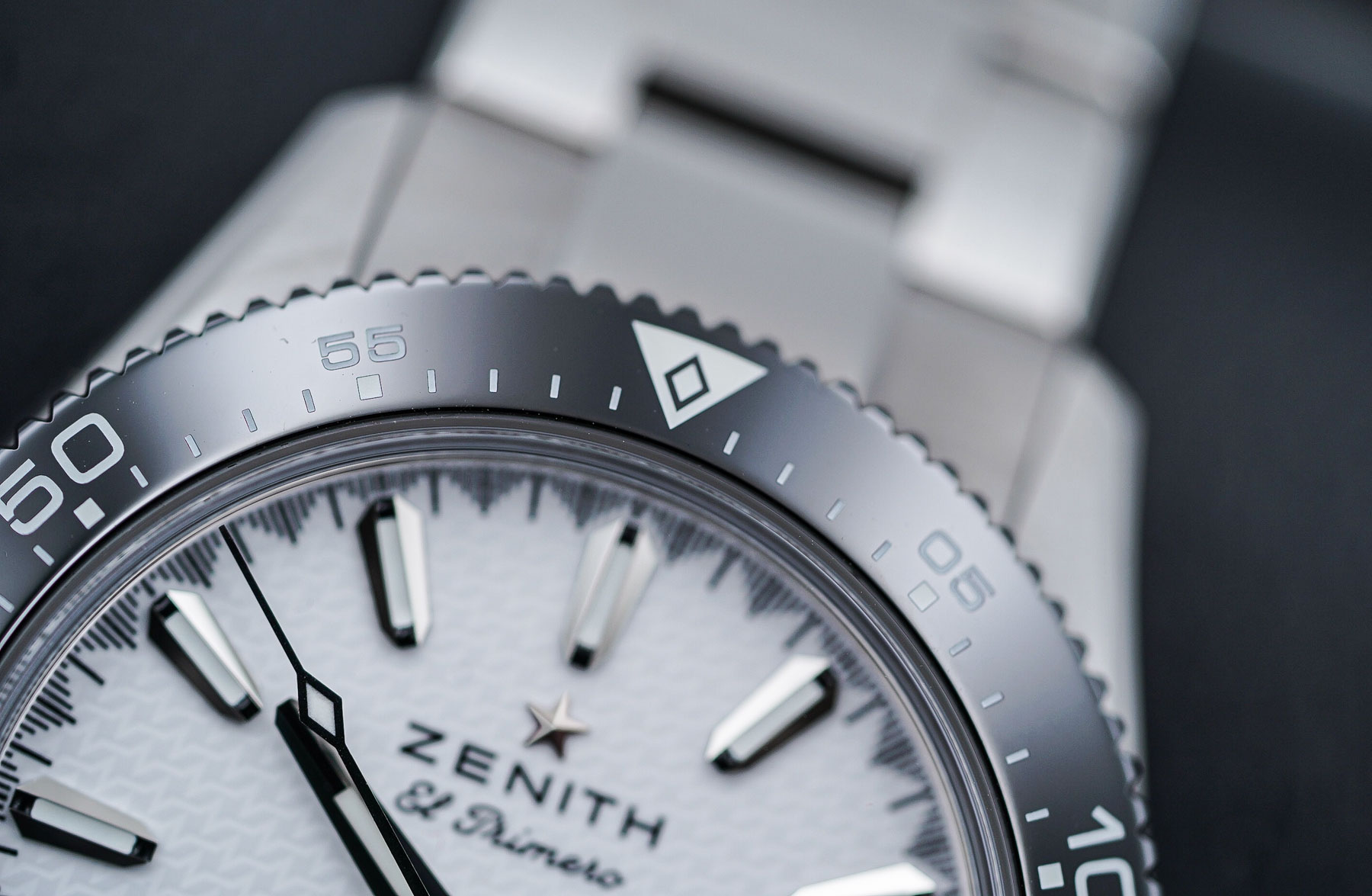
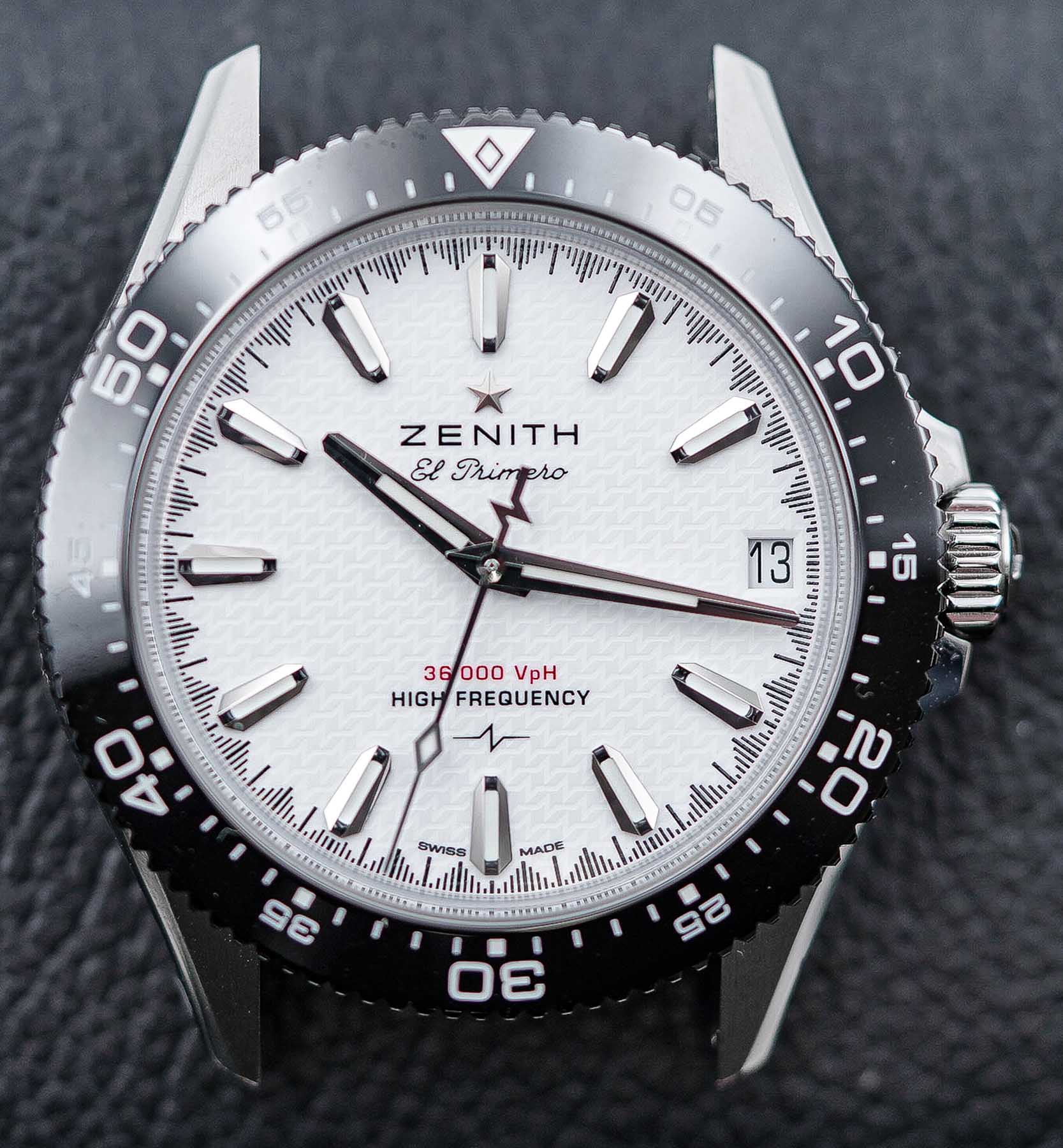
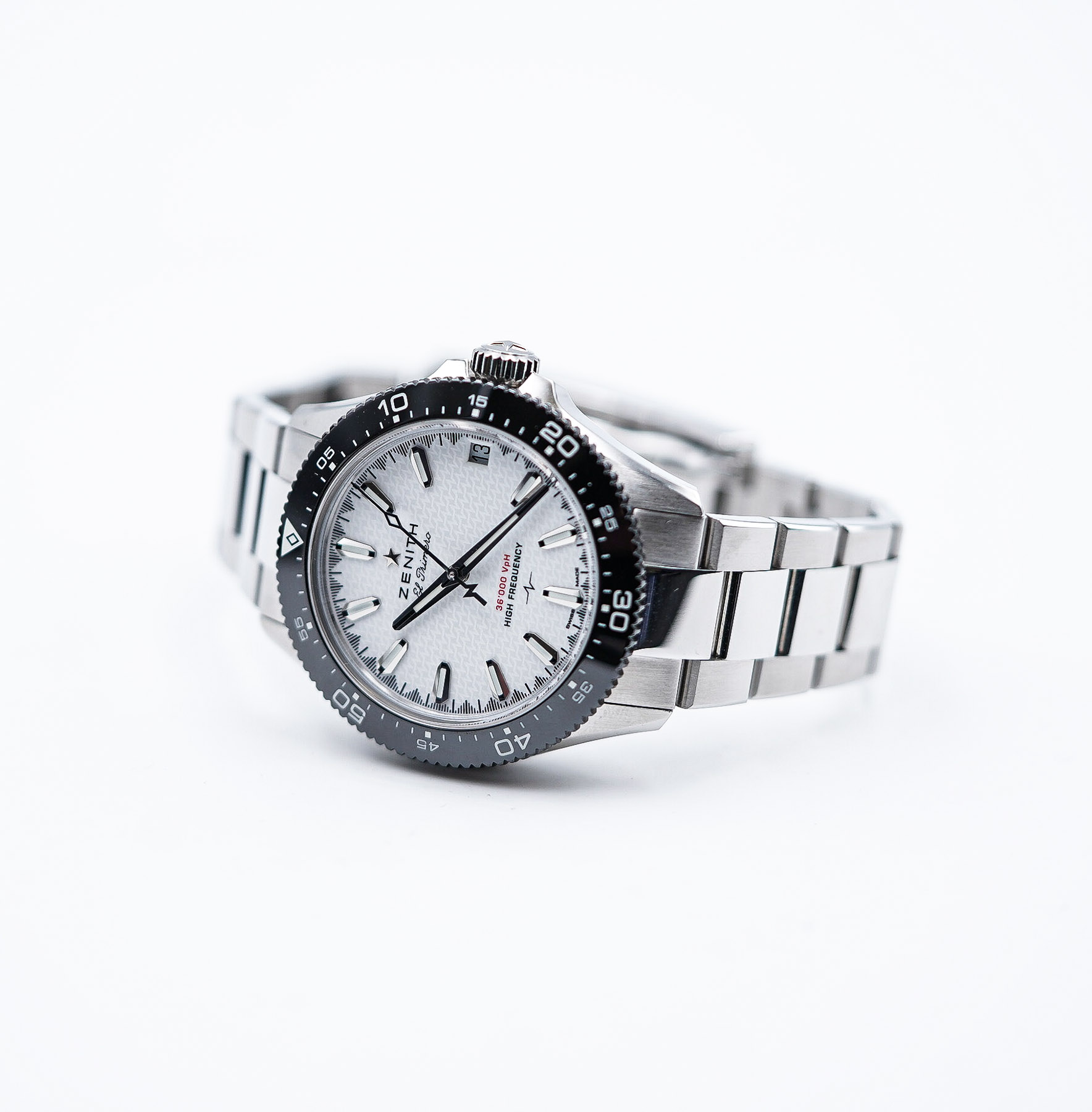
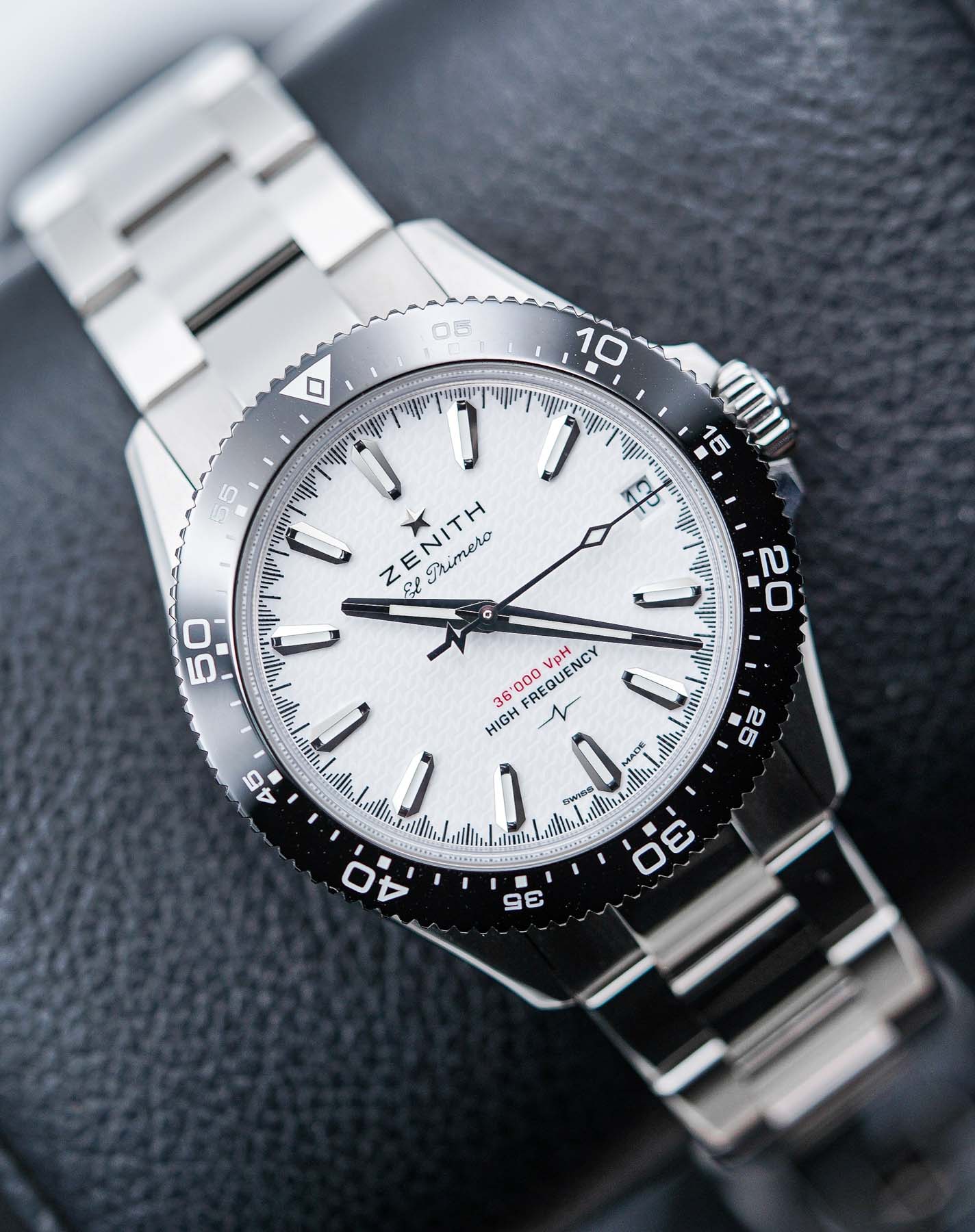
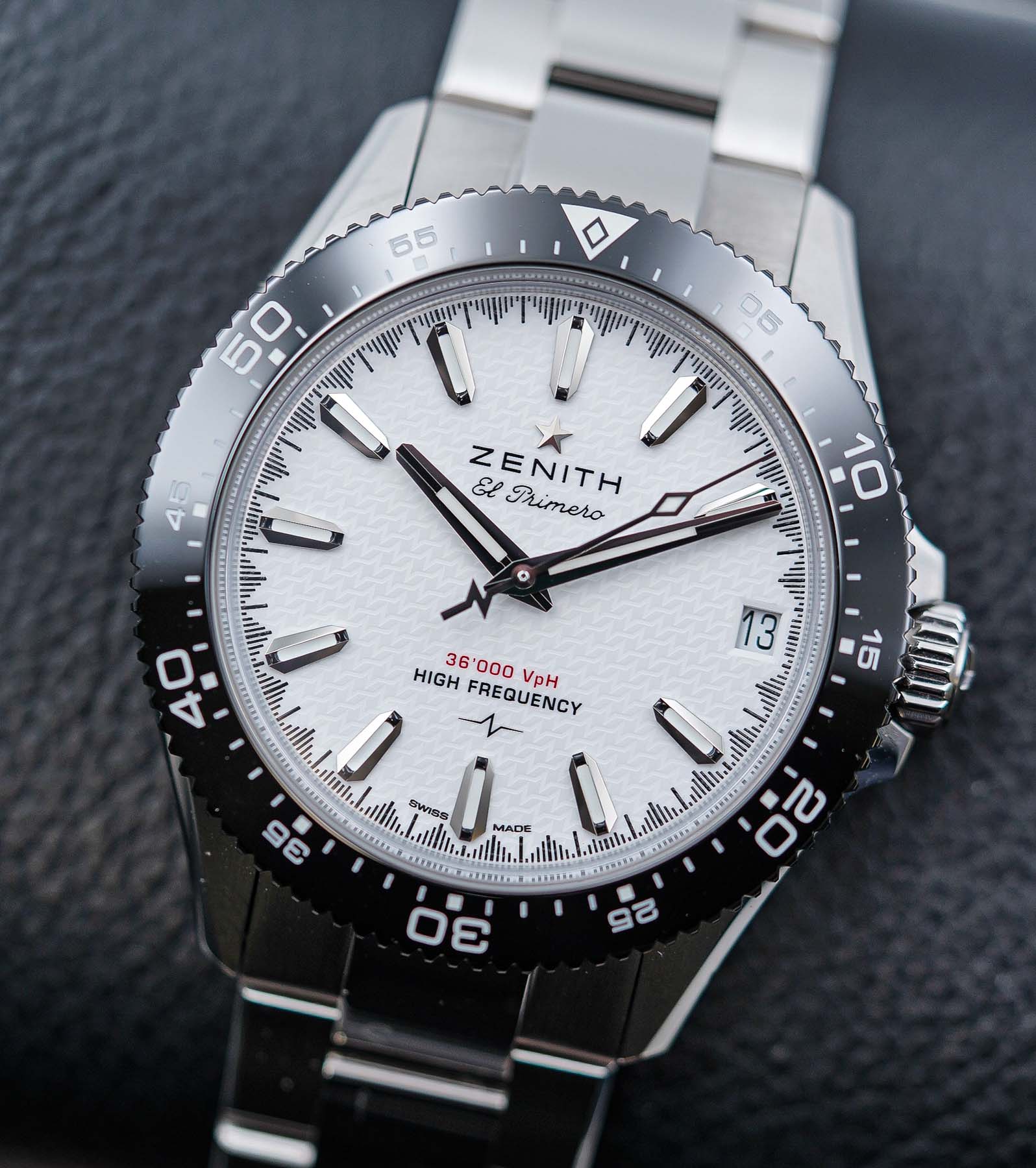
You get a screw-down crown protected by crown guards, a uni-directional 60-minute bezel and 200 metres of water resistance. That means swimming, travelling and almost anything you would realistically do with an expensive mechanical watch can be done without constantly worrying about it. The 120 click uni-directional ceramic bezel itself suits the white dial particularly well. Black against white gives the watch definition and prevents the ceramic dial from appearing overly dressy. Its action also contributes to the sense of quality. A rotating bezel is such a simple component conceptually, but it tells you very quickly whether a manufacturer has paid attention. There should be enough resistance to avoid accidental movement, positive indexing and as little unnecessary play as possible. More importantly, the bezel gives this watch a reason to exist beyond simply being a Chronomaster Sport without the chronograph. One aspect of the bezel does concern me, though. Since it is made entirely of ceramic, it is potentially more vulnerable to chipping or shattering in the event of a hard impact or an accidental drop. Personally, I would have preferred a stainless steel bezel with a ceramic insert, offering a more reassuring level of durability. That said, the bezel itself is beautifully executed, and its design lends the watch a distinct vintage-inspired character that I find particularly appealing. And realistically, I probably use a rotating bezel more frequently in everyday life than I use a mechanical chronograph anyway.
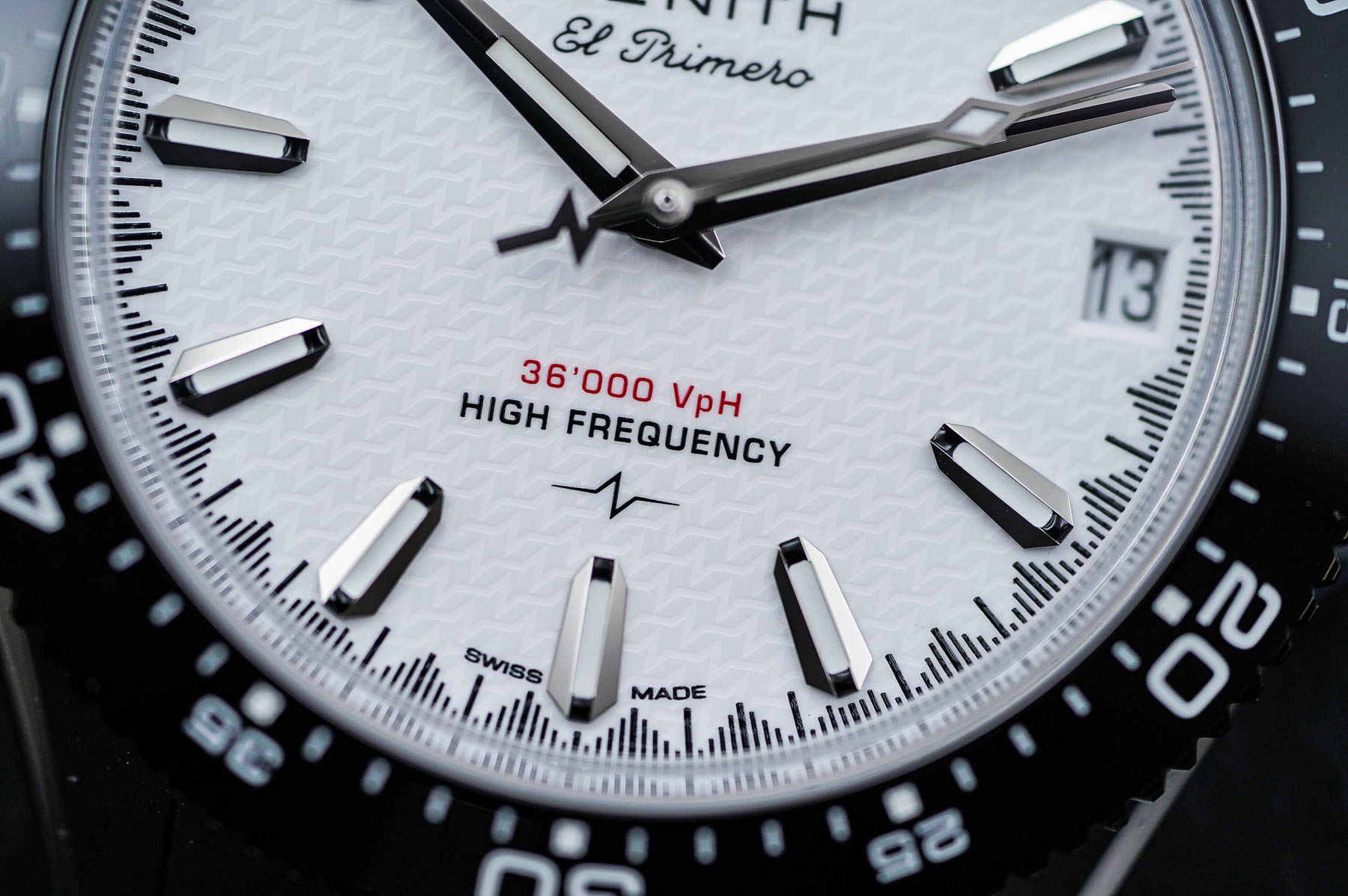
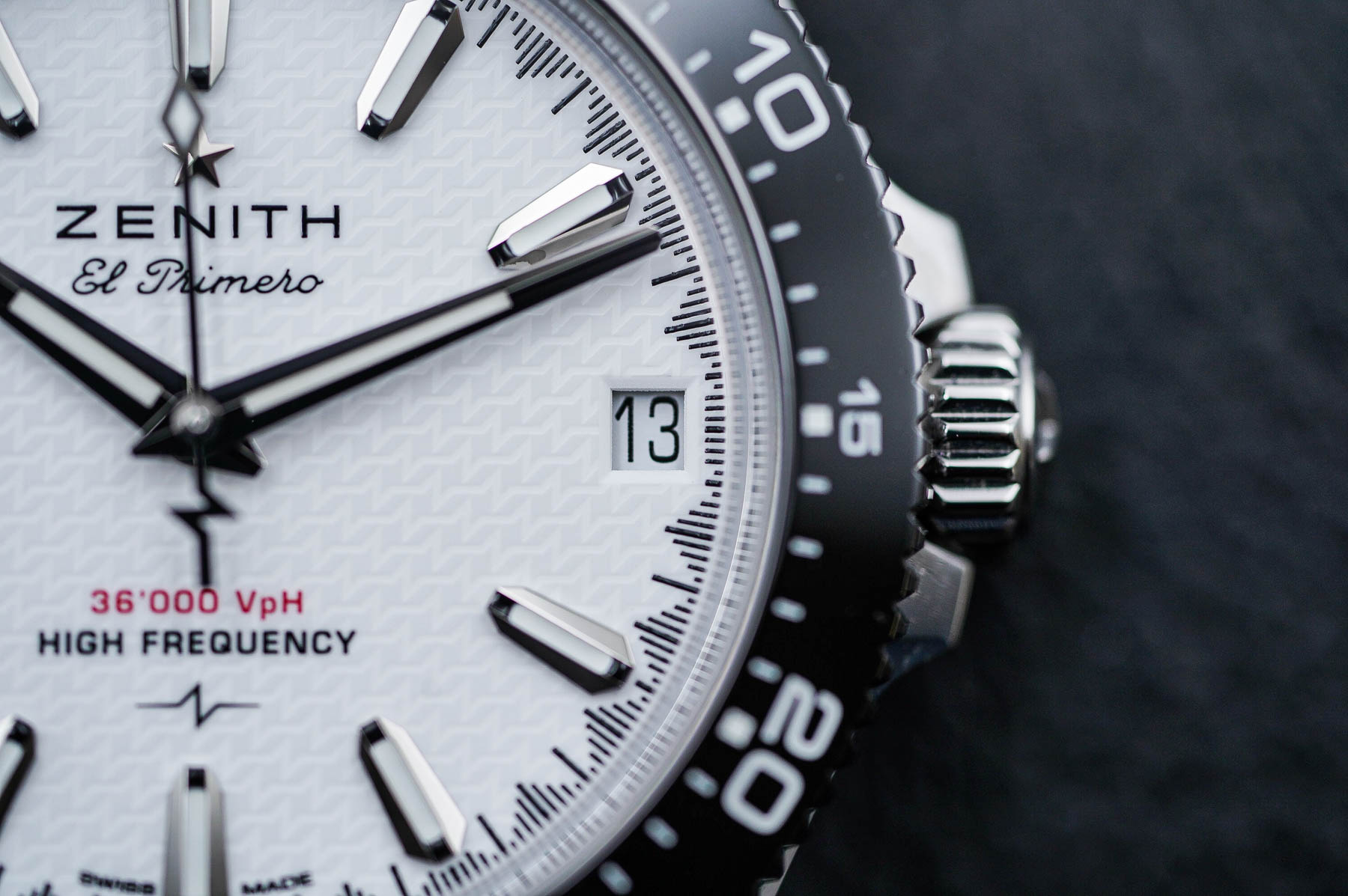
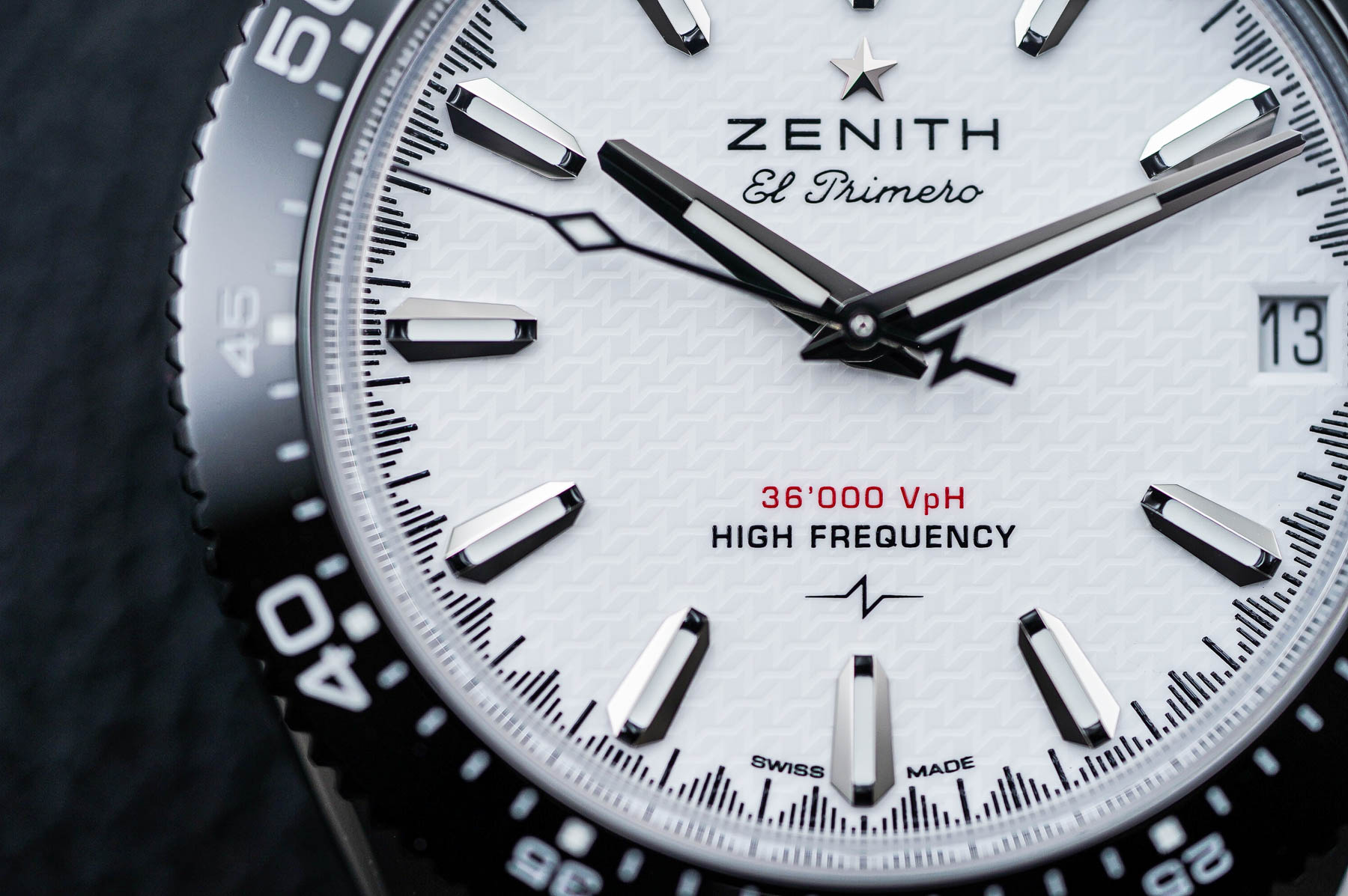
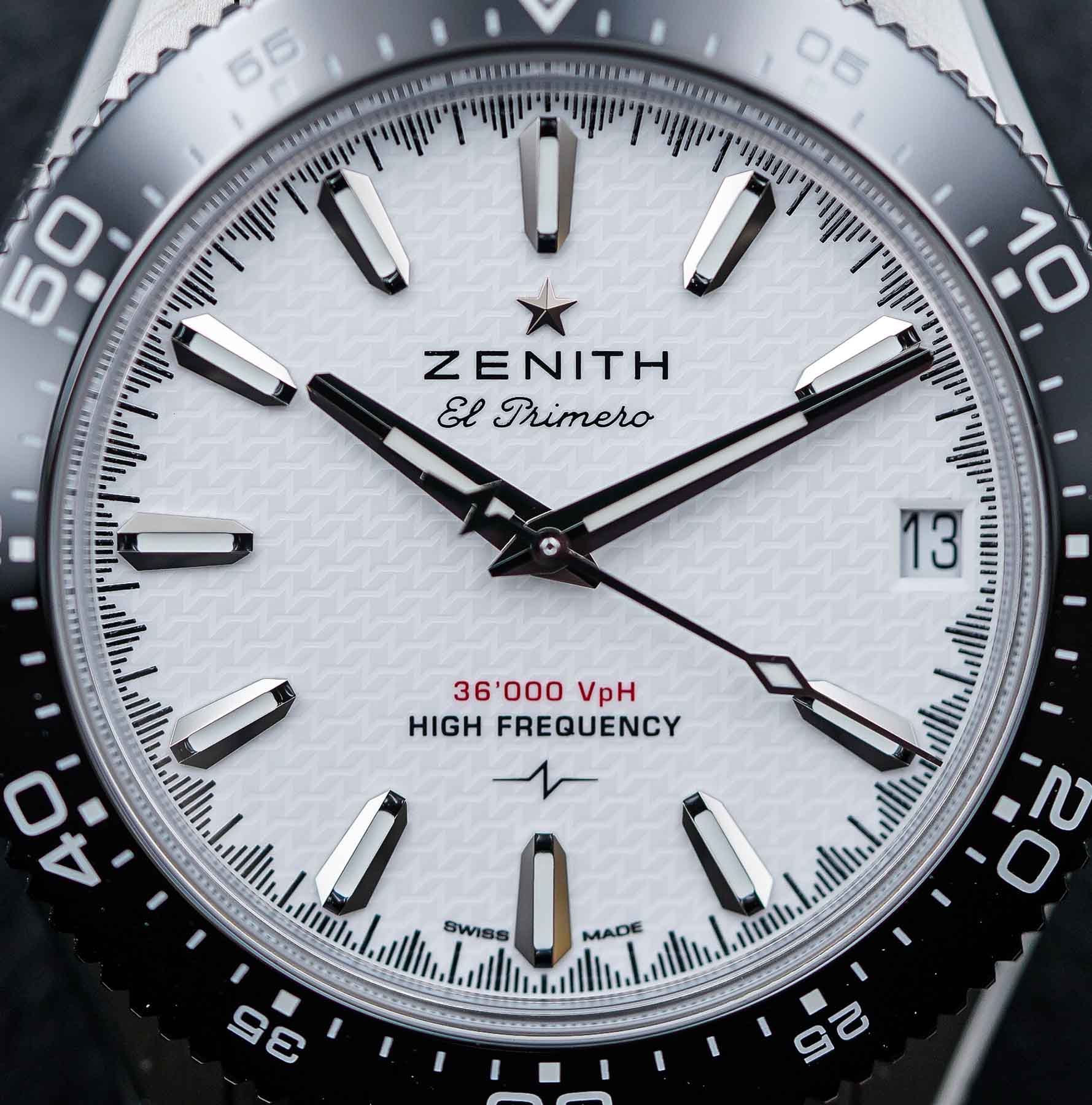
If the case is what makes the Chronomaster Solo Sport comfortable, the dial is what stops it from becoming just another luxury sports watch. My example uses the white ceramic dial, and ceramic is not there simply as a marketing material. Zenith has used the surface to create a repeating high-frequency motif made from small Z-shaped forms positioned at 45 degrees. From a distance, you barely notice it. That is exactly how I like patterned dials to work. Walk around with the watch normally and it essentially reads as a clean white sports-watch dial. Bring it closer, change the angle or photograph it under controlled lighting and suddenly the surface becomes much more complex. The white version has a sunray treatment that interacts particularly well with the pattern. Depending on the lighting, the dial can move from bright almost pure white to silver and light grey.
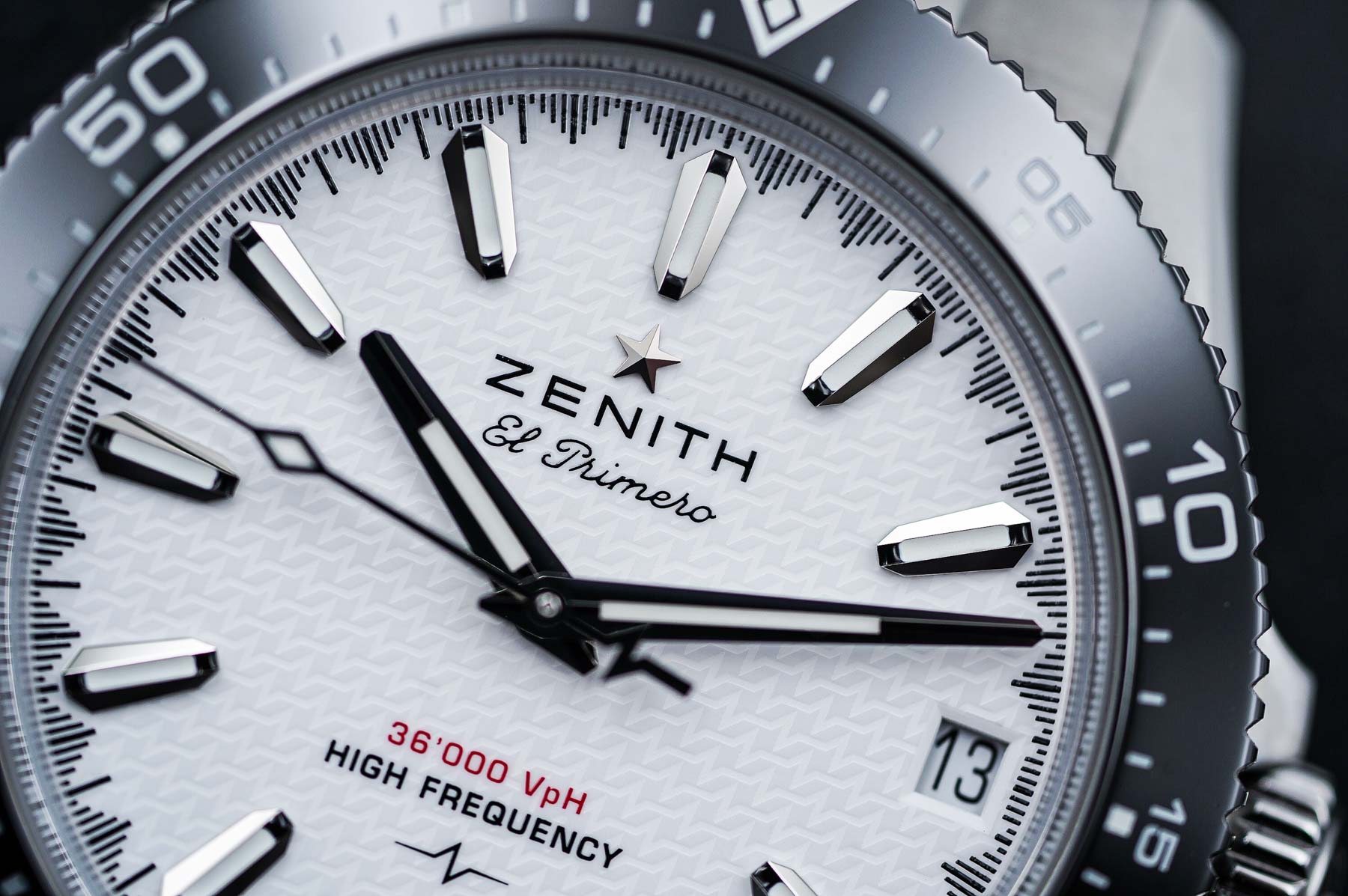
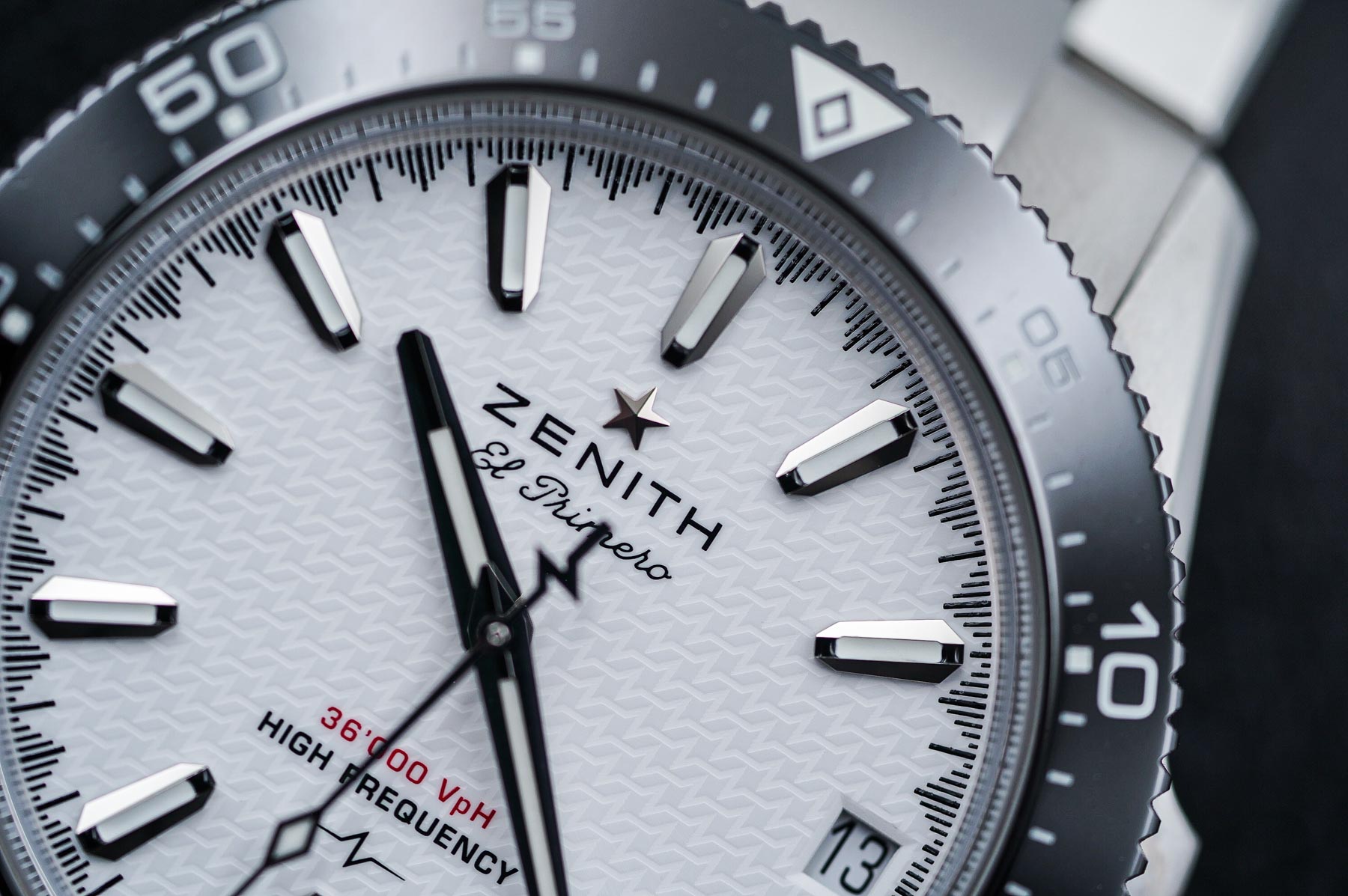
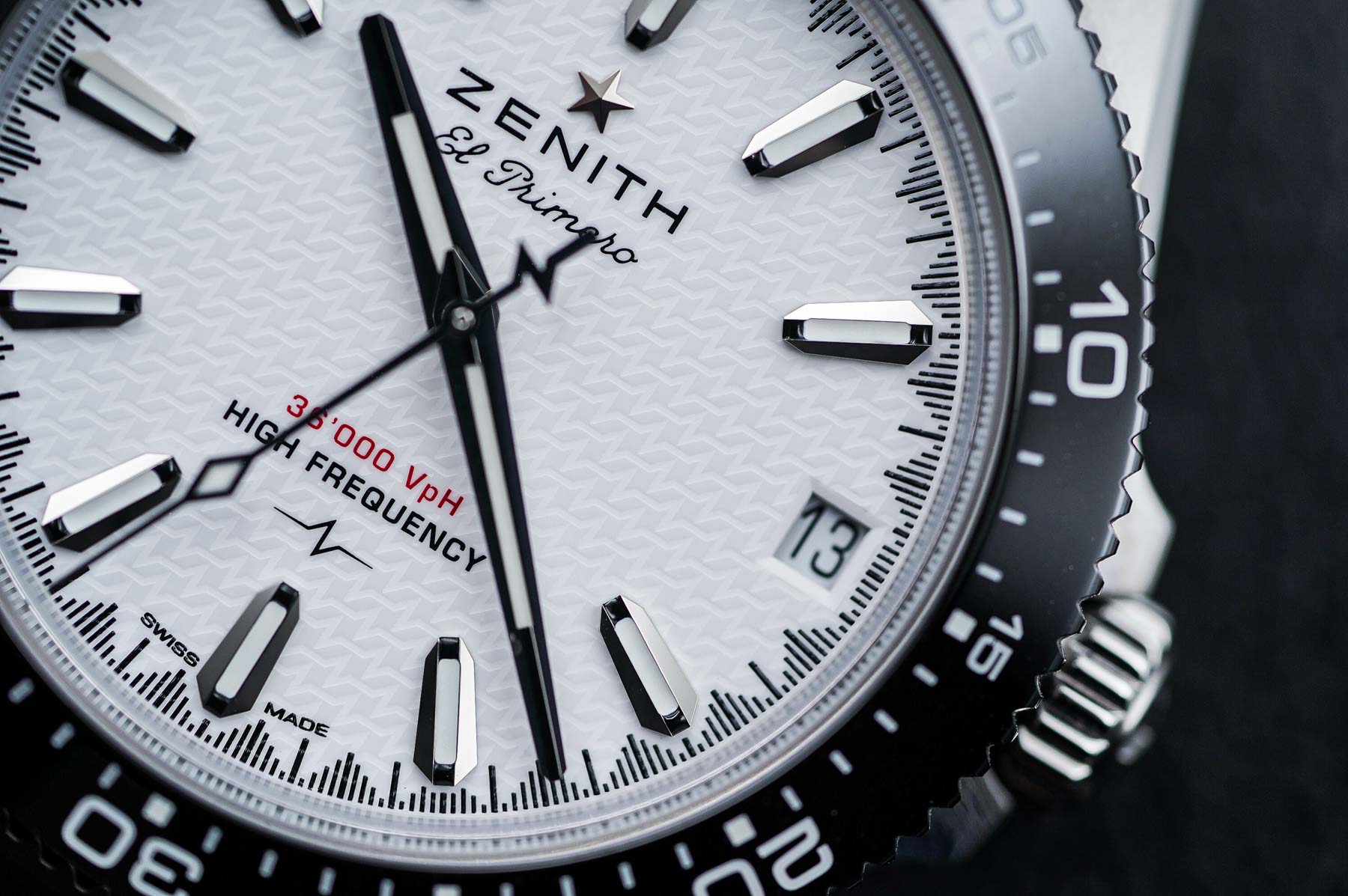
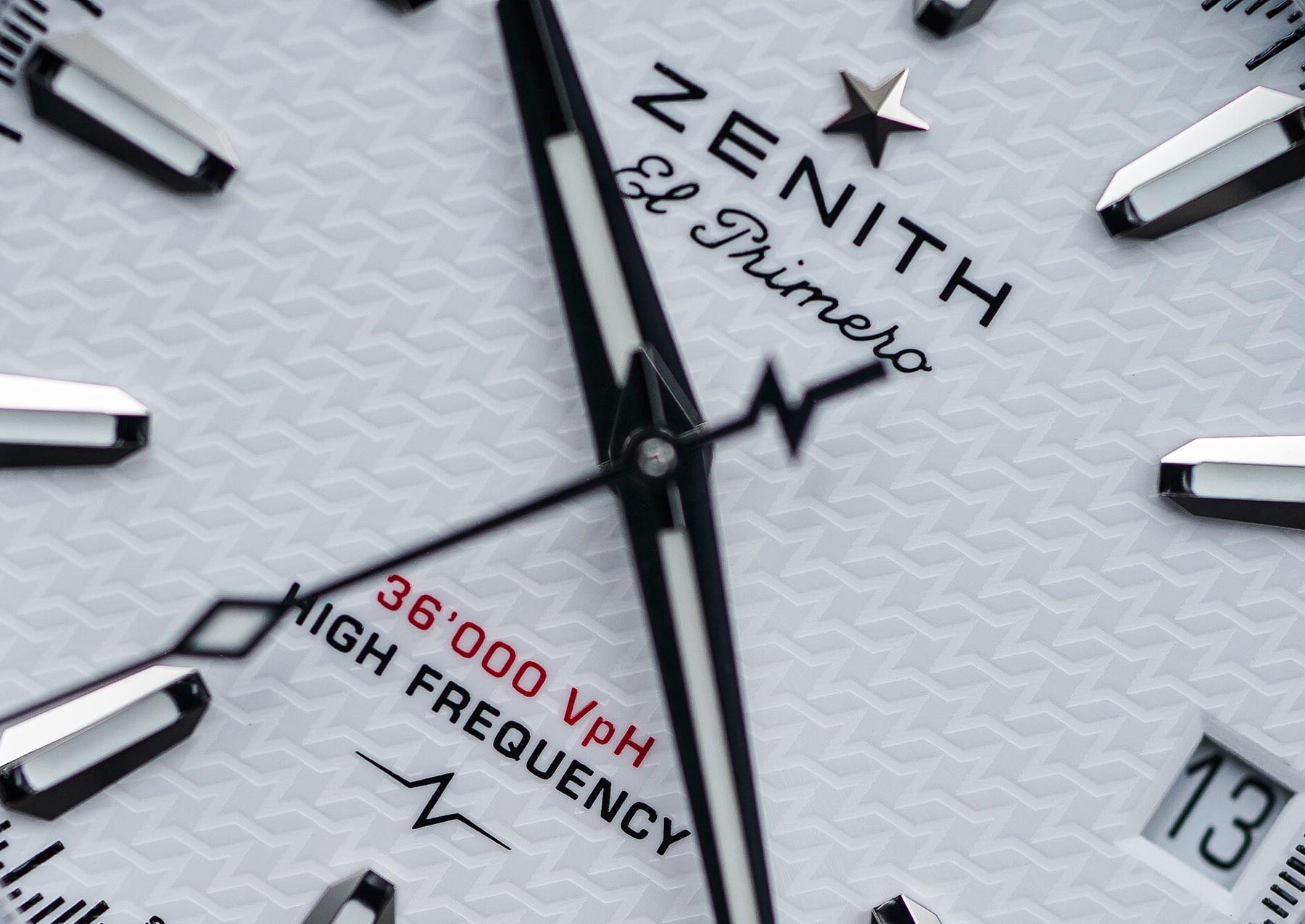
The applied hour markers are faceted and filled with Super-LumiNova C1, as are the hands. Legibility is excellent. Zenith has also brought in one of my favourite details: the so-called shark-tooth minute track around the perimeter. It adds a small connection to historic Zenith references without turning the whole watch into another heritage reissue. There is quite a lot going on if you inspect the dial closely. You have the patterned ceramic surface, faceted markers, minute track, date at 3 o’clock, Zenith star, the words “36’000 VpH” and “HIGH FREQUENCY”, plus another high-frequency emblem around six. Normally that much information would worry me. But because the white dial gives everything space, it works surprisingly well.
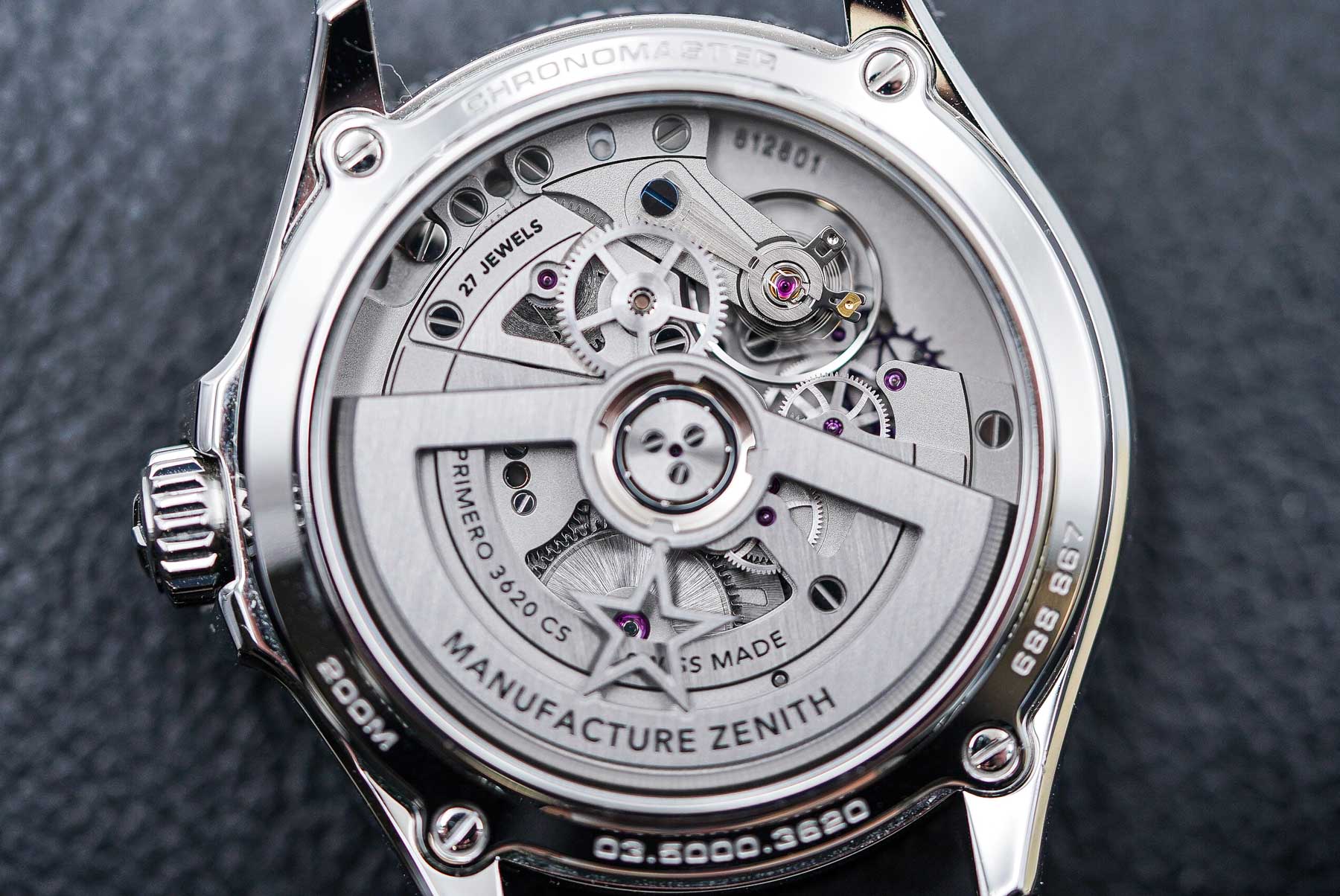
Would I remove something? Possibly. The two lines advertising 36,000 VpH and high frequency are not strictly necessary. Anyone buying this watch probably already knows why the El Primero matters. Removing one line might give the centre of the dial slightly more breathing room. Then there is the date. The white version is only available with one, while Zenith offers the black model both with and without a date. I actually appreciate having a date on an everyday sports watch, so it does not bother me functionally. Still, from a pure design perspective, I can understand why collectors will be attracted to the no-date black model. The central seconds hand is perhaps more interesting than usual because the movement underneath it operates at 5Hz. A conventional 4Hz mechanical watch advances its seconds hand eight times per second. At 5Hz, the Zenith makes ten steps every second. Is the difference dramatic from across the room? No. But watch it closely and the sweep has a beautifully smooth quality.
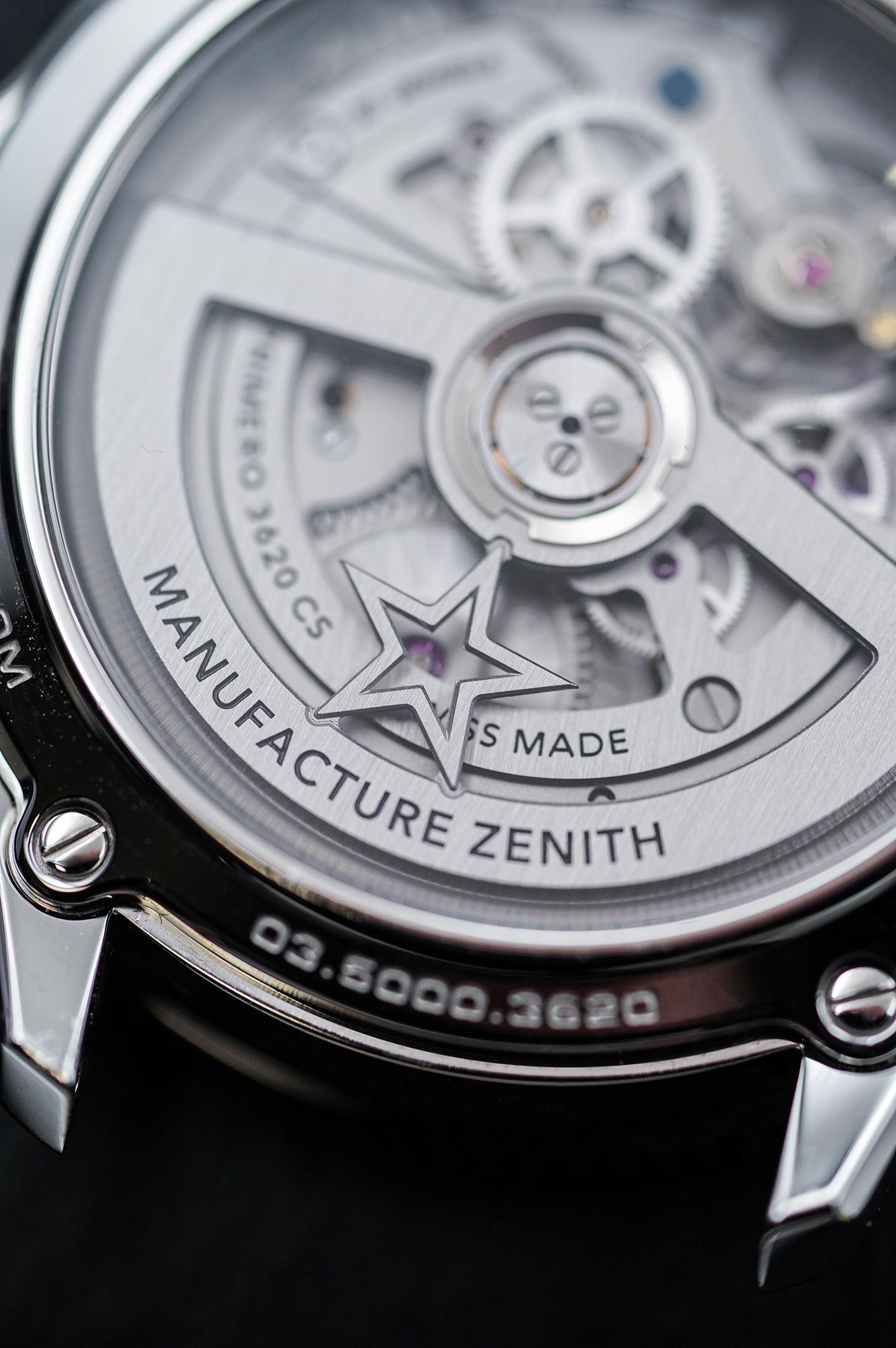
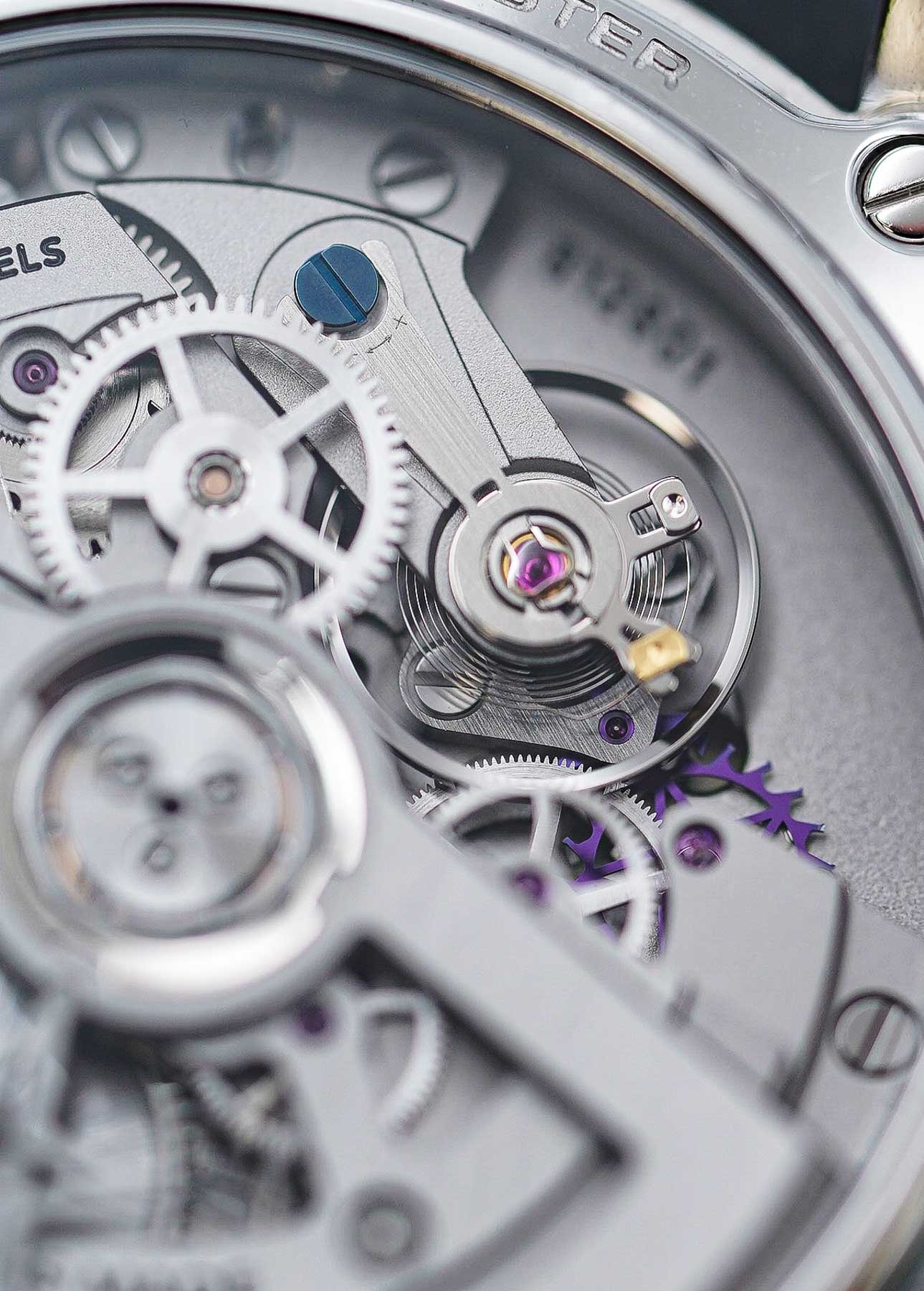
This is where the Chronomaster Solo Sport becomes much more interesting technically than its appearance initially suggests. Behind the sapphire display caseback sits Zenith’s automatic El Primero 3620 SC, a manufacture movement with 219 components operating at 36,000 vibrations per hour, or 5Hz, and offering approximately 60 hours of power reserve. Zenith also equips it with a silicon escapement, hacking or stop-seconds, and bidirectional automatic winding. And the name El Primero carries considerable weight. When Zenith introduced the original El Primero in 1969, it became one of the earliest automatic chronograph movements and, crucially, one of the very few to combine automatic winding with a 5Hz frequency. Five hertz means the balance completes five full oscillations per second, resulting in ten semi-oscillations or beats every second — hence 36,000 vibrations per hour. Historically, that high frequency was especially important for chronograph timing because ten beats per second allowed a mechanical chronograph to resolve intervals down to a tenth of a second.
But why use 5Hz when there is no chronograph? That is where the Solo Sport becomes slightly controversial in my opinion. For some enthusiasts, “El Primero” and “chronograph” are inseparable concepts. Taking the chronograph away sounds almost like removing the defining characteristic of the movement. I understand that criticism. But mechanically, there is still an argument for high frequency in a three-hand watch. The advantage is not simply a smoother seconds hand. A higher-frequency oscillator samples time more frequently, which theoretically makes it less vulnerable to small external disturbances affecting any single oscillation. In simple terms, if the balance receives a minor shock or positional disturbance, there are more oscillations occurring over the same period from which the movement averages its rate. That doesn’t automatically mean every 5Hz watch will outperform every 4Hz watch. Regulation, balance design, escapement geometry, manufacturing tolerances, lubrication, positional performance and many other factors still matter. But high frequency remains technically interesting.
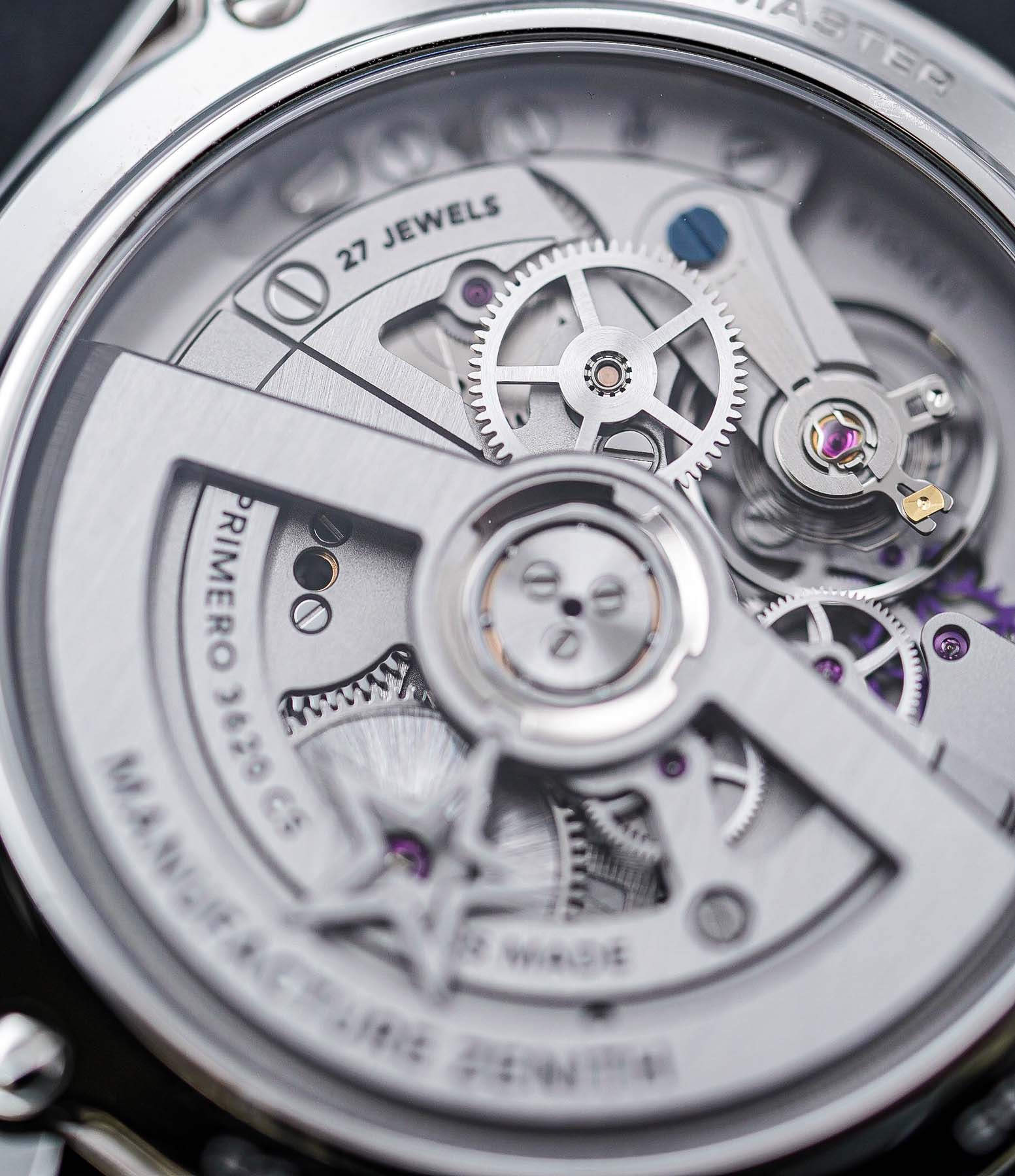
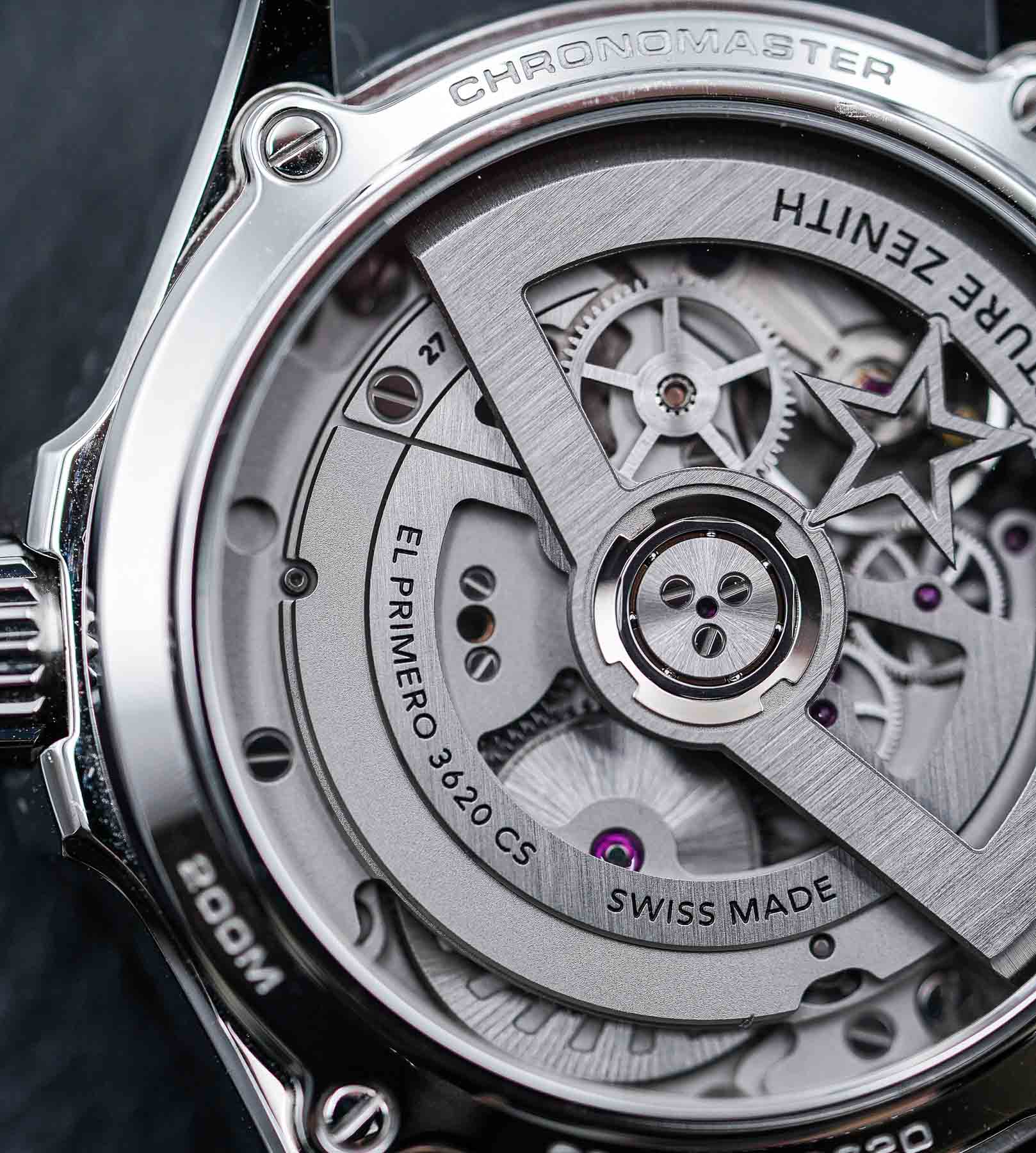
The downside is energy. Increasing frequency means the escapement performs more actions every hour. The balance changes direction more frequently, the escape wheel advances more often and the movement requires considerably more energy to maintain its amplitude. Historically, high-frequency movements could therefore suffer from increased wear and lubrication demands. That is part of what makes Zenith’s use of silicon especially relevant here. Silicon is extremely light, can be manufactured with very precise geometry and has useful anti-magnetic properties. In an escapement operating at 36,000 vibrations per hour, reducing inertia and friction becomes particularly valuable. Zenith has therefore taken the defining characteristic of the historic El Primero — frequency — and combined it with materials unavailable to the engineers who created the original calibre more than half a century ago. The approximately 60-hour reserve is equally impressive when considered together with that 5Hz frequency. You can take the watch off Friday evening and there is a reasonable chance it will still be running Monday morning.
Bidirectional winding also makes sense for this type of watch. Rather than the rotor winding the mainspring in only one direction and freewheeling in the other, rotational movement in either direction can contribute to winding efficiency. Through the caseback, the movement has a modern industrial appearance rather than pretending to be traditional haute horlogerie. That distinction is important at €10,500 retail price. You are not getting hand-finished inward angles or elaborately black-polished steel components. This is not that type of movement. Instead, Zenith uses brushed, grained and machined surfaces combined with its openworked star-shaped rotor. Personally, I think that visual language suits the watch. The movement looks mechanical, technical and purposeful. And after starting to learn watch servicing myself, I perhaps appreciate this section of the Solo Sport more than I would have several years ago. It is very easy to compare watches only by case material, water resistance and brand recognition. But mechanically, there is something special about having a 5Hz manufacture movement underneath a watch that can genuinely be worn every day.
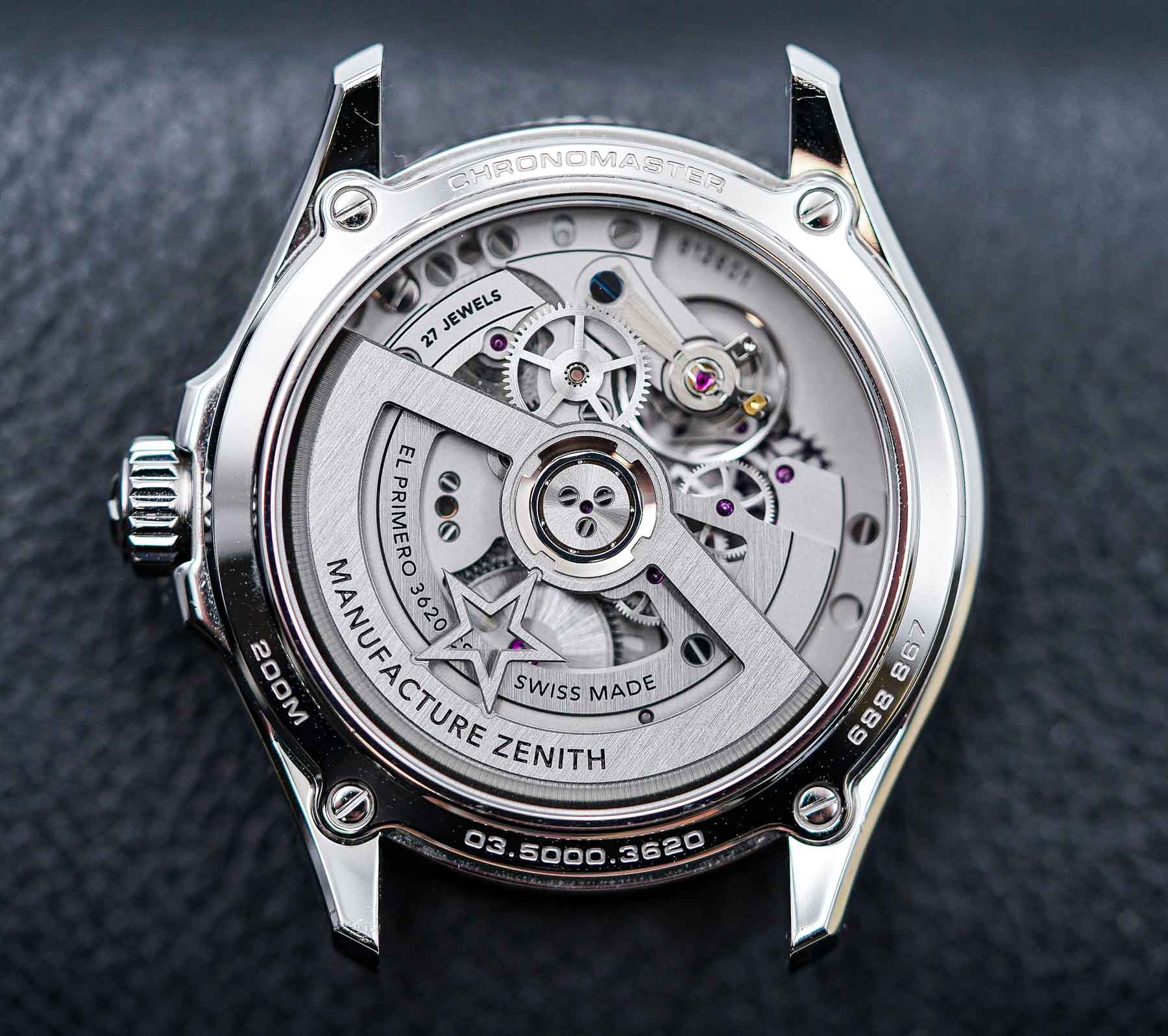
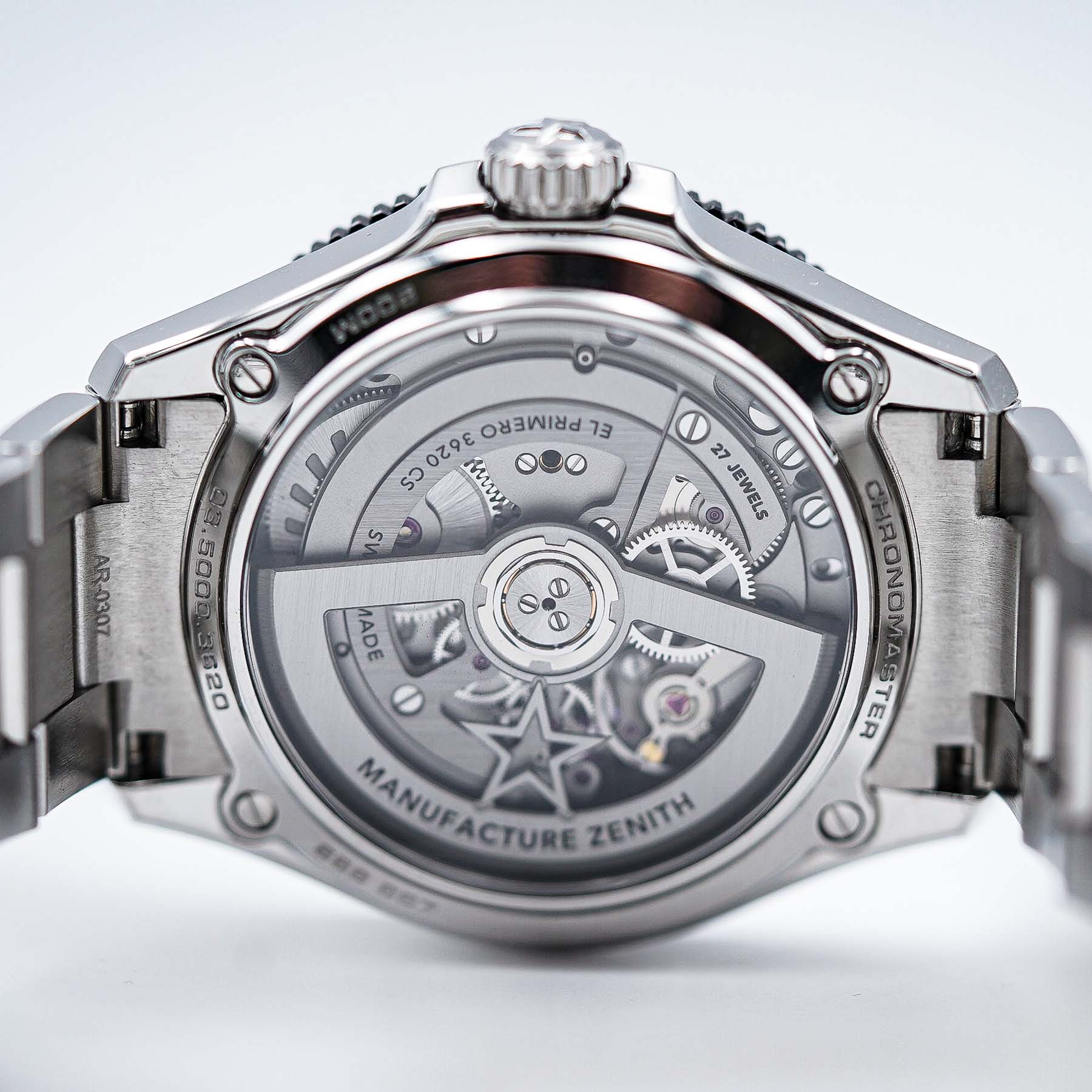
Compare it conceptually with something like a Rolex Submariner and the priorities are quite different. Rolex’s modern automatic movements are built heavily around durability, efficiency, long service intervals and a roughly 70-hour reserve at a lower frequency. Omega takes another approach with its co-axial architecture, Master Chronometer testing and very strong magnetic resistance. Zenith’s identity is frequency. None of those philosophies is automatically “better” in every respect. But from an enthusiast’s perspective, I find the Zenith more mechanically interesting than many of its direct sports-watch competitors. There is also something wonderfully unnecessary about it. A €10 quartz watch can tell time more accurately. A conventional 4Hz automatic calibre would have been perfectly adequate. Zenith could probably have created something cheaper and easier to manufacture. Instead, underneath this relatively simple three-hand watch is a movement operating 864,000 balance vibrations every twenty-four hours. That mechanical excess is exactly the kind of thing that makes mechanical watches fascinating in the first place. The remaining question is whether consumers will value it enough to pay for it.
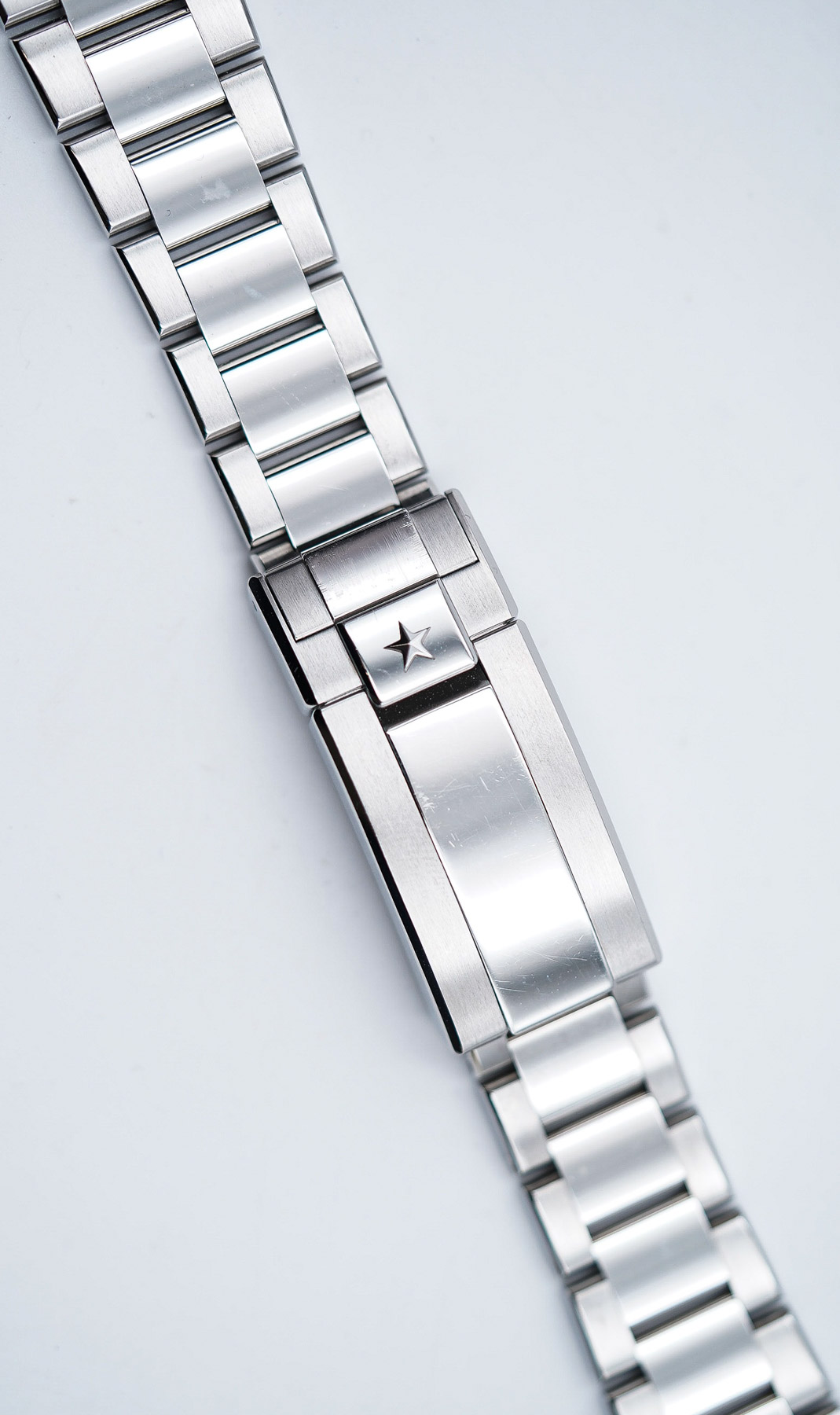
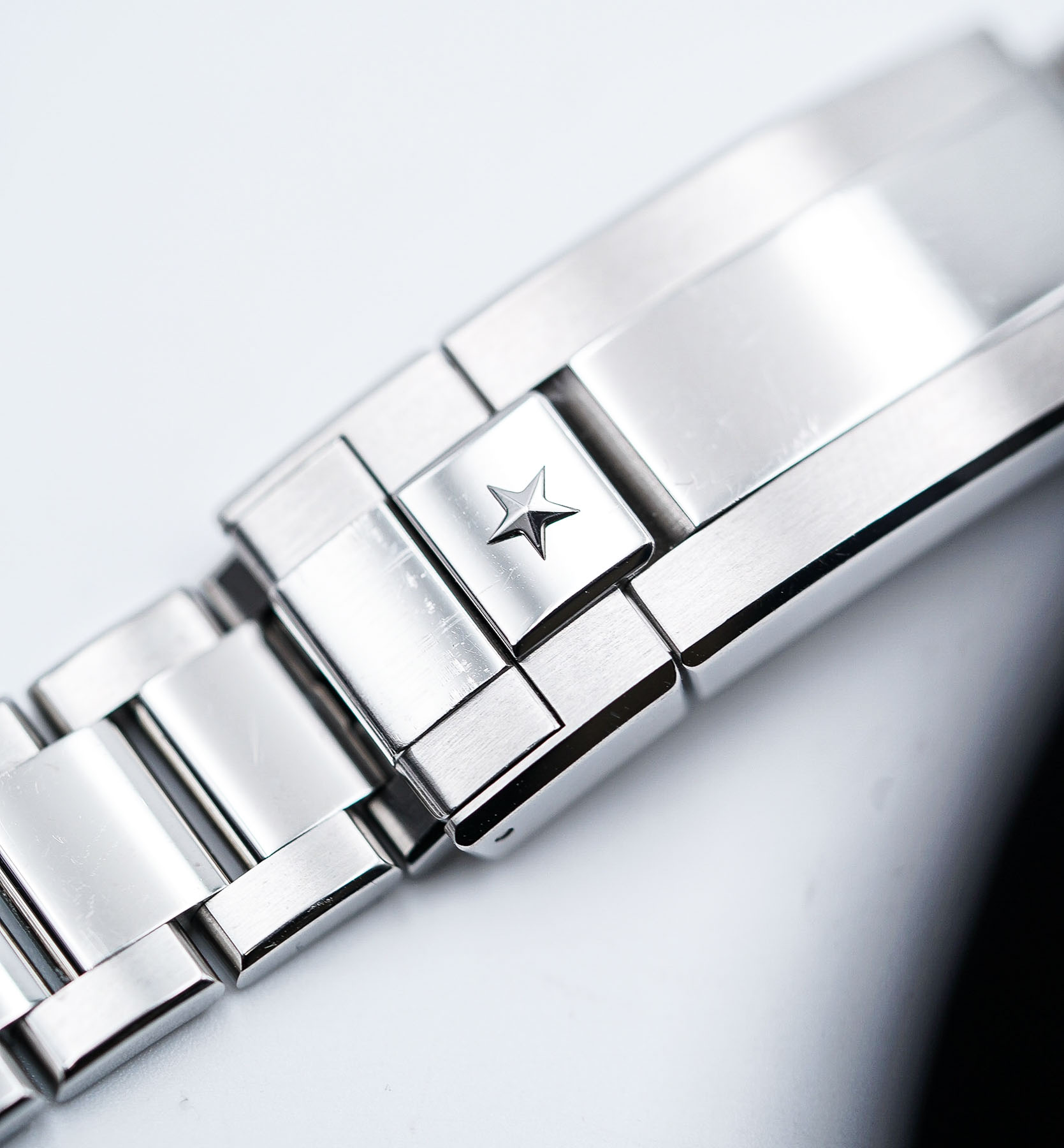
If the movement is the technical heart of the Chronomaster Solo Sport, the bracelet and especially the clasp might be its most immediately impressive piece of engineering. The bracelet uses a conventional three-link architecture with brushed outer links and polished centre sections. Those polished links will divide people. They undoubtedly make the watch look more luxurious and help it transition from sportswear to something more formal. They will also collect scratches. There is no way around that. If you are the sort of owner who becomes annoyed by every hairline mark, the centre links are going to require some psychological adjustment. Personally, I think they suit the watch because this is clearly not trying to be a military tool watch. But the bracelet itself is almost secondary to the clasp.
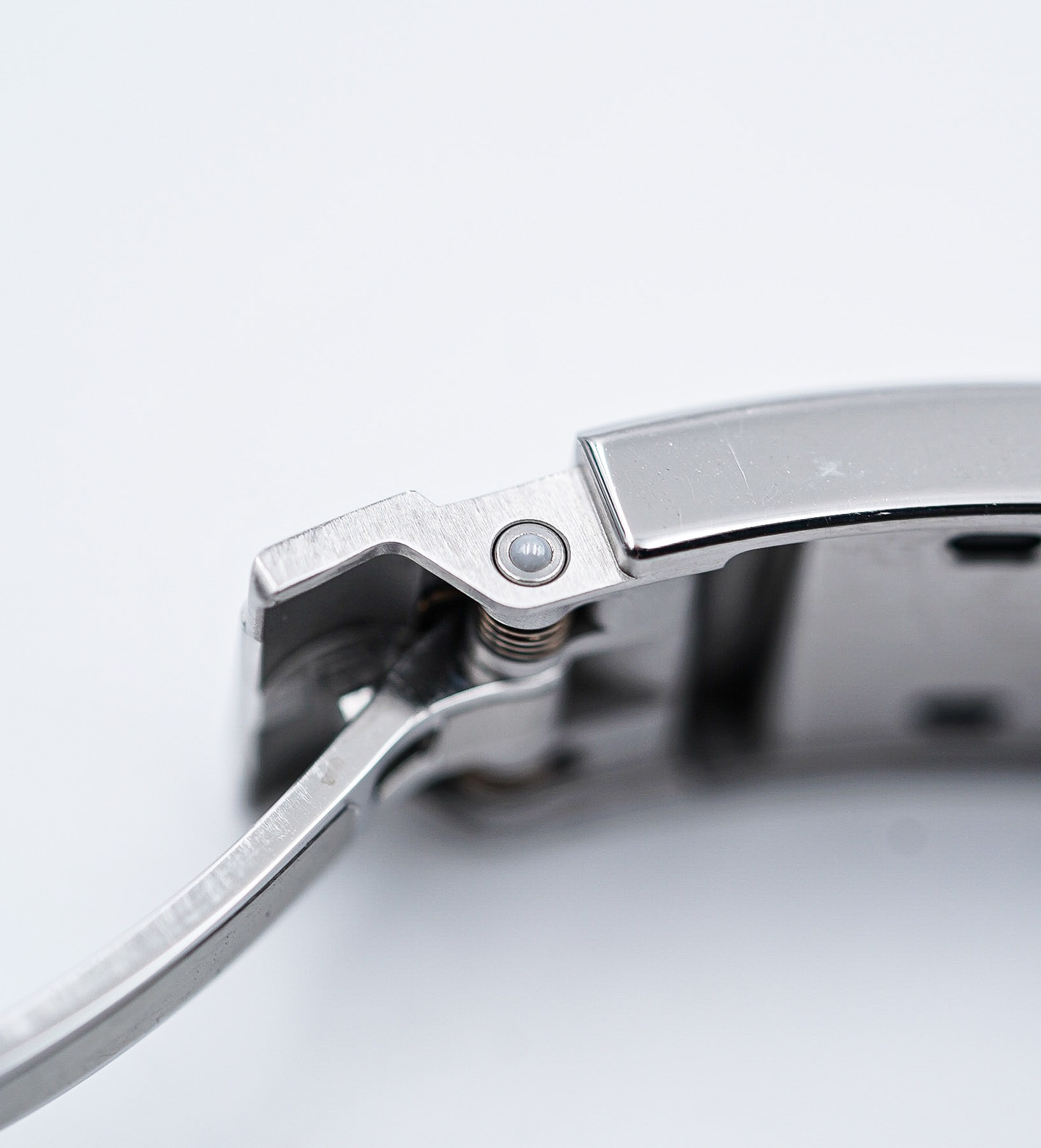
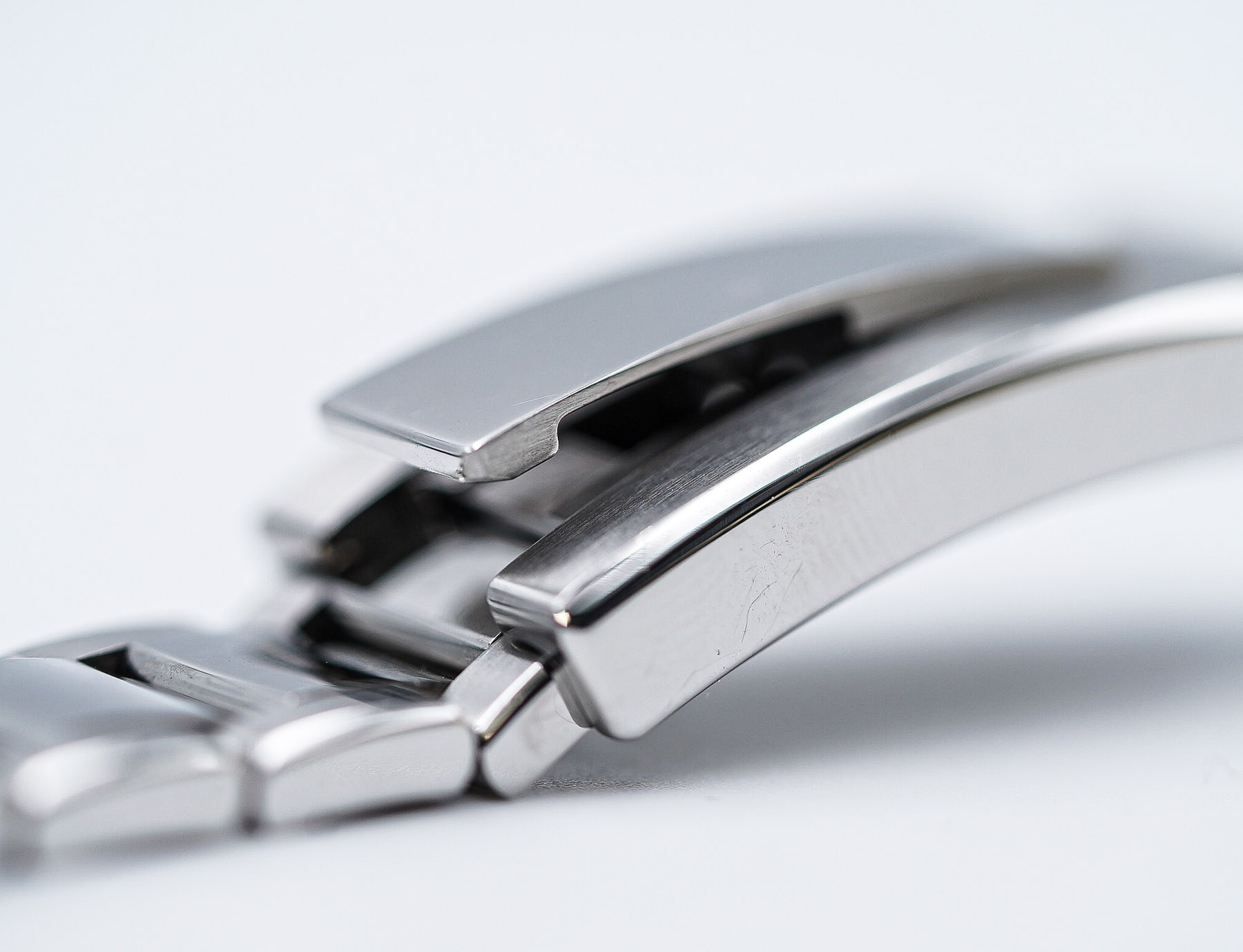
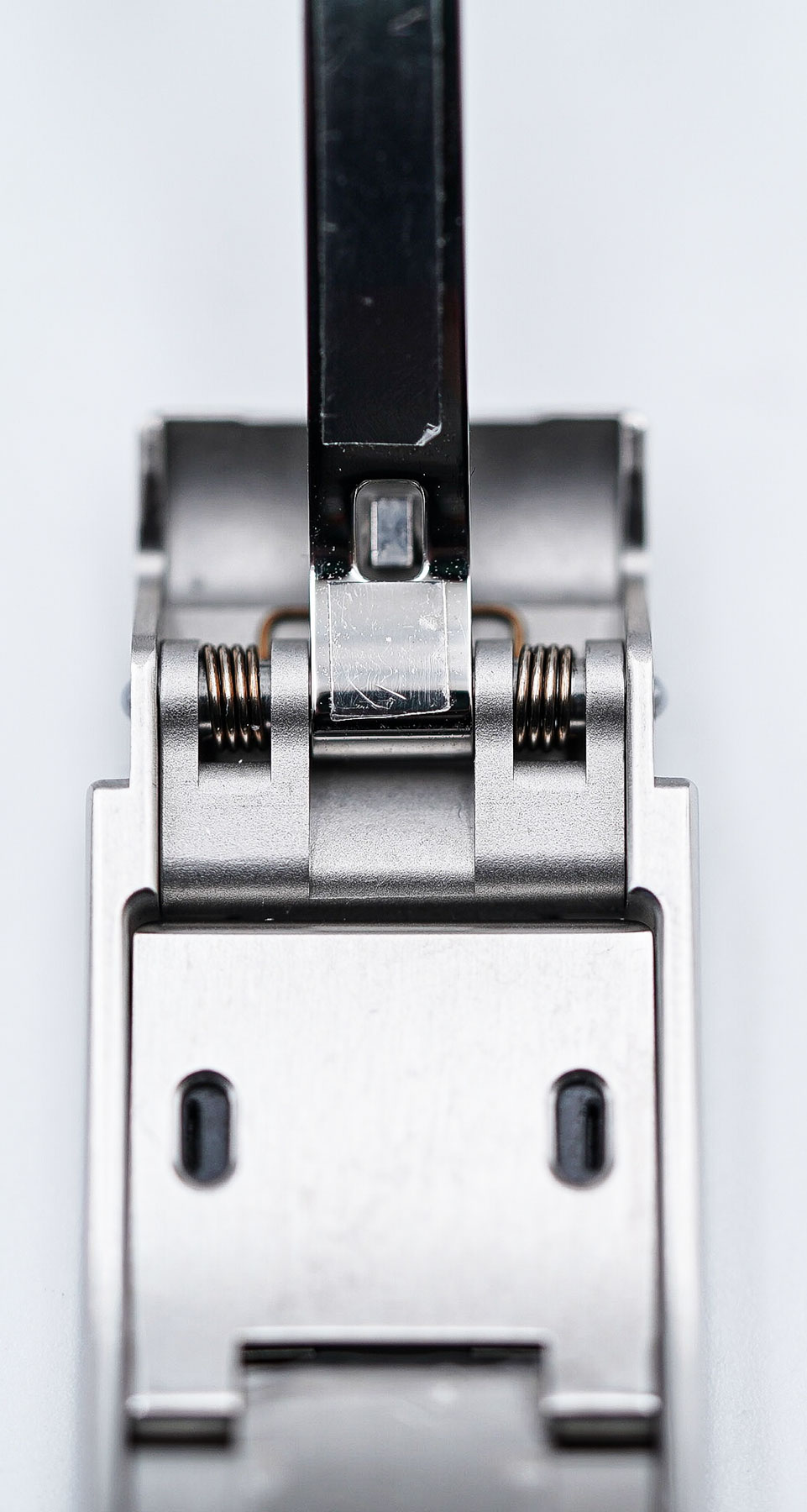
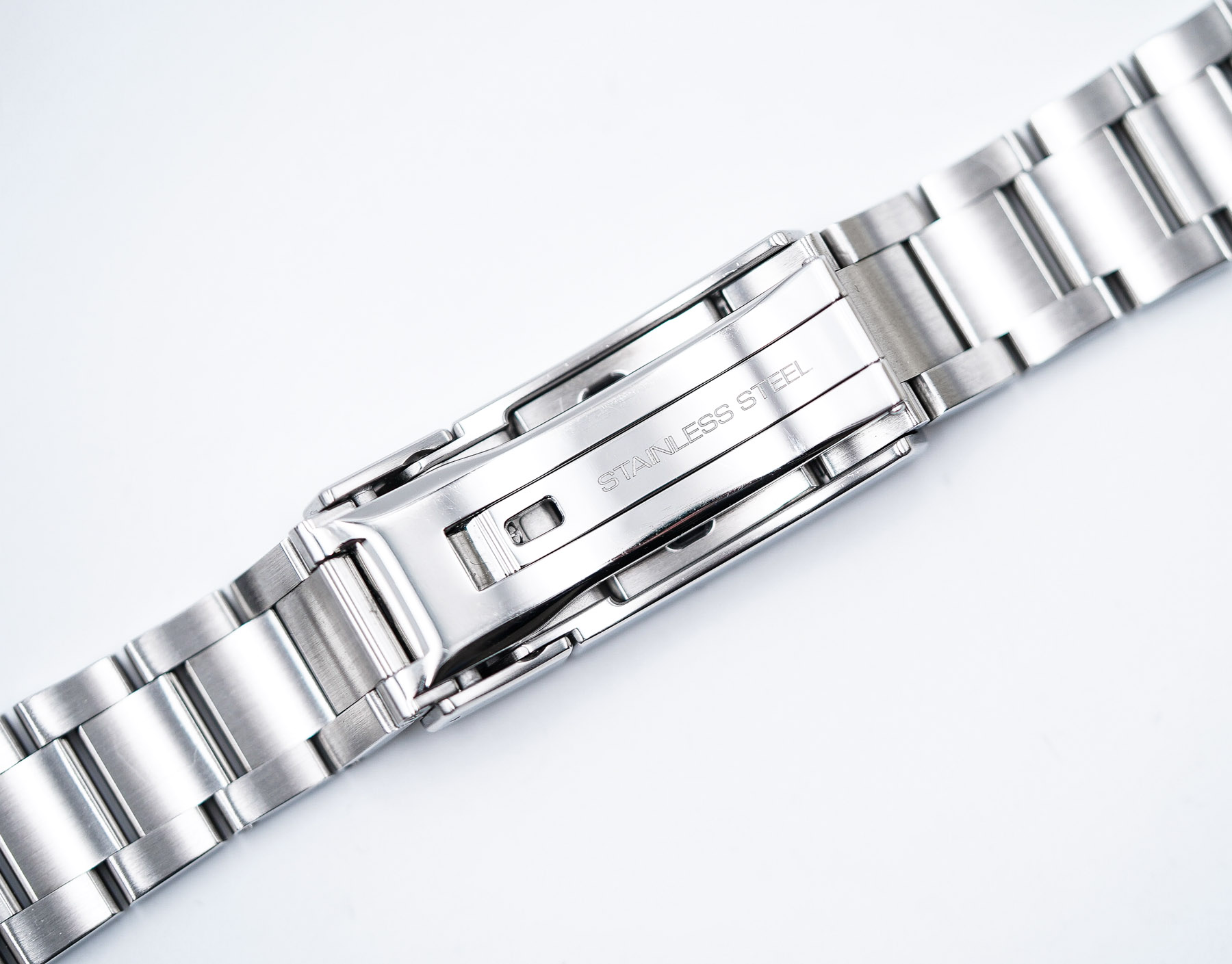
ZENCLASP is genuinely excellent! I already mentioned the flip-lock design earlier, but the longer I used it, the more little details I appreciated. The safety lock does not simply flap around once opened. The closing action assists in positioning it. The engagement points feel extremely positive. The micro-adjustment is hidden rather than turning the clasp into a huge metal box underneath the wrist. And the adjustment range is useful rather than decorative. You have 10mm available in 2.5mm increments, which means you can genuinely compensate for your wrist expanding during a hot day without reaching for tools. Zenith’s ceramic-ball solution is especially fascinating. The clasp uses ten ceramic balls within its locking and positioning architecture and consists of 41 individual components. Zenith says the mechanism was developed over three years. That almost sounds ridiculous for a clasp. But this is exactly the kind of ridiculous engineering I want to see when a steel sports watch costs more than ten thousand euros. The industry has spent decades perfecting movements while clasps were often treated as little more than stamped pieces of metal. Even fairly expensive watches were sometimes sold with adjustment systems that looked years behind the movements inside them. That has changed dramatically, and Zenith has clearly taken the challenge seriously. Is ZENCLASP alone a reason to spend €10,500? Obviously not. But it is a perfect example of why judging this watch purely from photographs and a specification sheet misses some of its appeal. You have to operate it. You have to feel it lock. You have to resize it while it is on your wrist. And once you do, a lot of other clasps suddenly feel surprisingly primitive.
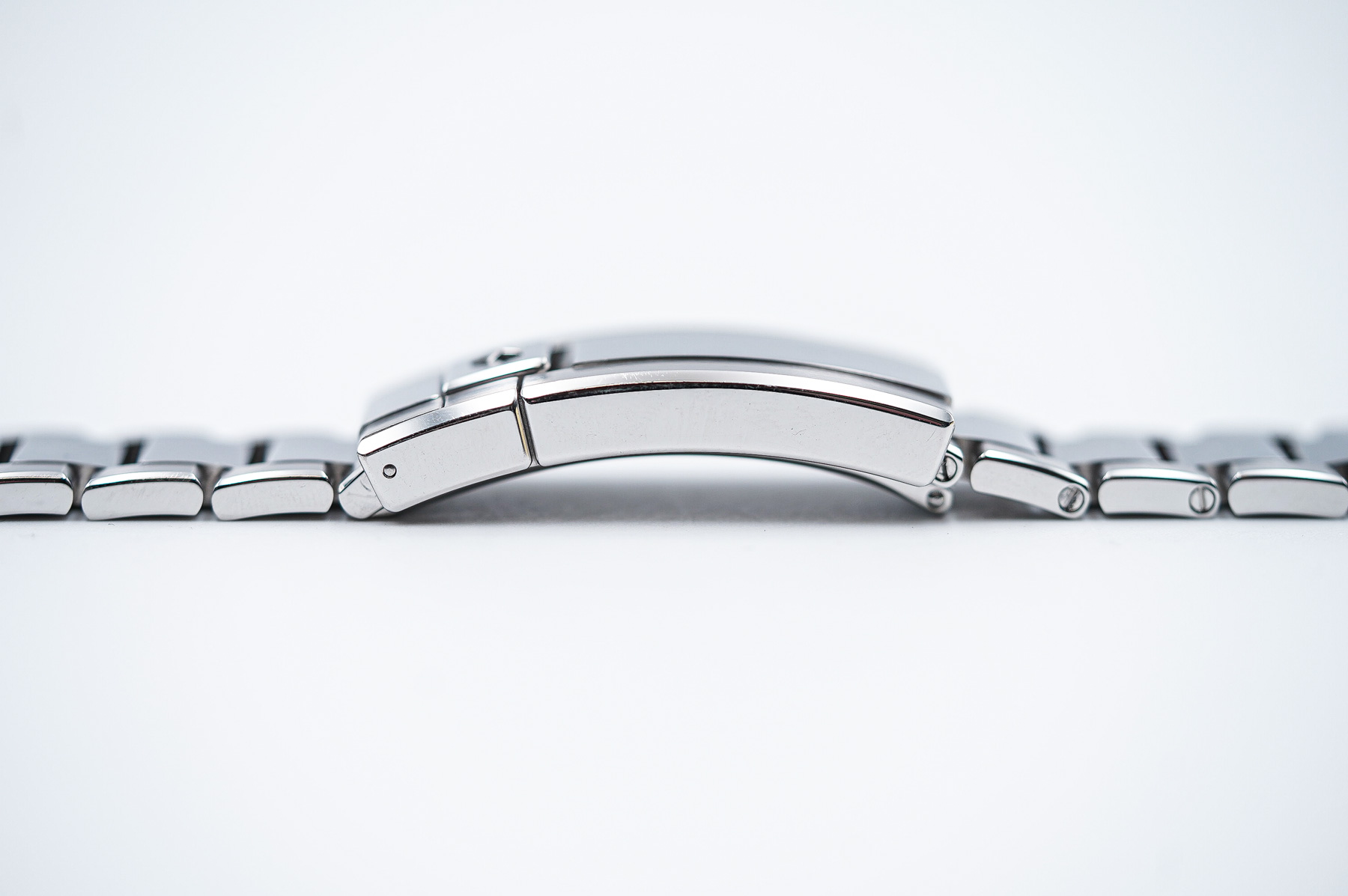
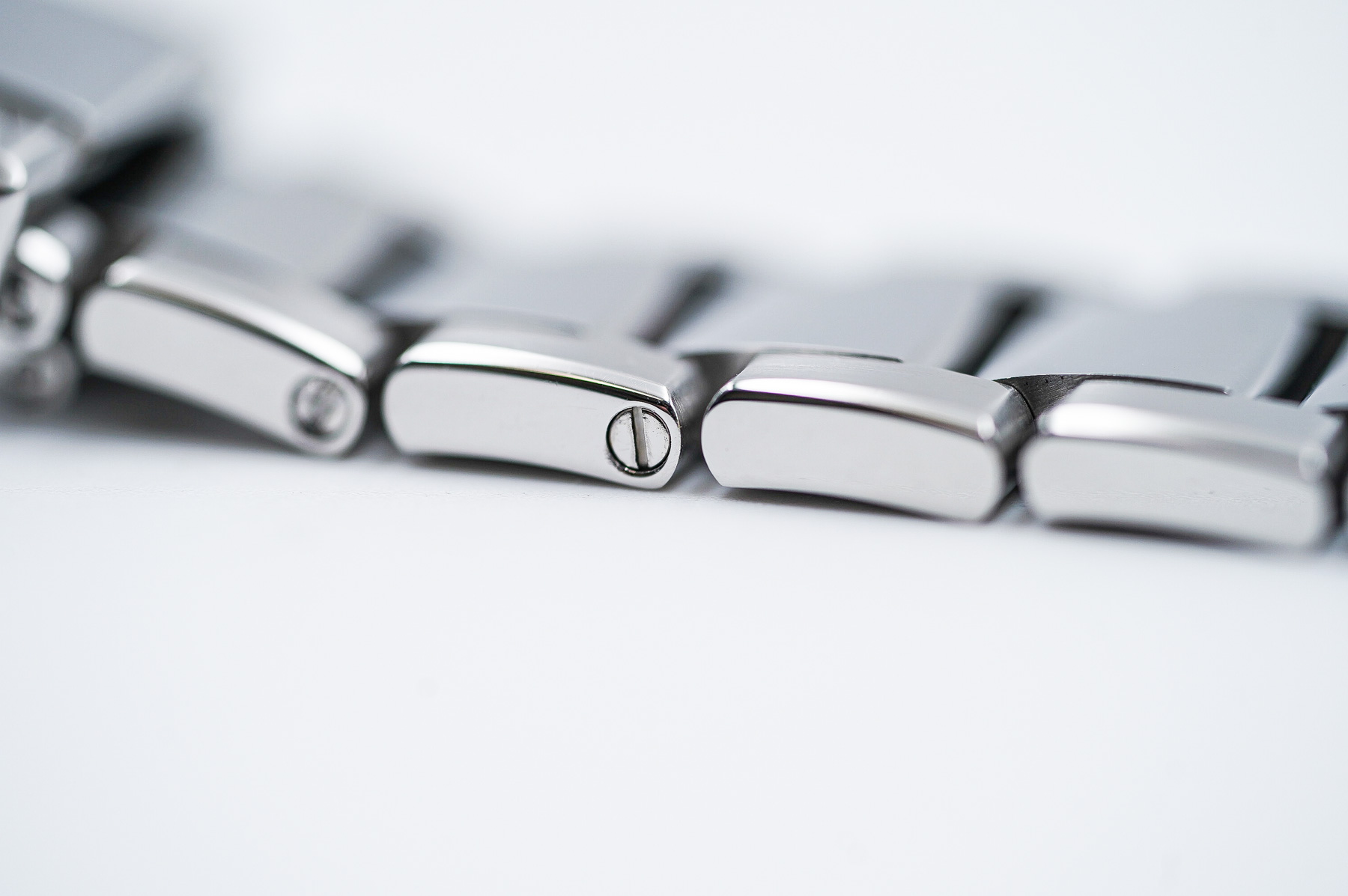
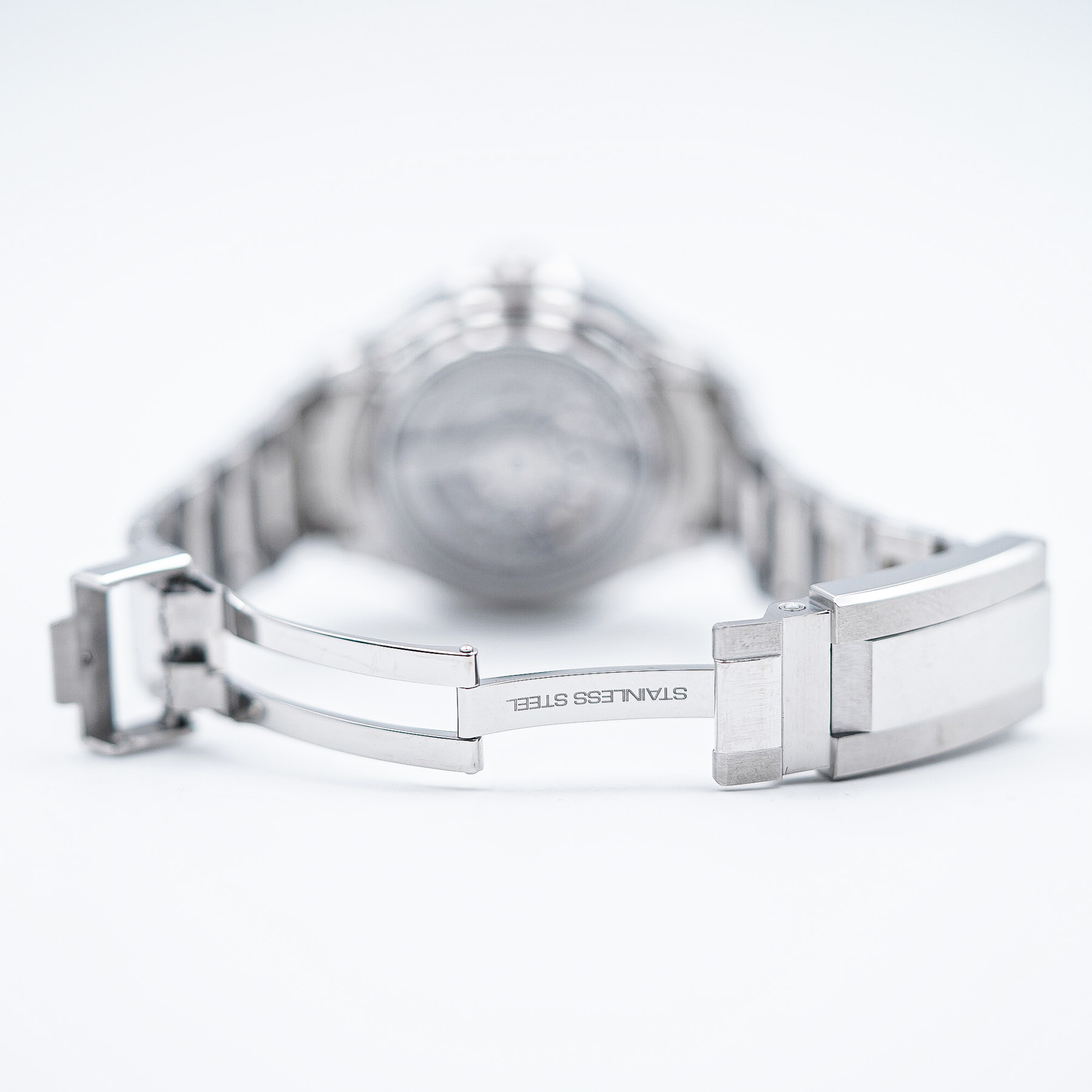
My only concern is complexity. Forty-one components is an extraordinary number for something whose basic job is to keep a bracelet closed. More components inherently mean more parts that could theoretically require attention in the distant future. Zenith’s extensive cycle testing is reassuring, and the use of ceramic at wear points makes engineering sense, but I will be interested to see what these clasps look like after ten or fifteen years of actual ownership. Still, if I am evaluating the mechanism as it exists today rather than inventing hypothetical future problems, it is one of The Best clasps I have handled!
After spending time with the Zenith Chronomaster Solo Sport, I found myself returning to the same question I had when it arrived. Has the watch convinced me that the price is completely irrelevant? No. And I don’t think an honest review should pretend otherwise. At this level there are simply too many excellent alternatives. You can buy formidable sports watches from Omega. Breitling offers serious competition. Tudor gives you a great deal of watch for considerably less money. And once you reach this price level, the Rolex Submariner inevitably enters the conversation.
That comparison is unavoidable. The Submariner has extraordinary brand recognition, arguably unmatched residual value, an exceptionally proven case and movement architecture and one of the most recognisable designs ever created. If somebody simply asks me which is the safer €10,000-plus purchase from a financial or resale perspective, I think everybody already knows the answer. But watches are not investment spreadsheets. And technically, there are areas where I actually find the Zenith more impressive. I prefer the ZENCLASP. I find the 5Hz El Primero 3620 significantly more interesting from a watchmaking perspective. The ceramic patterned dial offers more detail. The watch feels excellent on the wrist. It provides 200 metres of water resistance without becoming thick or cumbersome. And crucially, it feels like a watch designed for enthusiasts rather than something bought simply because everybody recognises the name on the dial. That does not make the price low. It makes the price easier to understand. Those are two very different things. At perhaps €7,000–€9,000, I think this would be an extremely dangerous competitor in the luxury sports-watch market. At €10,500, you have to specifically want the Zenith. And maybe that is ultimately what Zenith is betting on.
This isn’t necessarily the watch somebody buys because they walked into a jewellery store looking for “a luxury watch.” It is the watch for somebody who knows what 36,000 vibrations per hour means. Somebody who cares that Zenith developed a 41-component clasp with ceramic locking elements. Somebody who notices the shark-tooth minute track, understands the history behind El Primero and appreciates that underneath a seemingly simple three-hand dial sits one of the more unusual automatic movements in this category. There is one philosophical question I still haven’t completely resolved, though. Does a Chronomaster without a chronograph make sense? Before wearing the watch, I was leaning towards no. El Primero and the chronograph are historically so closely connected that removing the complication feels almost contradictory. But after living with the Solo Sport, my opinion changed. It does not feel like a chronograph with something missing.
The rotating bezel, increased water resistance, screw-down crown, cleaner dial and smaller case give it another purpose. And honestly, the combination may even make more sense for the way many people actually use their watches every day. I rarely need to time something to a tenth of a second. I frequently need to know whether 15 or 30 minutes have passed. Rotate the bezel and you are done. Simple. There are still things I would change. I could live without some of the writing on the dial. The polished bracelet sections are going to accumulate scratches quickly. I wish the white model had a no-date option for people who prefer symmetry. And yes, I still believe €10,500 is an ambitious retail price. But none of those criticisms changed the fact that I enjoyed wearing this watch far more than I expected. Perhaps the greatest compliment I can give the Chronomaster Solo Sport is that after several days I stopped thinking of it as “the Zenith without the chronograph.” It simply became the Zenith I was wearing.
The proportions are excellent. The white ceramic dial has enough detail to remain interesting without becoming visually exhausting. The 40mm case feels smaller and better balanced in person than photographs suggest. The El Primero 3620 gives it genuine mechanical personality. And ZENCLASP shows what can happen when a manufacturer spends as much effort engineering the parts you touch every day as the movement hidden behind the caseback. Would I call it perfect? Definitely not. Would I call it cheap? Absolutely not. Would I choose it automatically over a Rolex Submariner simply because the movement is more technically interesting? No. Buying a watch at this level involves far more than comparing frequencies and clasp mechanisms. But after having the Zenith on my wrist, the choice is much less obvious than I expected it to be. And considering where I started — looking at the €10,500 price and wondering who exactly this watch was for — that might be the biggest surprise of the entire review. The Chronomaster Solo Sport has not convinced me that €10,500 is a bargain. It has convinced me that there is a real watch behind that price. And for someone who values the El Primero story, high-frequency watchmaking, thoughtful engineering and something a little less predictable than the default luxury sports-watch choice, that may be enough.

