
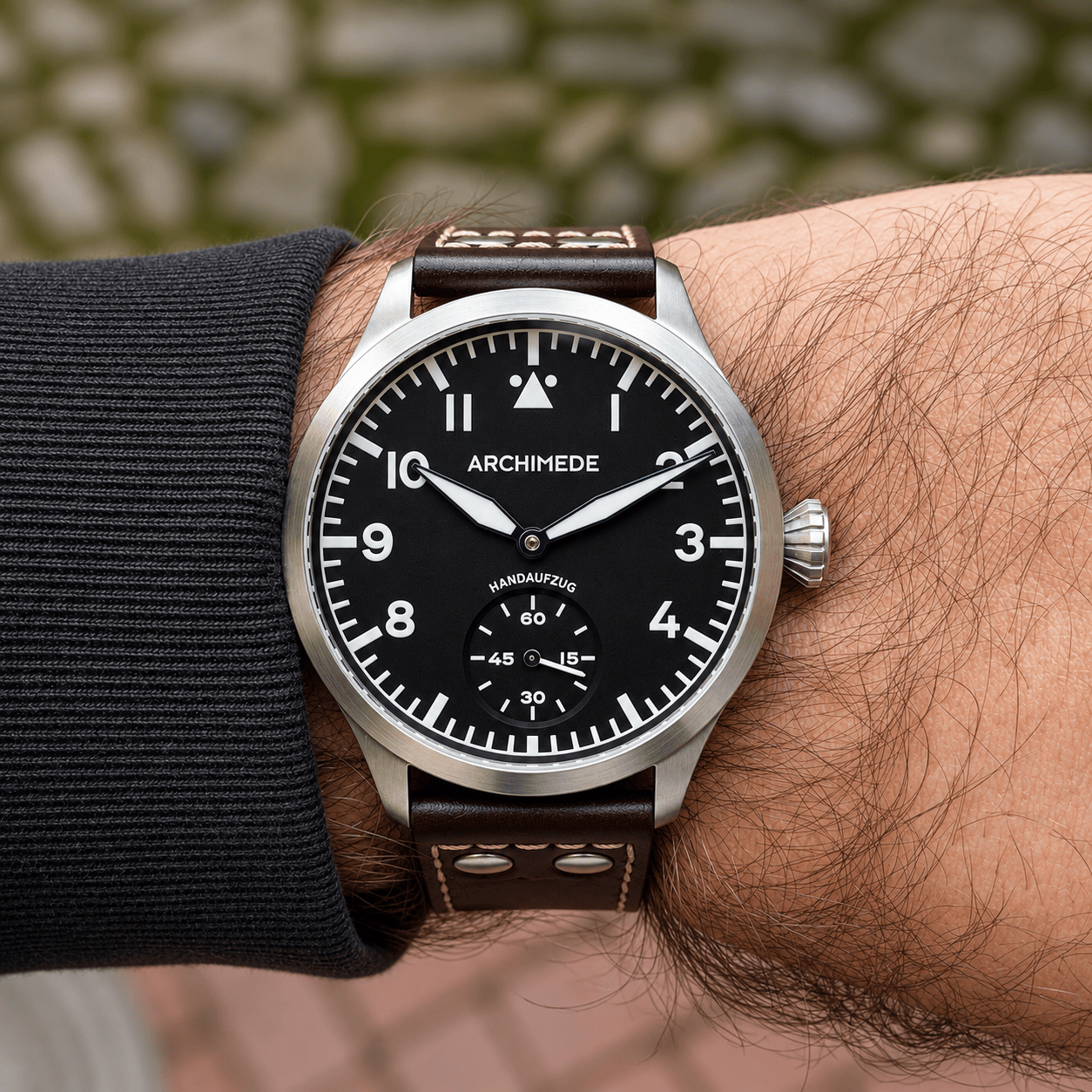
There is something particularly appealing about a traditional pilot’s watch. Perhaps it is the combination of purposeful design, historical associations with aviation, and an almost complete absence of unnecessary decoration. A proper Flieger watch is not supposed to impress with complicated displays or extravagant finishing. Its primary purpose is to communicate information clearly, reliably and instantly. Everything else should come second. The Archimede Pilot 45 HW is a watch that understands this philosophy remarkably well, although, as I discovered while examining it more closely, there are a few areas where the overall experience could be improved.
Archimede is a German watch brand based in Pforzheim, a city with a particularly important place in the country’s watchmaking and jewellery industry. However, the story behind the name goes considerably further back than the launch of the brand itself. Archimede belongs to the Ickler family, whose history in watchmaking dates to 1924, when Karl Ickler established his company specialising in the manufacture of watch cases. Over the following decades, the business developed its expertise in case construction, metalworking and precision manufacturing. After the Second World War, Karl’s sons, Heinz and Kurt, rebuilt the production facilities in 1947 and continued developing the family enterprise.
The Archimede brand itself was introduced in 2003, bringing the family’s manufacturing expertise into the production of complete watches. Today, the company remains closely associated with Pforzheim and maintains a considerable degree of in-house production, particularly when it comes to watch cases. Design, engineering, prototyping, machining, surface finishing, engraving and final assembly are all part of the Ickler manufacturing operation. This is an important distinction because Archimede is not simply another small brand purchasing generic cases and assembling watches around readily available movements. Its strongest identity comes from its manufacturing background and the experience accumulated over generations.
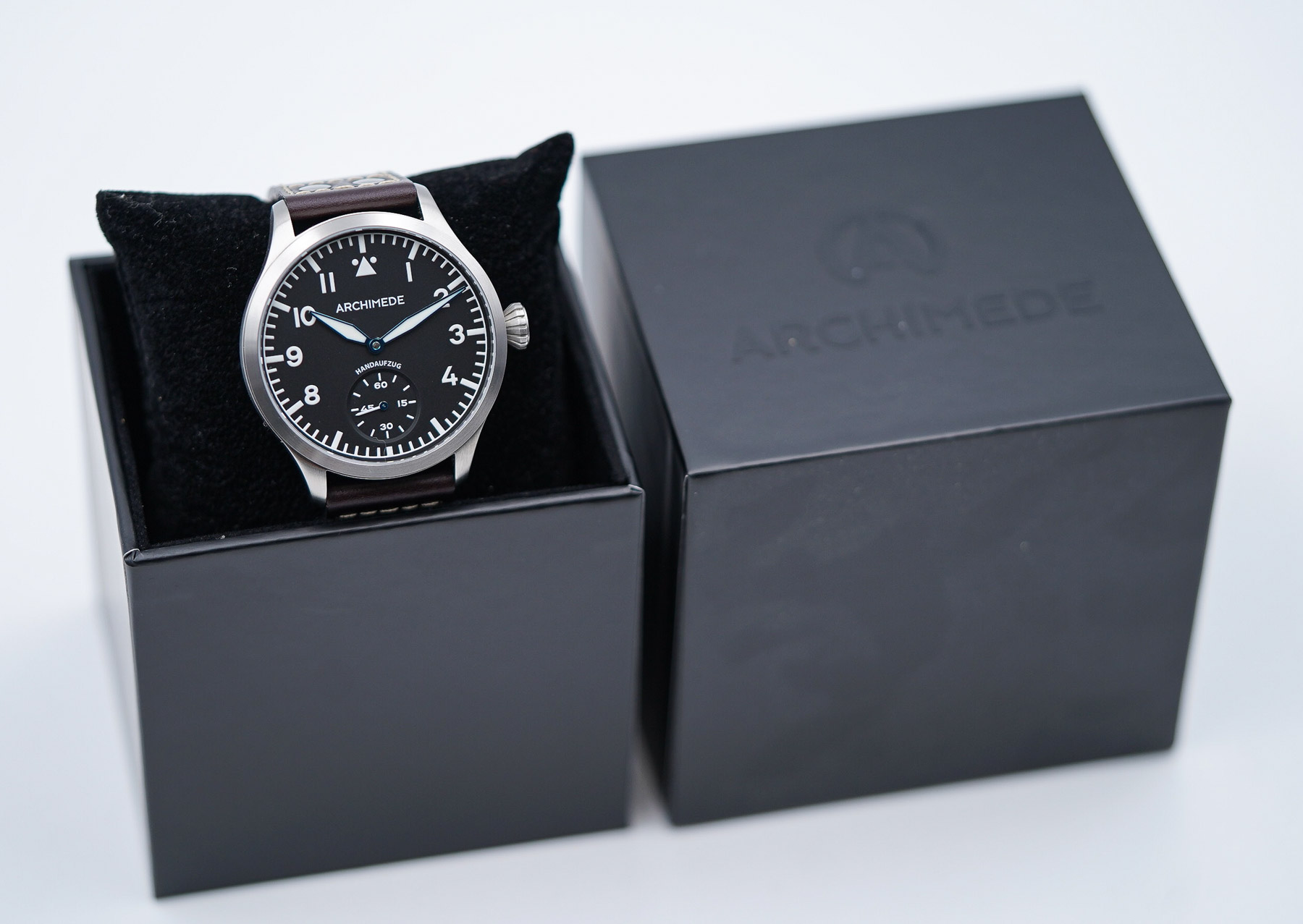
\The Pilot collection is arguably one of the most recognisable expressions of this philosophy. Inspired by the traditional German aviation-watch aesthetic, it combines highly legible dials, oversized crowns, luminous hands and uncomplicated mechanical movements. The Pilot 45 HW takes that concept in a particularly traditional direction, using a manually wound Swiss movement rather than an automatic calibre. My particular example is the S.LDB configuration, equipped with the ETA 6498 TOP movement and a dark brown leather strap. It is a straightforward watch, but that is precisely its attraction. There is no attempt to reinvent the pilot-watch concept or introduce unnecessary complications. Instead, Archimede has concentrated on proportions, legibility, mechanical reliability and solid case construction. The result is a watch with a very clear identity, although a few details deserve more attention than they receive.
The first thing that becomes apparent when handling the Pilot 45 HW is its physical presence. With a 45mm diameter, a thickness of approximately 10.5mm and a lug-to-lug measurement of 53mm, this is unquestionably a large watch. It is not designed to disappear beneath a shirt cuff, nor is it particularly interested in following contemporary preferences for compact wristwatches. Its proportions are rooted in the traditional aviation-watch philosophy, where a large dial and immediate readability were considered essential. Despite its generous diameter, the relatively modest thickness helps the watch avoid looking unnecessarily bulky. The case has a predominantly brushed stainless-steel finish, which suits the utilitarian character of the design. I particularly appreciate the decision to avoid excessive polishing. A pilot’s watch should look like an instrument rather than a piece of jewellery, and the restrained surface treatment reinforces that impression.
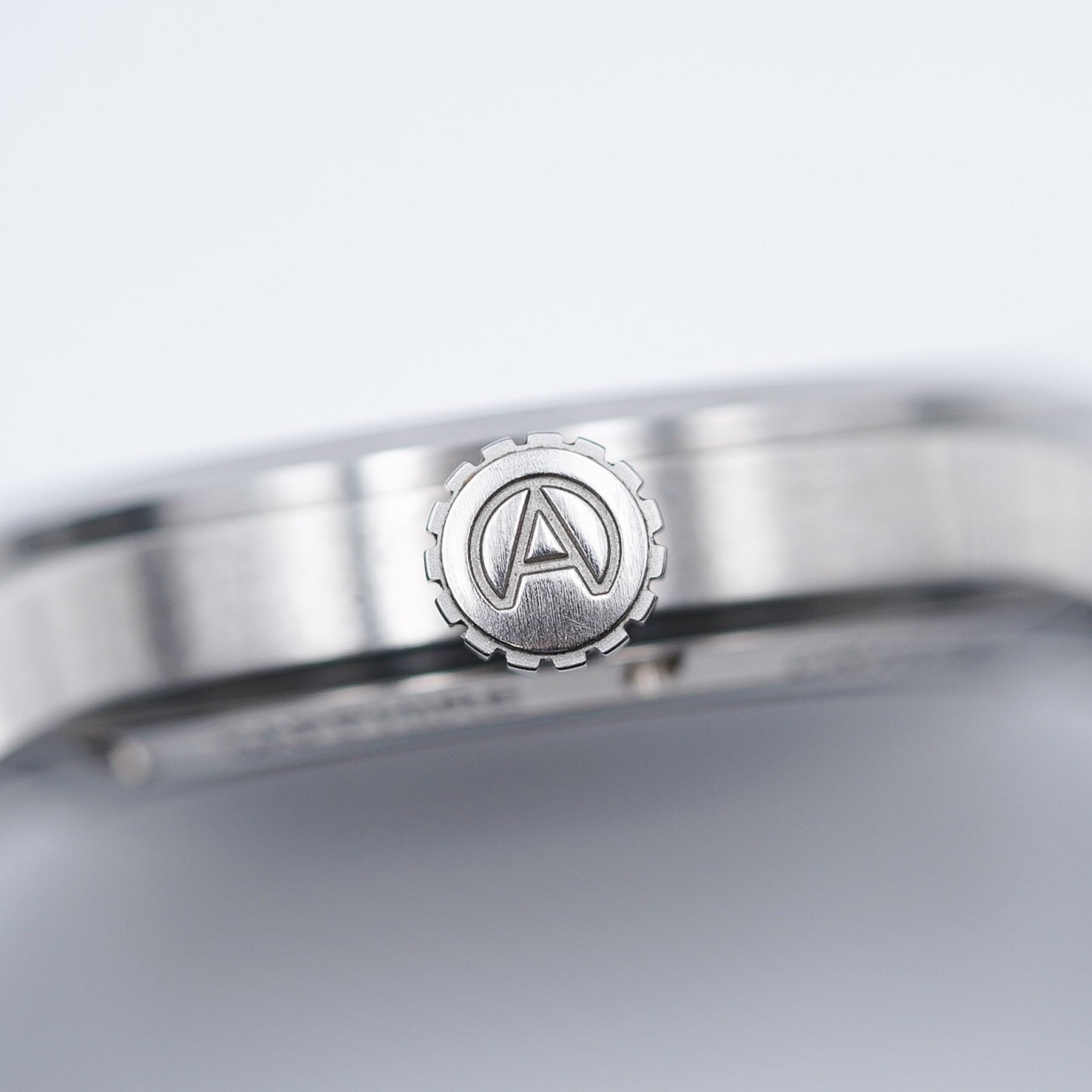
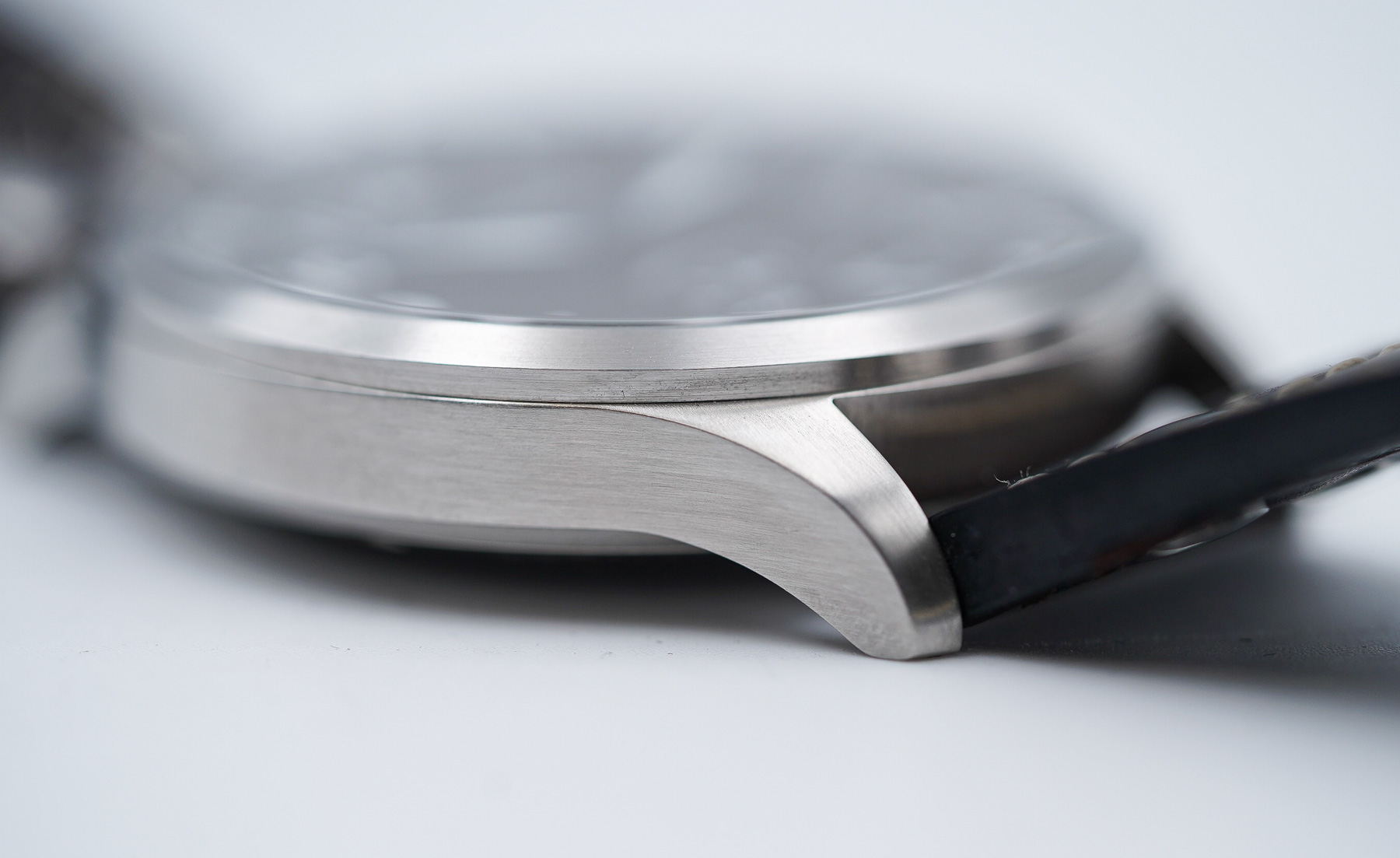
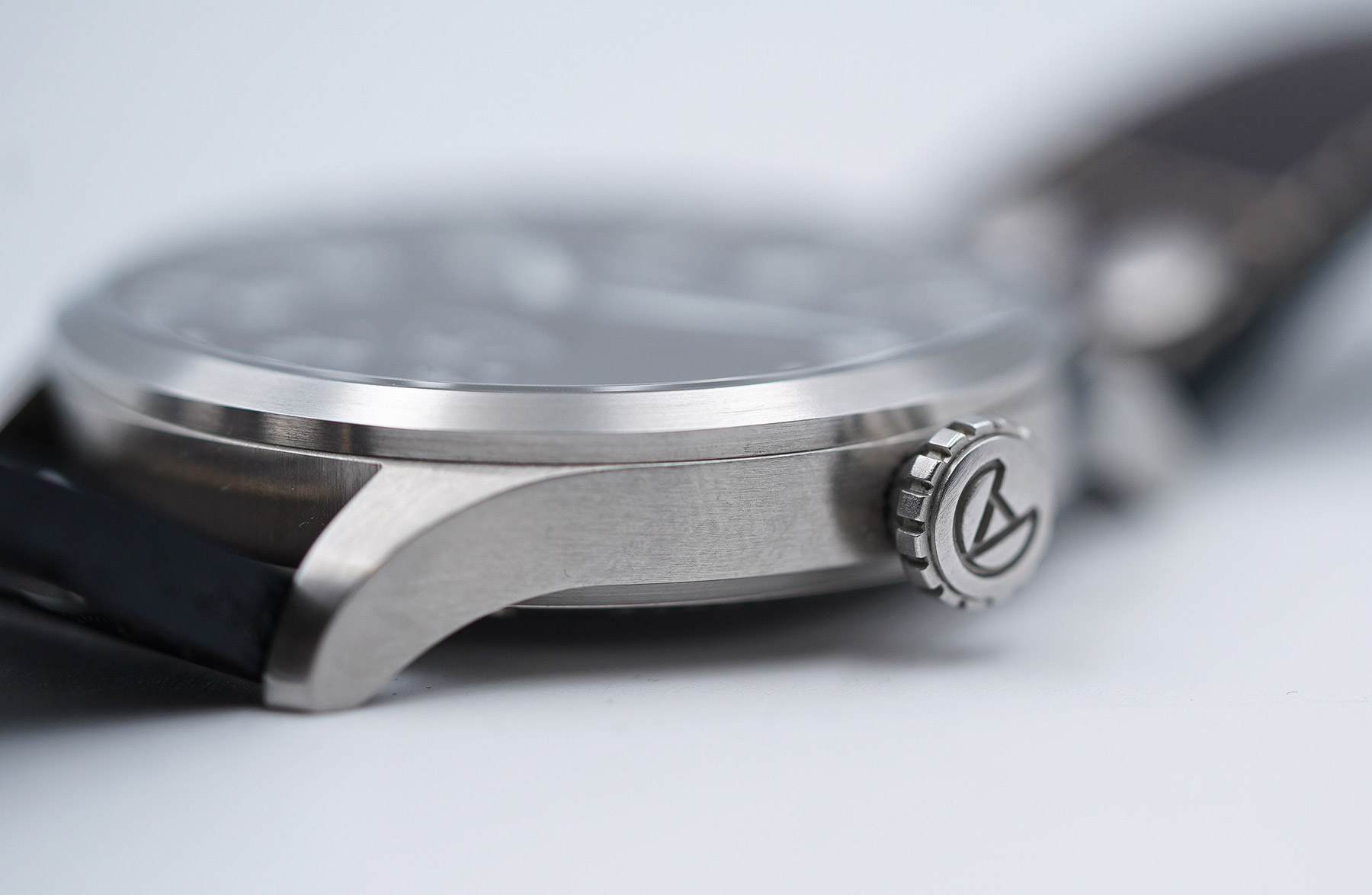
The case construction is one of the strongest arguments in favour of Archimede. The watch uses an ICKLER-manufactured stainless-steel case produced in Pforzheim, Germany. Considering the company’s long experience in manufacturing watch cases, this is hardly surprising. The transitions between the case surfaces are clean, the lugs have a purposeful shape, and the overall construction gives the impression of a properly engineered product rather than an inexpensive fashion accessory. The oversized onion-style pilot crown is another defining feature. It is easy to grip and operate, even without having to concentrate particularly hard on positioning your fingers. This is especially important with a manually wound watch, where the crown becomes part of the daily interaction with the movement. The engraved Archimede logo adds a small but welcome detail without becoming overly decorative.
The watch is fitted with a sapphire crystal featuring internal anti-reflective treatment, while the screw-down case back incorporates another sapphire window, allowing the movement to be observed. Water resistance is rated at 10 ATM, which is more than sufficient for the everyday situations most owners are likely to encounter. One particularly positive aspect is that Archimede has managed to keep the case relatively slim despite its large diameter and the use of a substantial hand-wound movement. The result is a watch that has considerable wrist presence without becoming excessively tall. Nevertheless, the 53mm lug-to-lug measurement means that it will not be suitable for every wrist. Buyers should consider its dimensions carefully rather than relying exclusively on the relatively modest thickness. Overall, the case is an excellent example of what I would expect from a company with Ickler’s manufacturing background. It is practical, robust and thoughtfully executed. There is very little to criticise here.
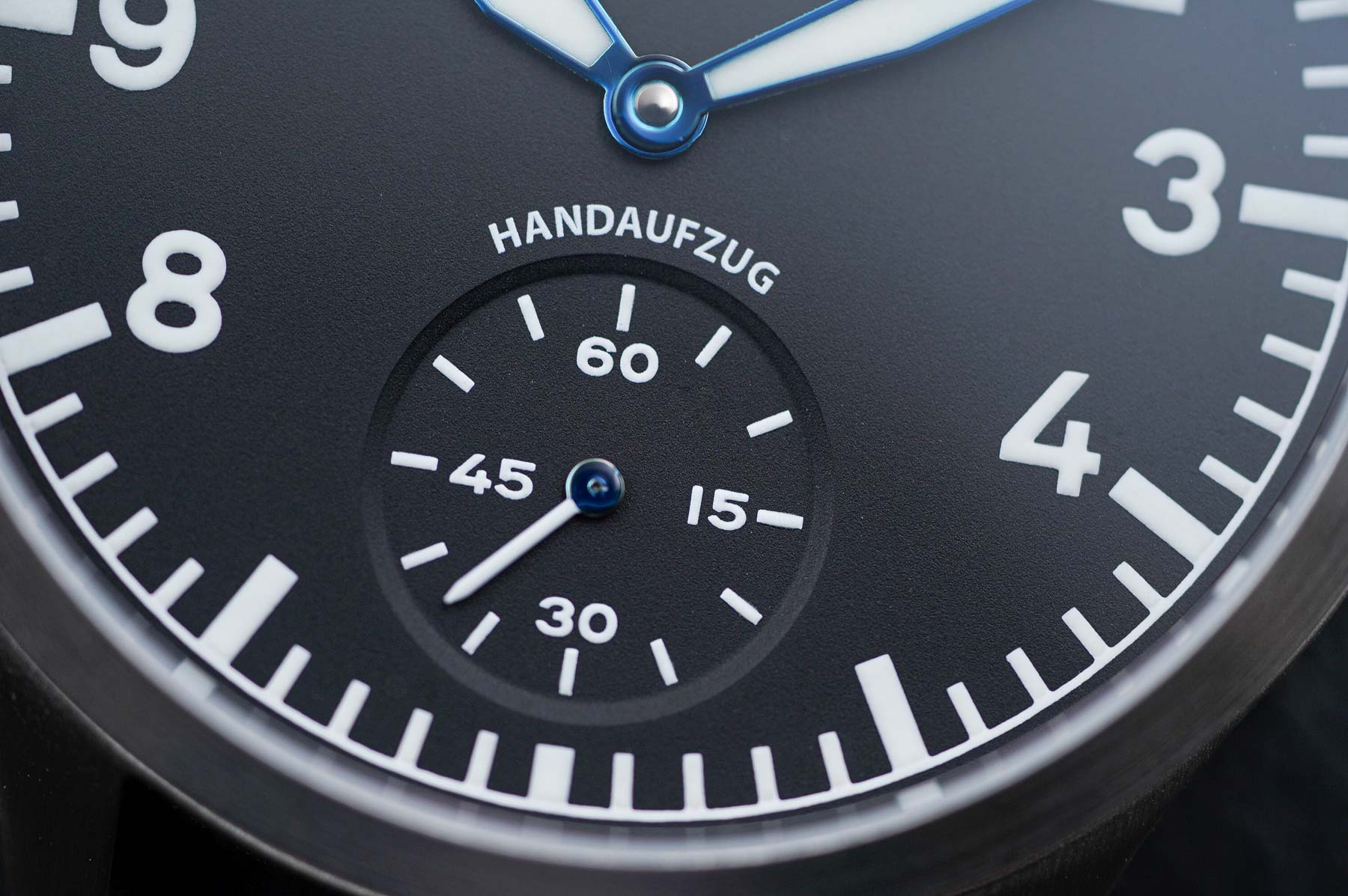
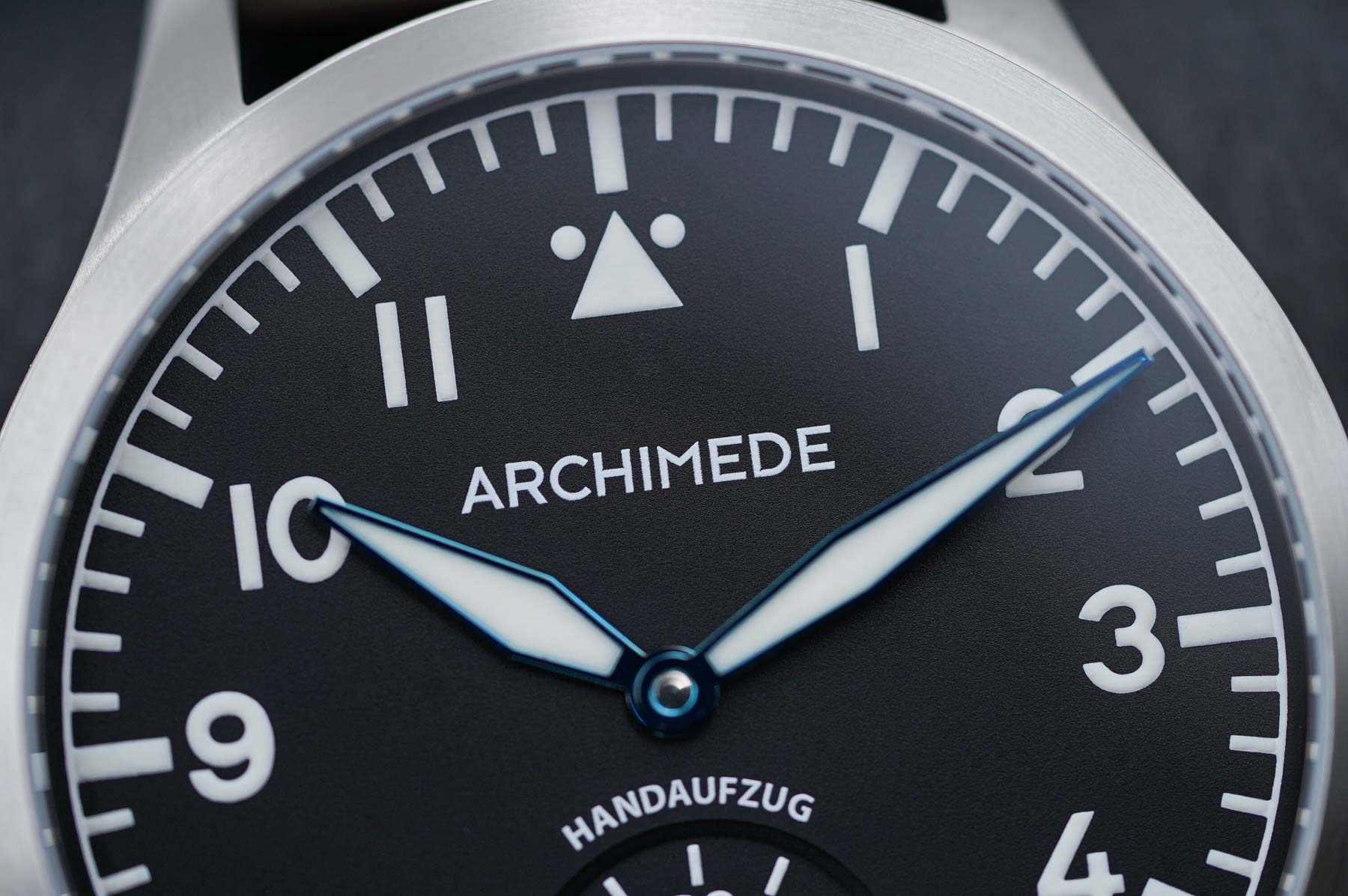
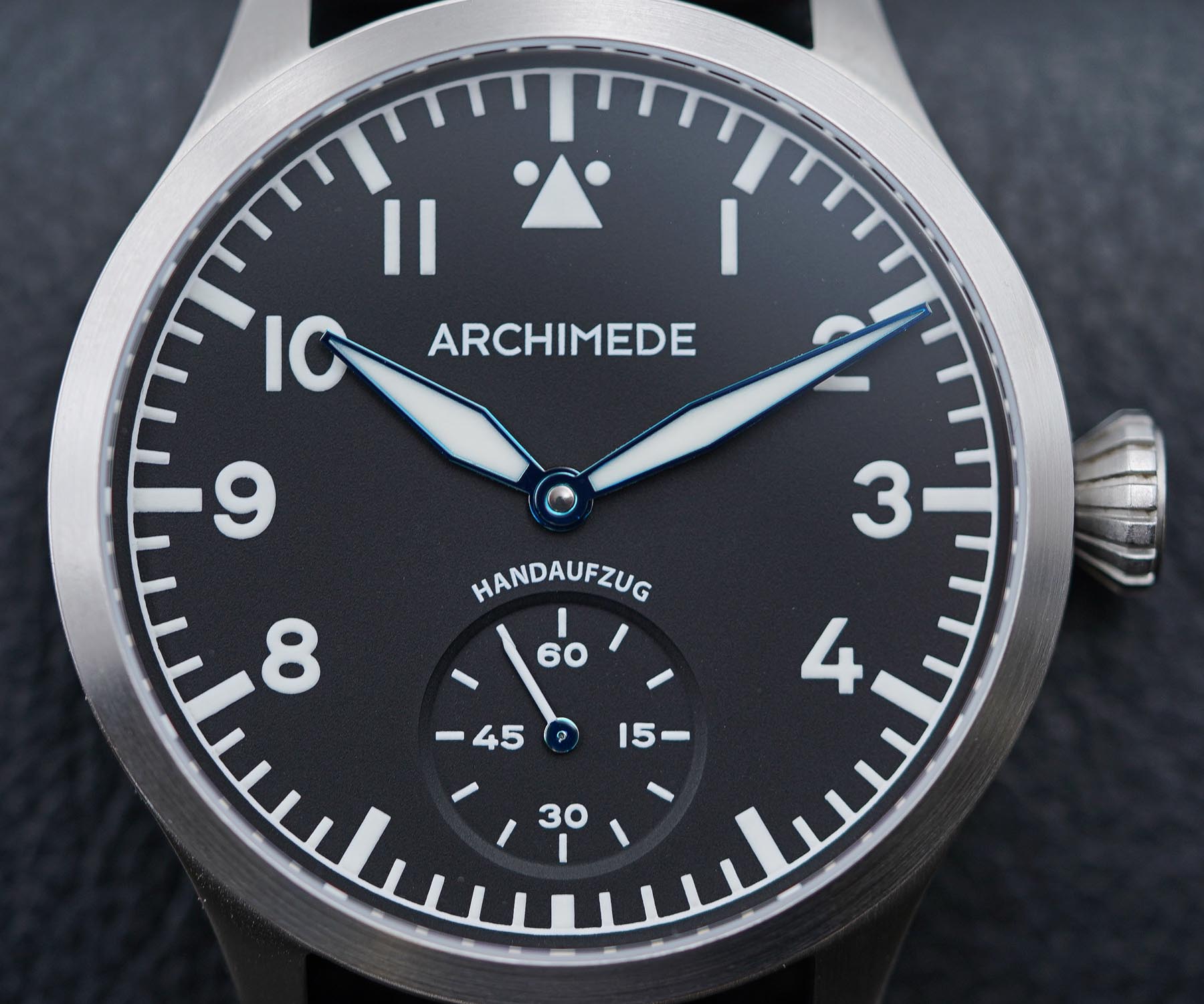
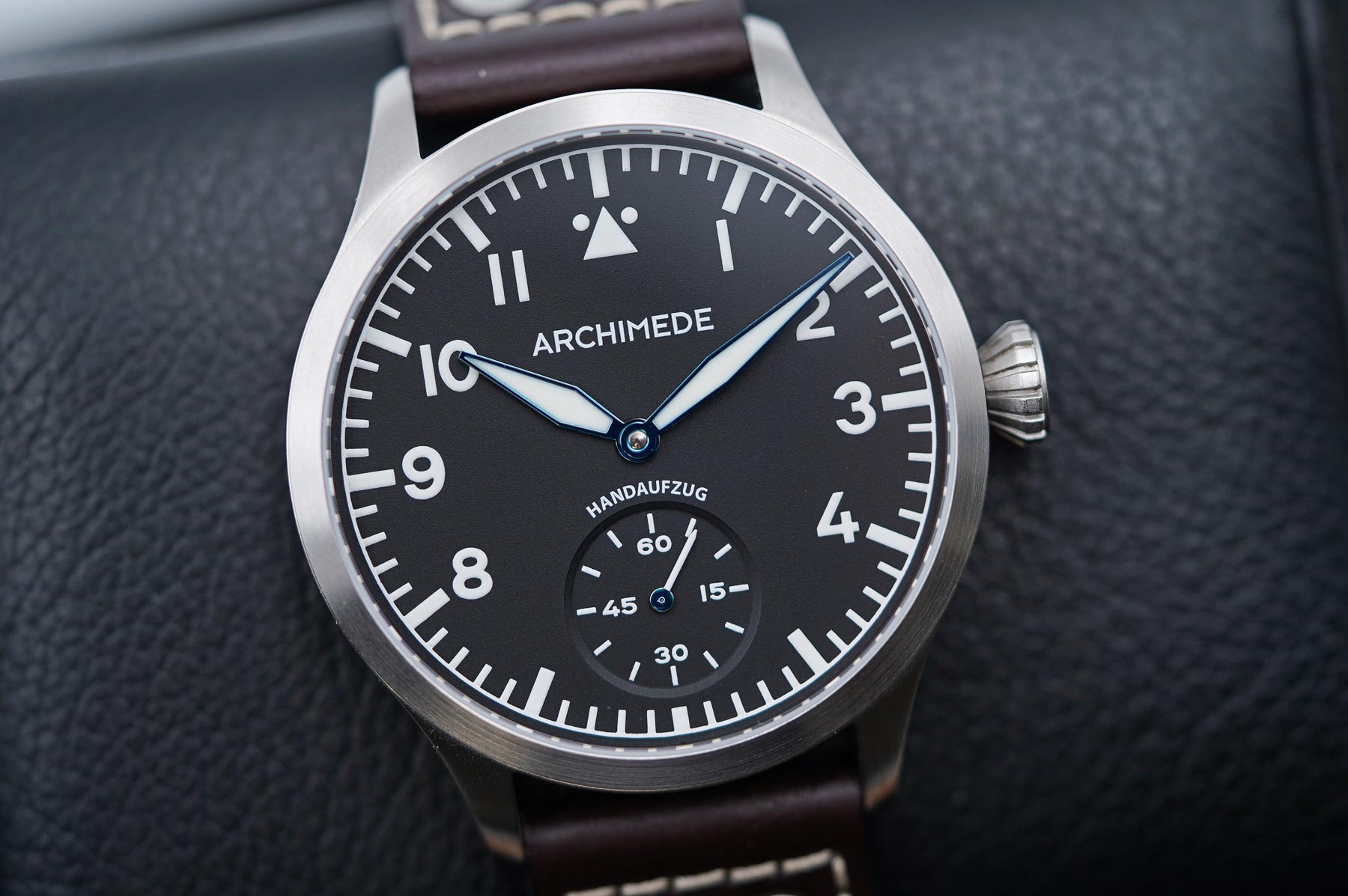
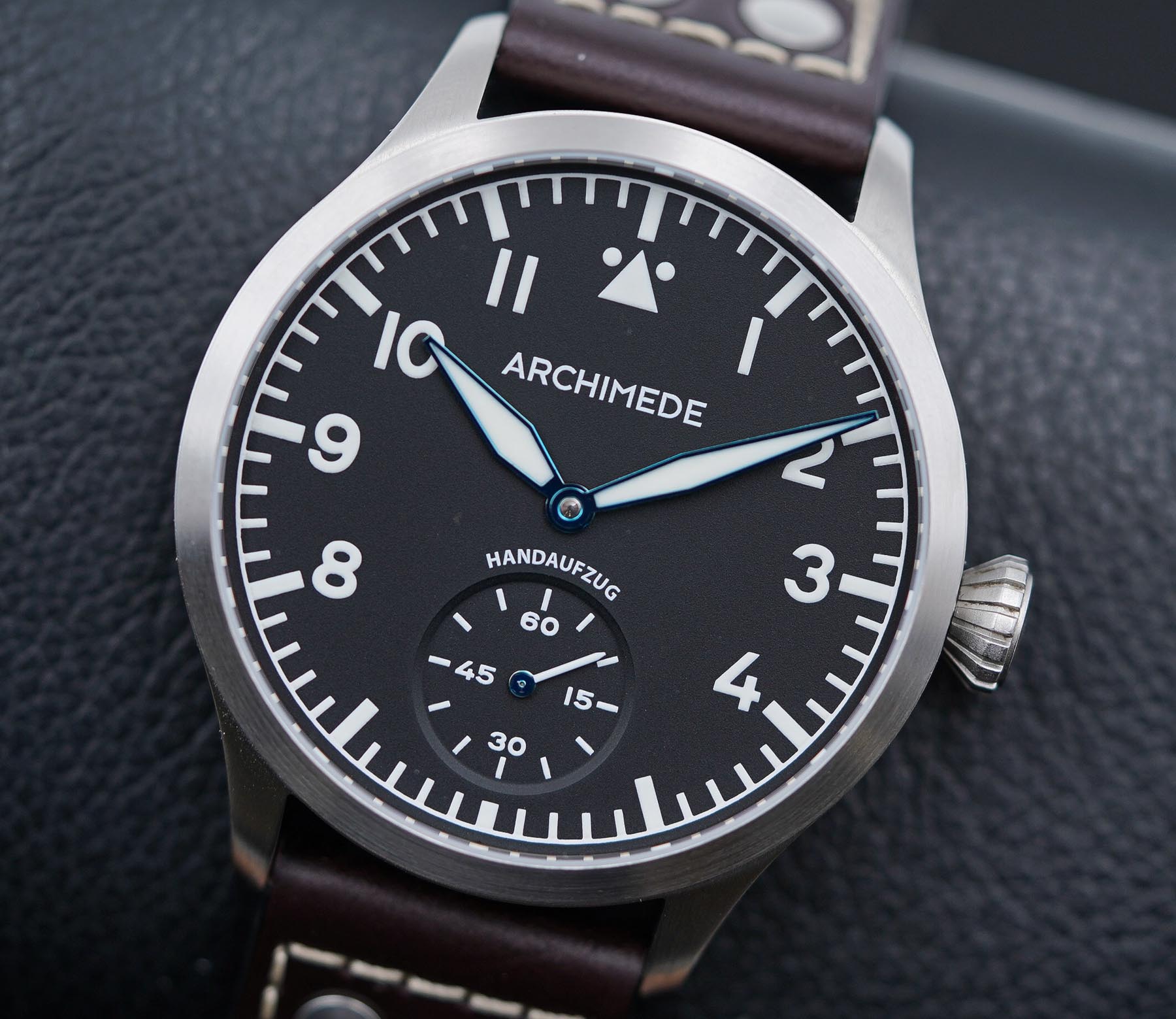
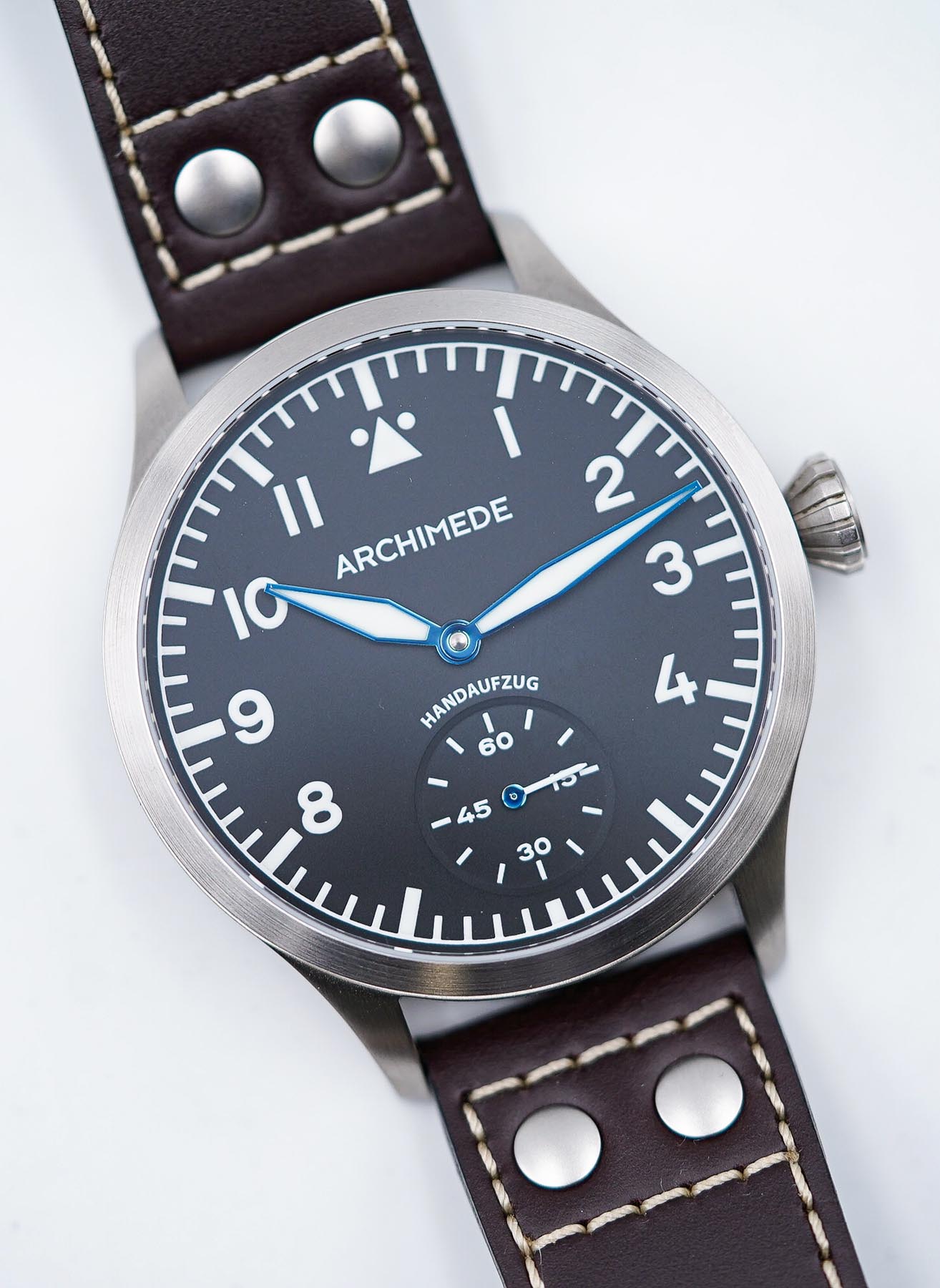
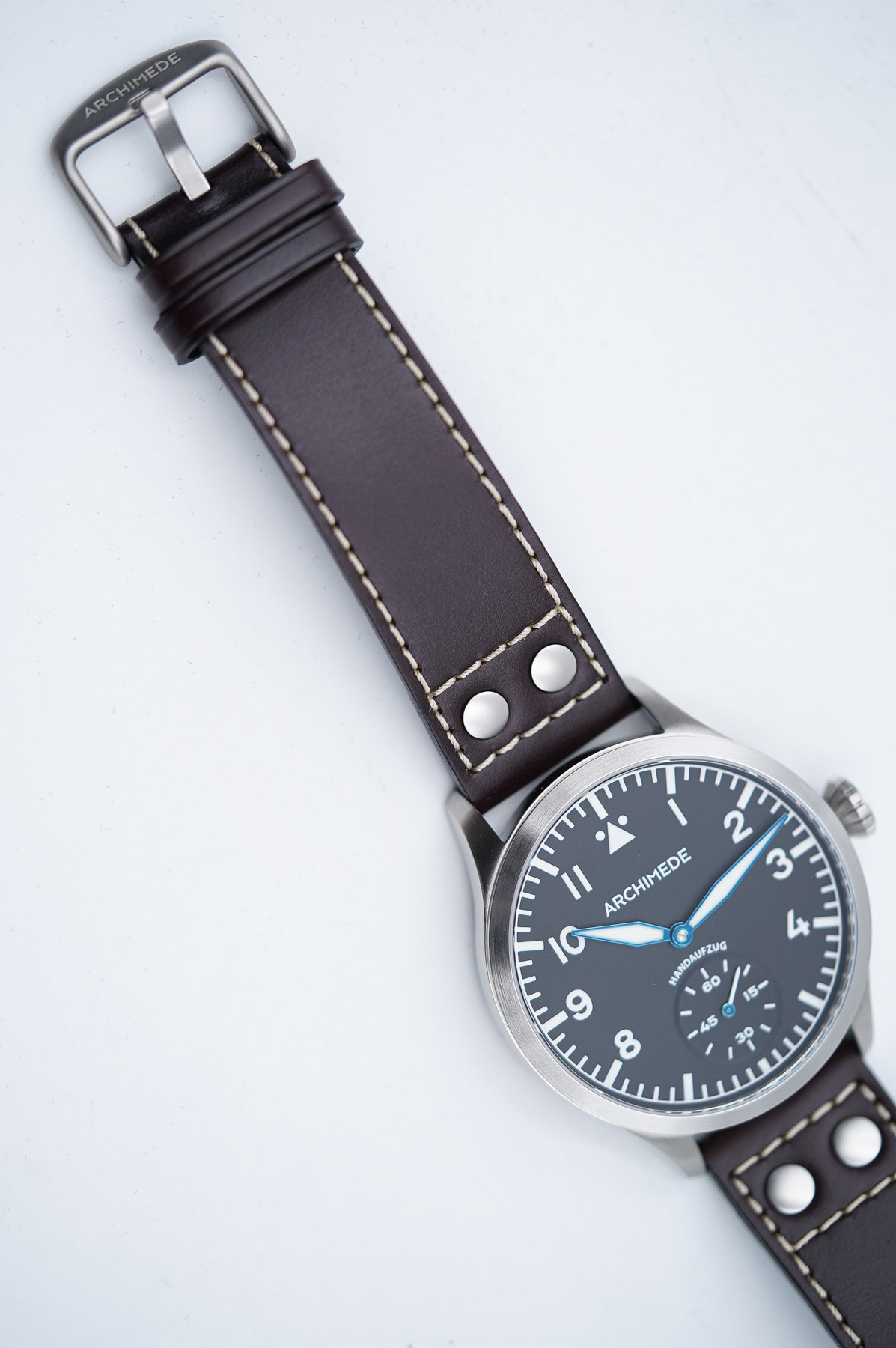
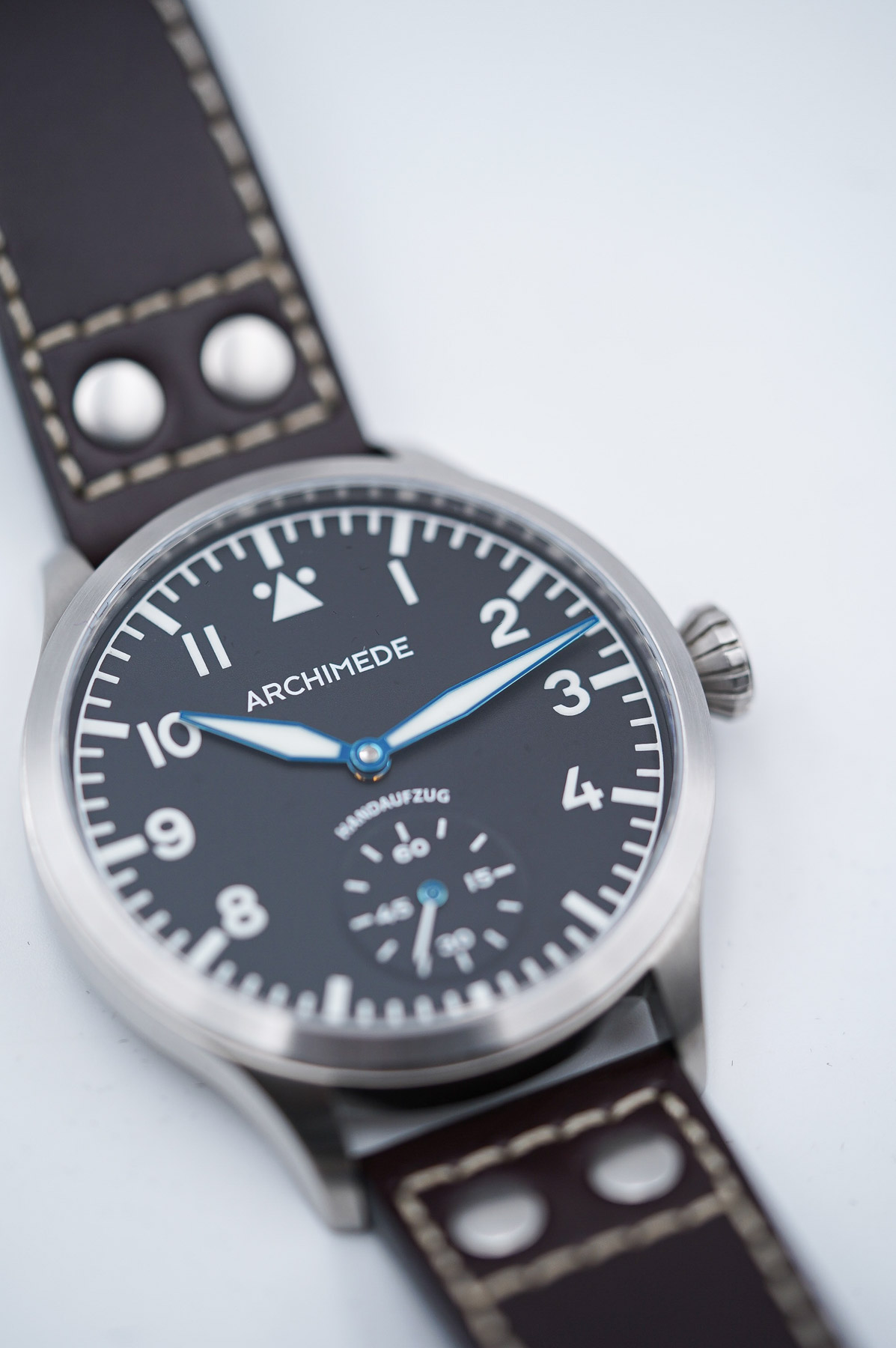
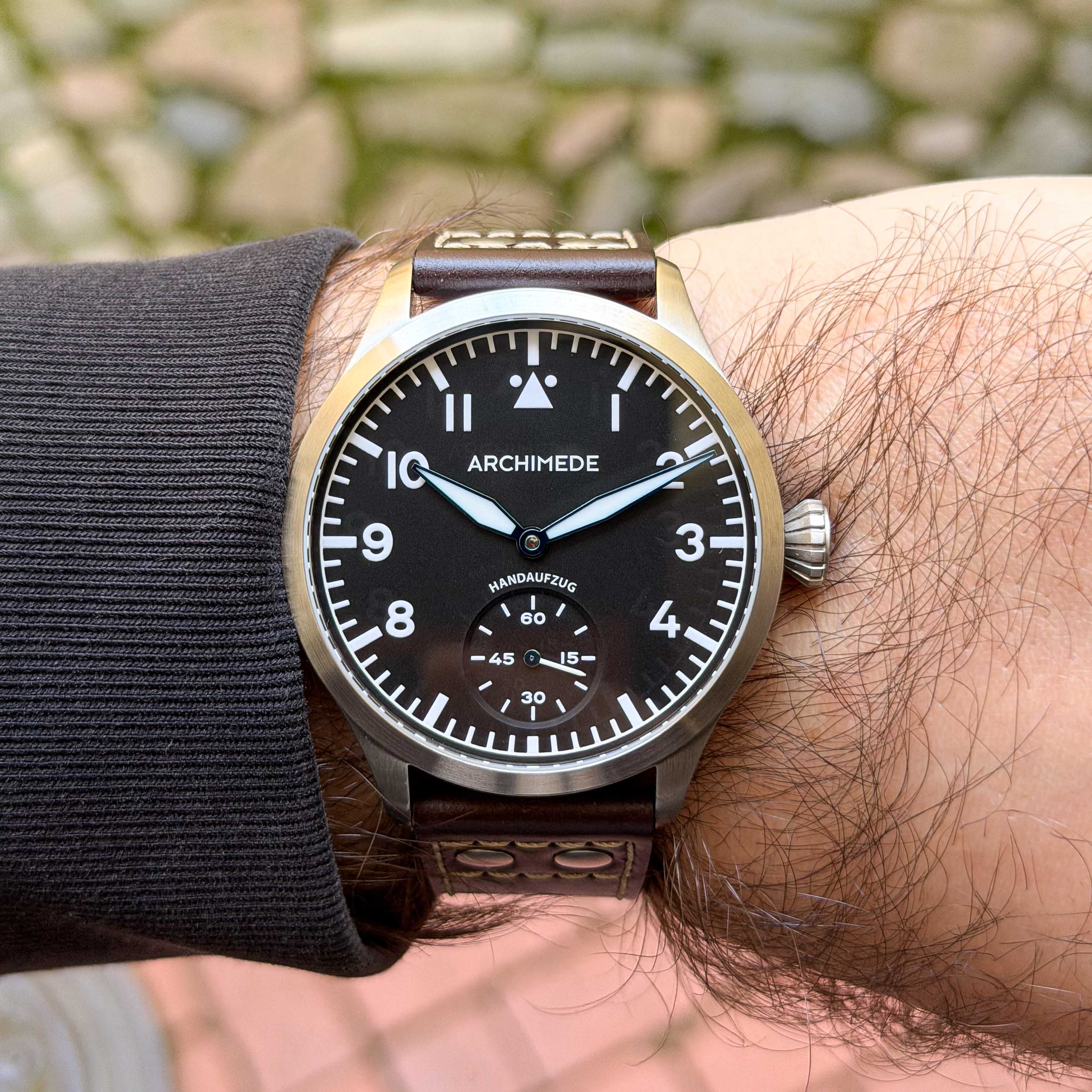
The dial is probably the most immediately recognisable element of the Pilot 45 HW. Archimede has followed the traditional Type A-inspired aviation-watch layout, featuring large Arabic numerals, a prominent triangular marker at twelve o’clock and a clearly defined minute track around the perimeter. The matte black background provides excellent contrast against the white numerals and indices. There is no unnecessary texture, sunburst effect or decorative pattern competing for attention. Everything has been arranged with legibility in mind, and the result is a dial that looks remarkably clean despite its generous dimensions. One detail I particularly appreciate is the small seconds subdial positioned at six o’clock. It adds a little visual balance to what would otherwise be a relatively empty lower portion of the dial. The small seconds display is also a natural companion to the ETA 6498 movement, whose architecture was originally designed around this traditional configuration. The blue hands are another highlight. Their shape is unmistakably associated with traditional pilot watches, and the luminous material provides excellent visibility in darker conditions. The blue colouring also introduces just enough visual character to prevent the dial from appearing too monochromatic. In daylight, the hands have an attractive appearance against the black background, while their luminous sections become particularly prominent after dark.
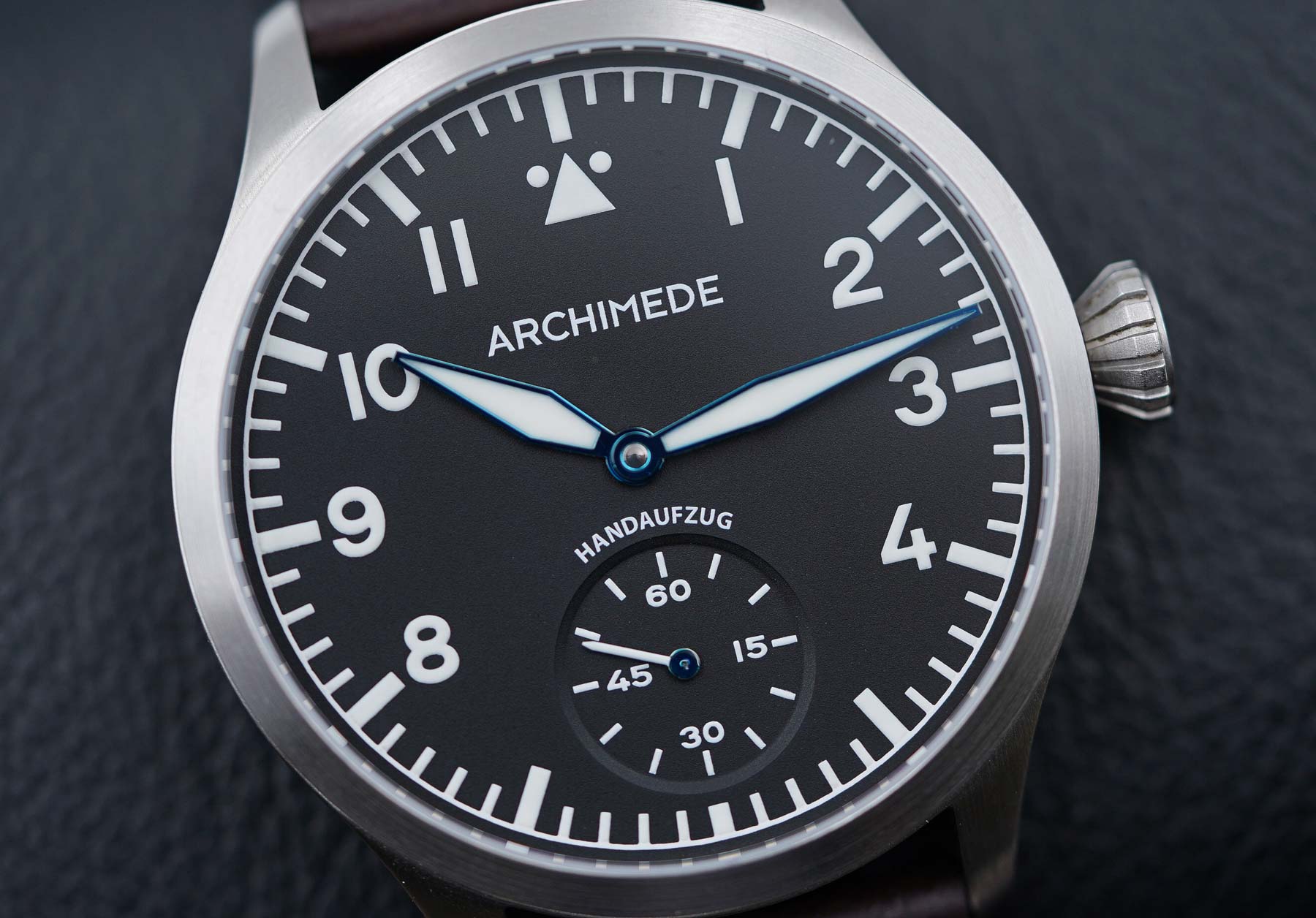
The luminous performance is especially impressive. The numerals, minute markers and hands produce a strong green glow, making the watch easy to read in low-light conditions. This is not merely an aesthetic addition; it is one of the most important functional characteristics of a proper aviation-inspired watch. I also appreciate the restrained branding. The ARCHIMEDE name is positioned beneath twelve o’clock, while the German designation HANDaufzug, indicating manual winding, sits above the small seconds display. Neither interferes with the overall layout. There is, however, a certain charm in the simplicity of this dial that makes it difficult to find much to criticise. It does exactly what it is supposed to do. The proportions are appropriate, the contrast is excellent, and the hands and markers are sufficiently distinctive to make reading the time effortless. It is a good reminder that a successful watch dial does not necessarily require elaborate decoration. Sometimes a well-executed, functional design is considerably more satisfying than something considerably more complicated.
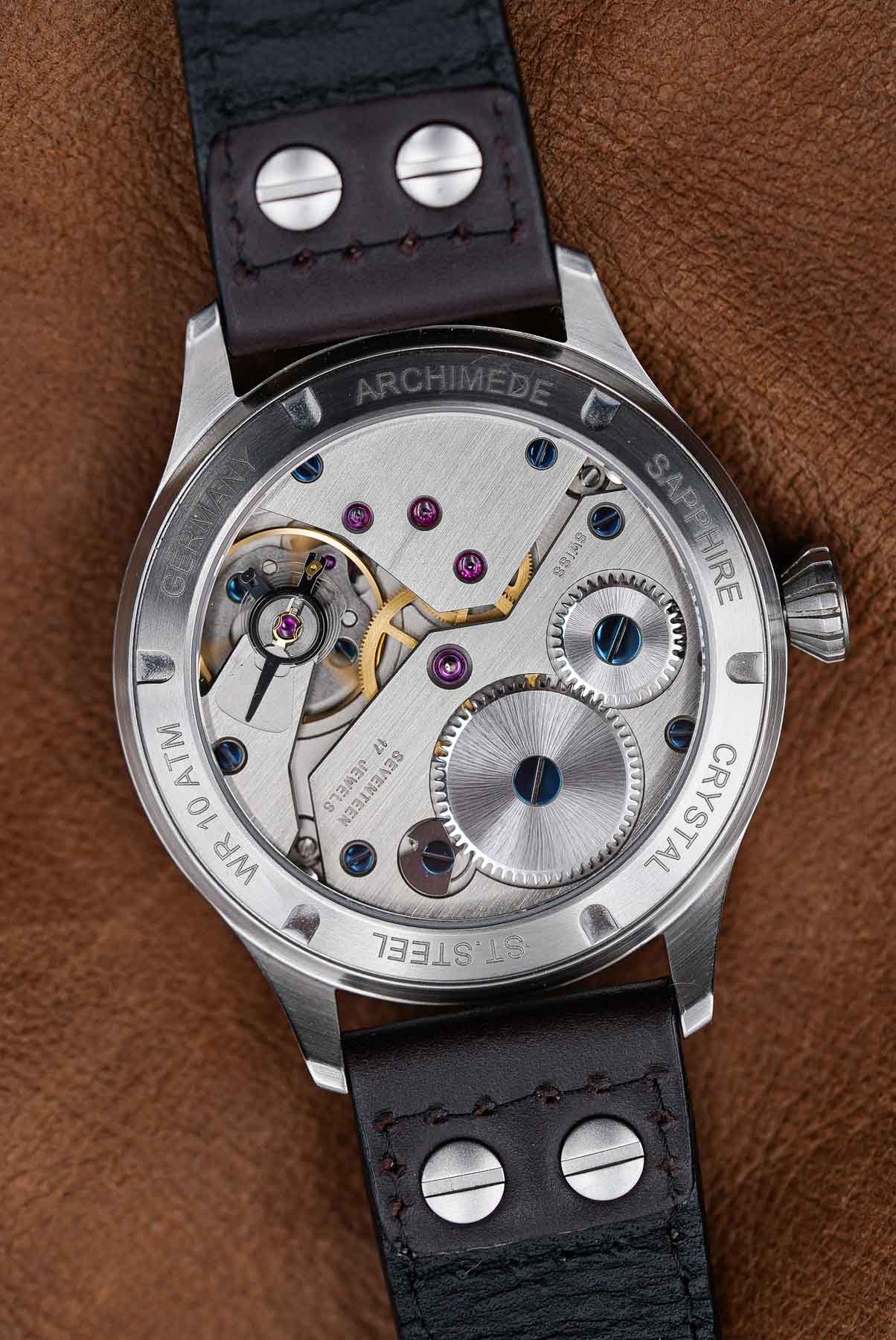
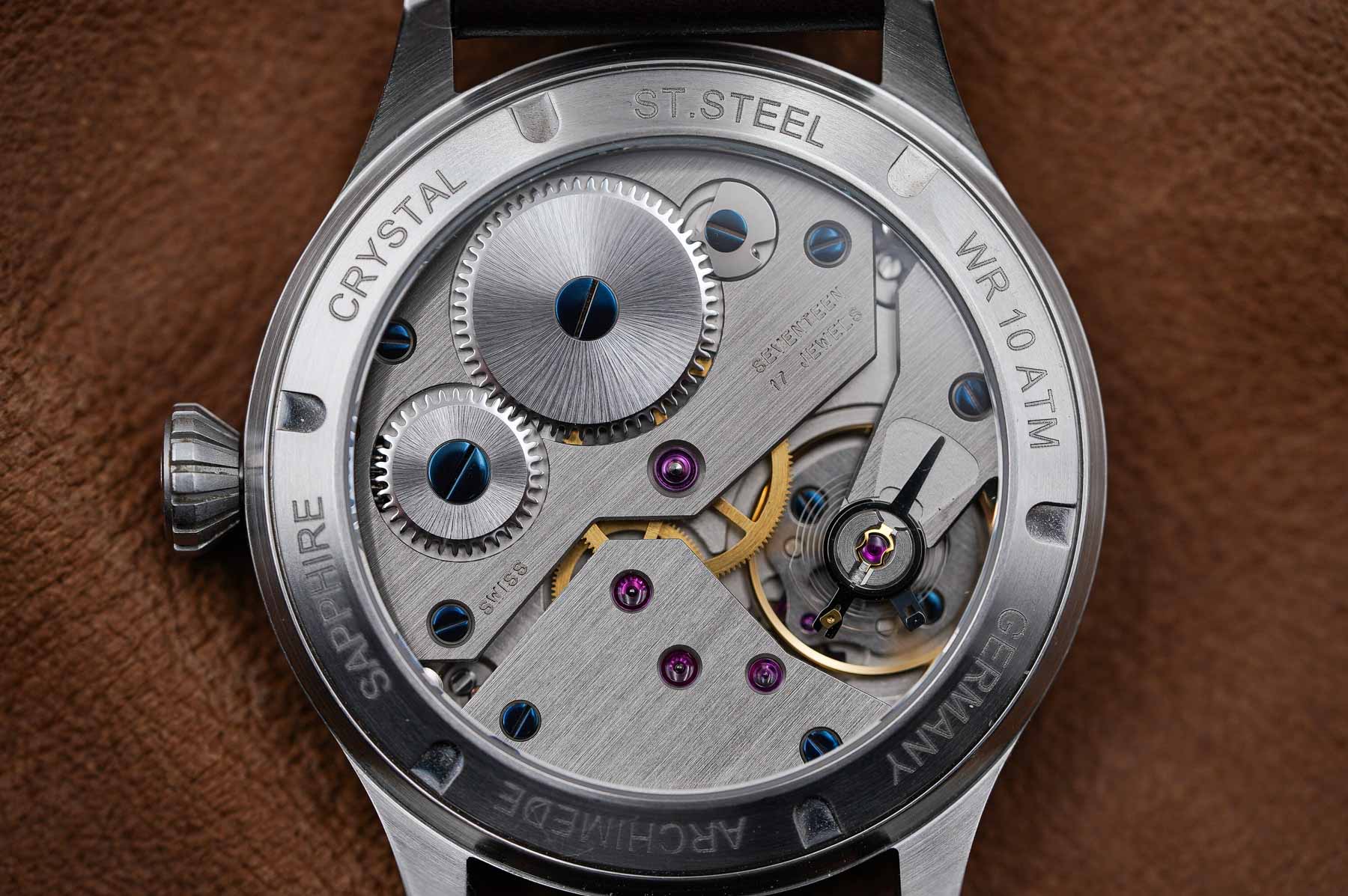
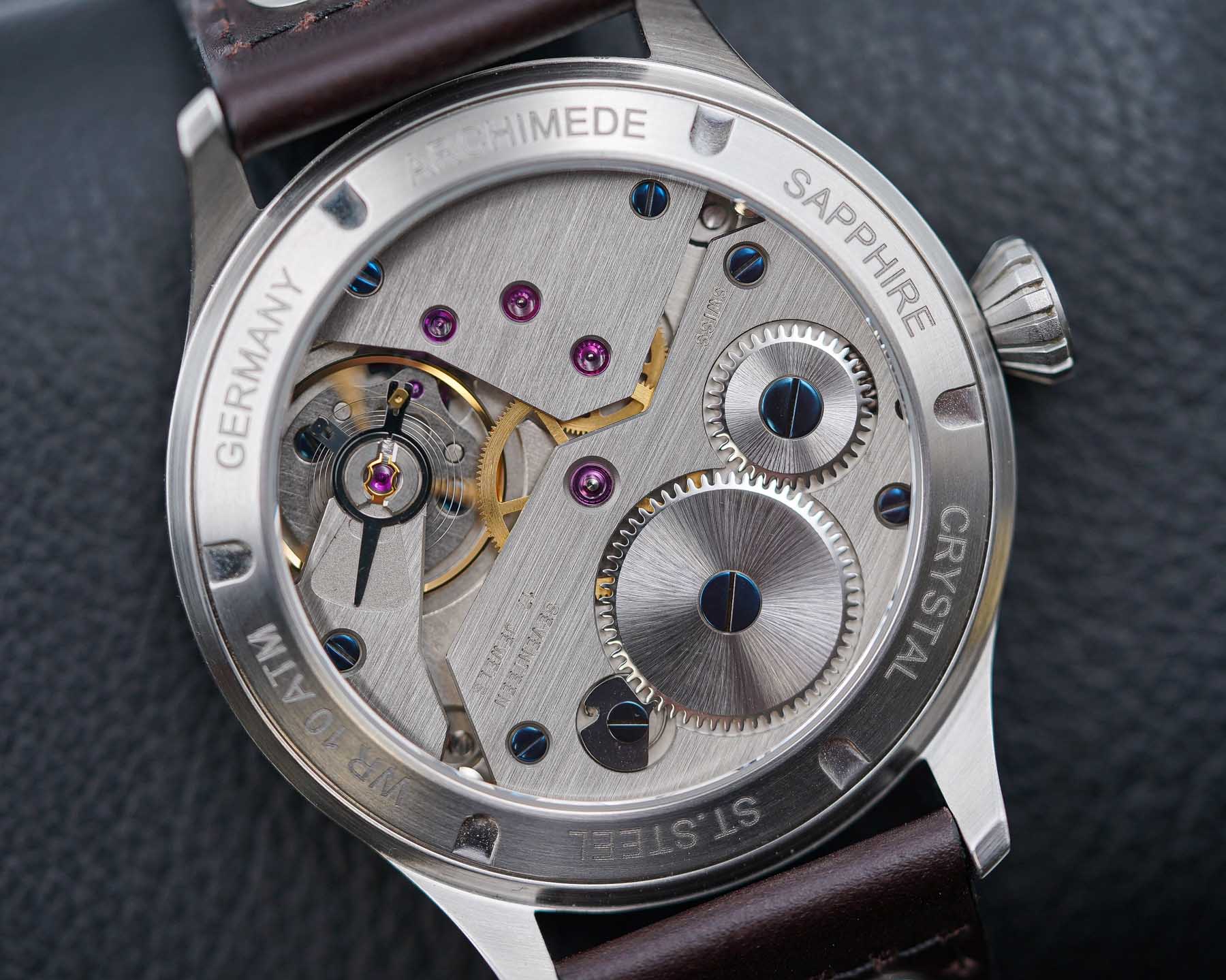
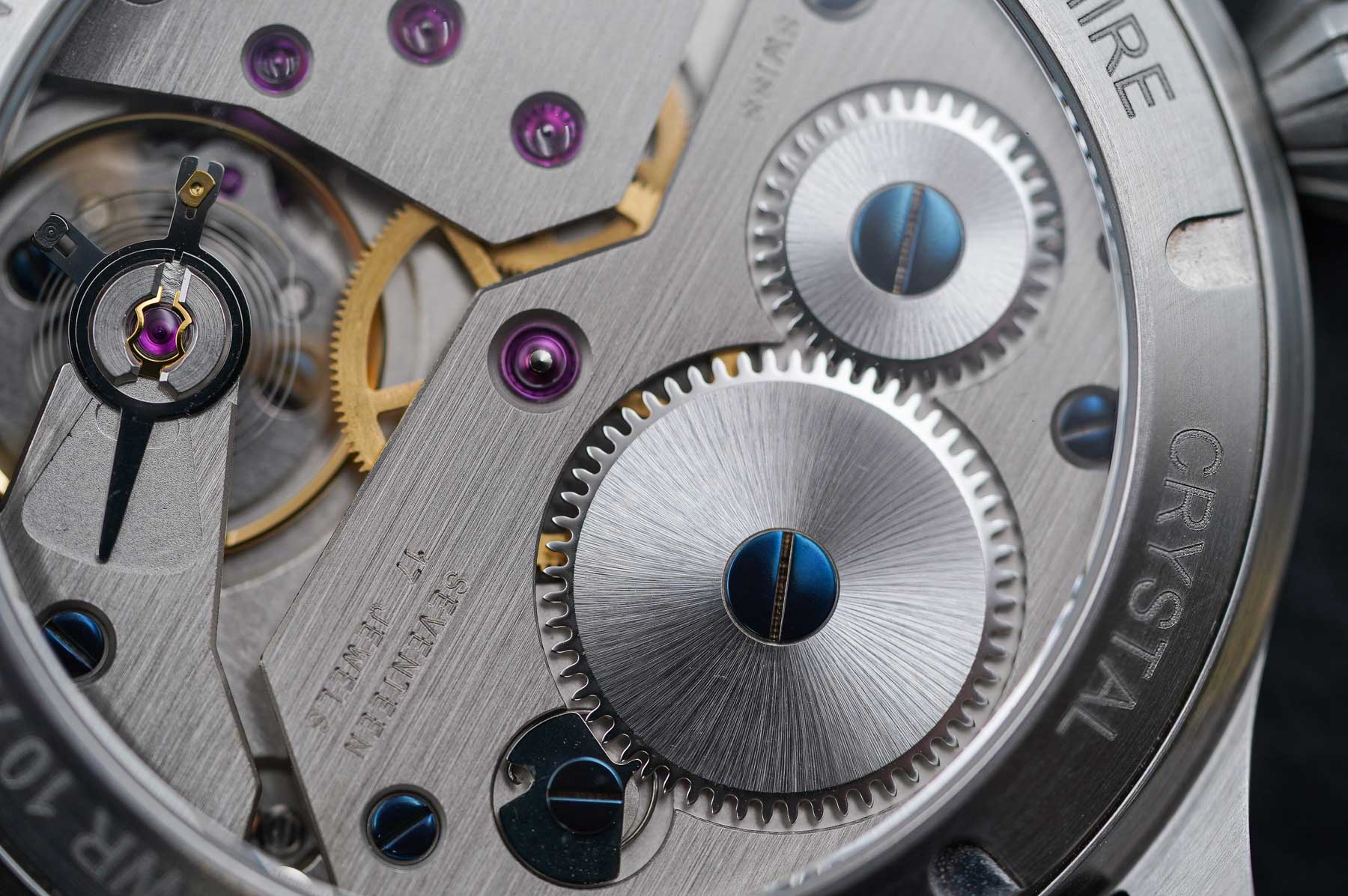
For me, the movement is perhaps the most interesting part of this particular configuration. The Archimede Pilot 45 HW is equipped with the ETA 6498, a manually wound Swiss mechanical calibre with a long history and a reputation for reliability. You can read about history of that movement in a seperate article, that I wrote. And also it is my favourite watch movements of all time! The 6498 belongs to the well-known family of Unitas pocket-watch movements. Its origins are associated with the large, traditional pocket-watch architecture, which explains its generous dimensions and characteristic layout. Over the years, this movement has become a popular choice among independent watchmakers and smaller brands producing mechanical watches with a traditional aesthetic. Its architecture is particularly attractive in a watch such as the Pilot 45 HW. The large movement fills the case nicely, while the small seconds display at six o’clock is a natural consequence of its construction. Unlike many contemporary automatic movements, there is no rotor covering the bridges and wheels, so the mechanical architecture remains visible through the sapphire case back.
The ETA 6498 is also an uncomplicated movement from a practical perspective. It offers manual winding, a traditional mechanical construction and straightforward servicing characteristics. It is a proven calibre, and there is a good reason why it continues to be used in watches from numerous independent manufacturers. My particular watch features the TOP version of the ETA 6498, which is a more refined specification than the standard movement. The TOP designation is important because it represents an upgrade in movement grade and finishing rather than simply another name for the same basic calibre.
However, this is also where I have some reservations about Archimede’s execution. Looking through the exhibition case back, I cannot help feeling that the movement deserved a little more attention. While the overall appearance is clean and the traditional mechanical architecture is attractive, the decoration is relatively restrained. The bridges could certainly benefit from more elaborate finishing, additional decorative patterns and a greater level of visual refinement. This becomes particularly noticeable when comparing the Archimede with similarly priced watches from manufacturers such as Stowa, which have also used the ETA 6498. Some of Stowa’s executions demonstrate a more elaborate approach to movement decoration, with more visually interesting bridge finishing and a stronger emphasis on the presentation of the mechanical components.
I am not suggesting that decorative finishing makes a movement mechanically superior. It does not. Accuracy, reliability, regulation and long-term serviceability are much more important considerations. Nevertheless, when a manufacturer offers a TOP-grade movement and provides an exhibition case back specifically to showcase it, the visual presentation becomes part of the overall ownership experience. I would have liked to see Archimede take this opportunity further. More elaborate bridge decoration, better visual finishing and a little more attention to the details visible through the sapphire window would have made a considerable difference. The ETA 6498 is a movement worth showing off. It has history, character and an architecture that is particularly well suited to traditional mechanical watches. I simply believe that Archimede could have done more to make the TOP version visually special. That said, there is something undeniably satisfying about winding a large mechanical movement by hand. It creates a more direct relationship between the owner and the watch, something that is increasingly missing from modern automatic and quartz timepieces.
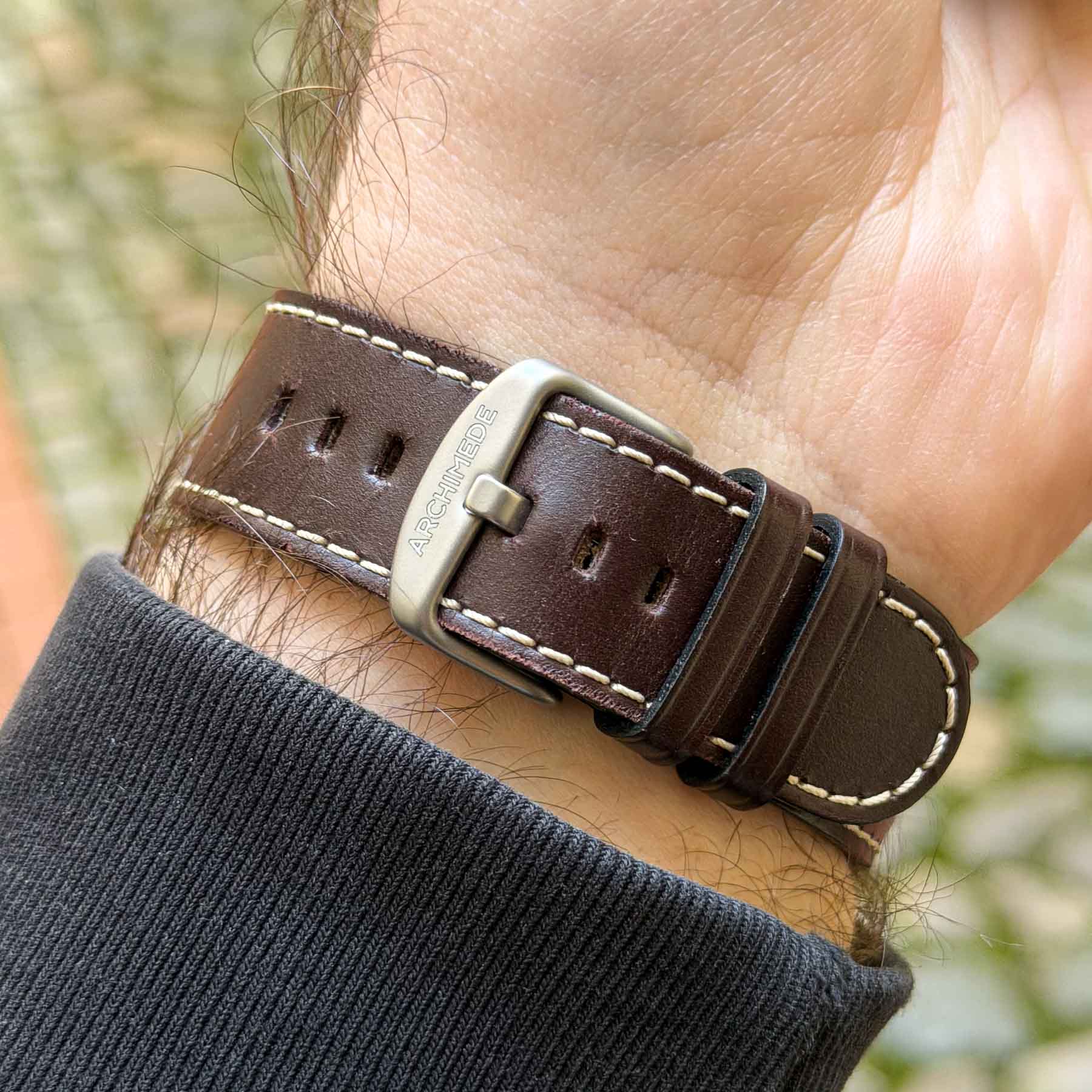
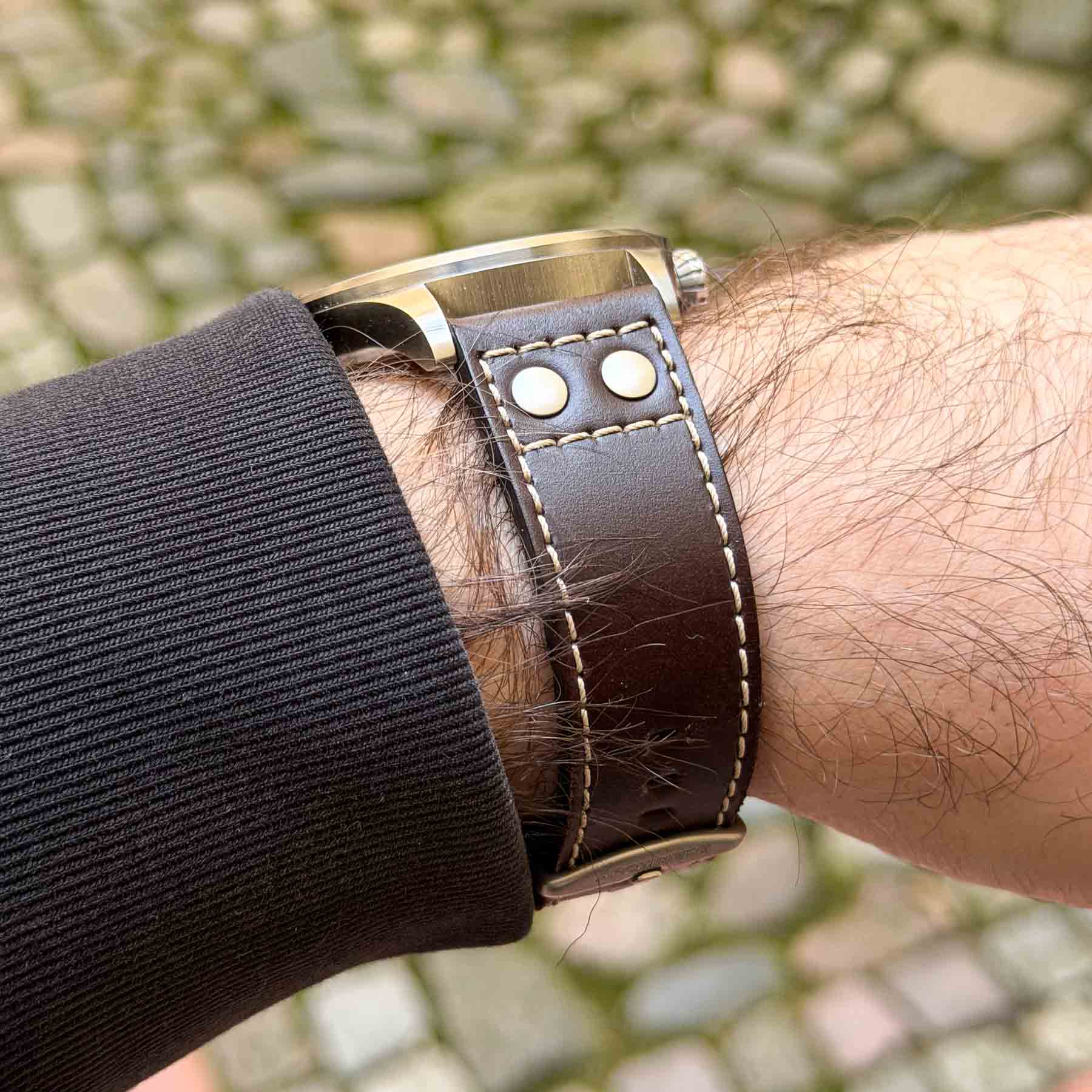
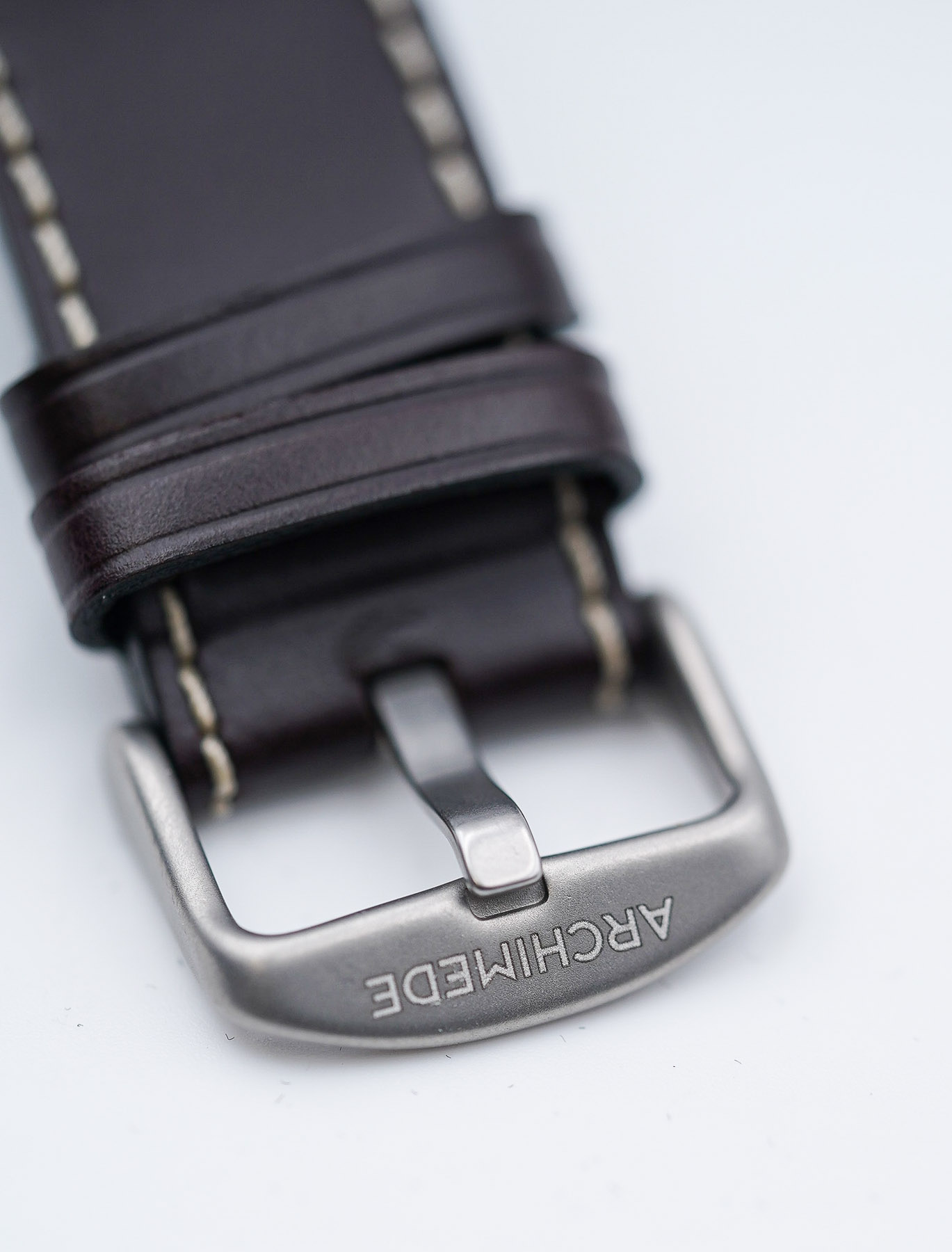
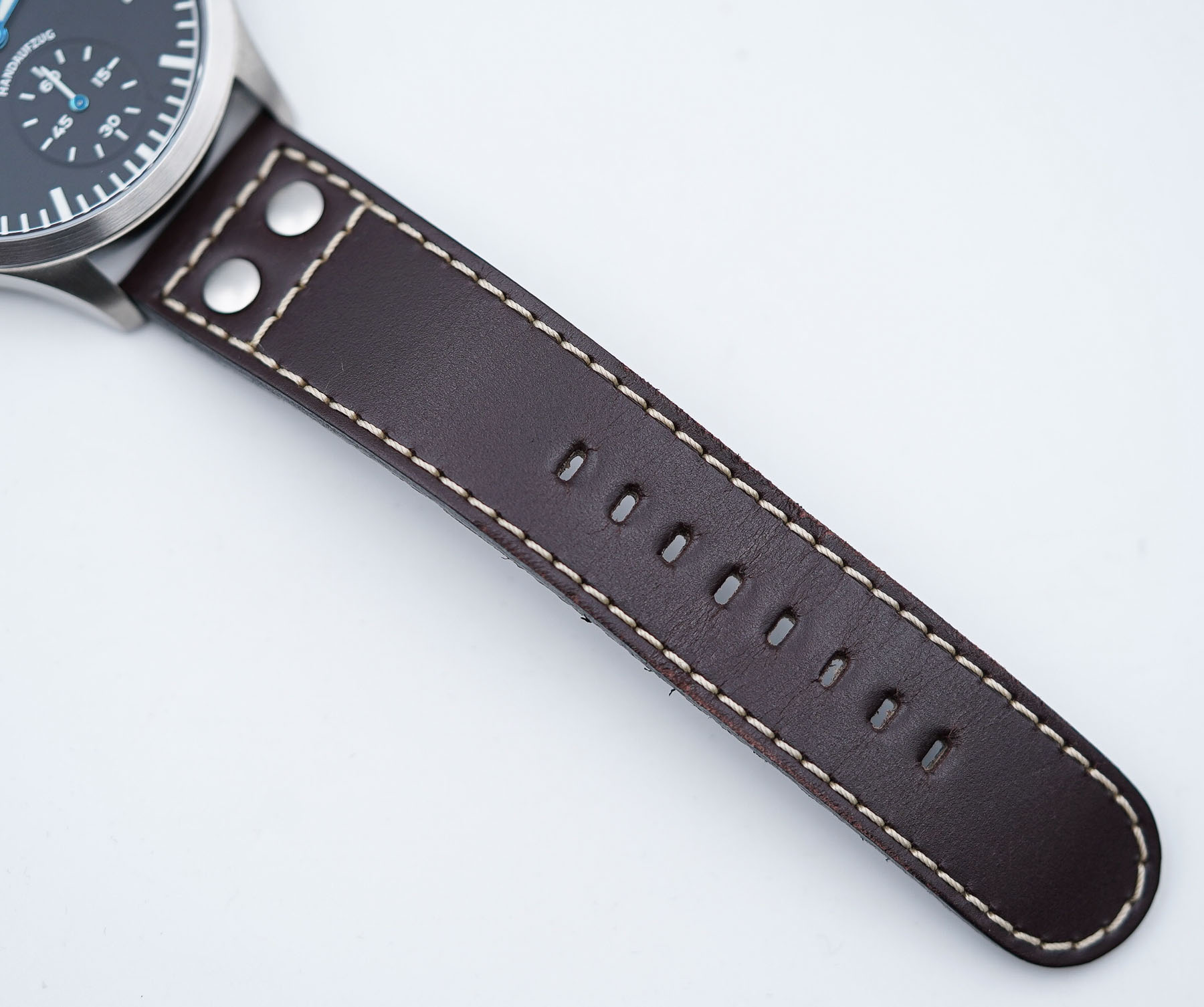
The dark brown leather strap is visually an excellent match for the Pilot 45 HW. Its colour complements the brushed stainless-steel case, while the white stitching and metal rivets reinforce the traditional aviation-watch appearance. The riveted construction is particularly appropriate here. It immediately recalls the straps used on historical pilot watches, where durability and secure attachment were more important than elegance. The brown leather also gives the otherwise monochromatic watch a warmer, slightly vintage character. However, this is one area where my experience has been less positive. The leather is simply too stiff. While the strap looks appropriate and appears reasonably substantial, it lacks the suppleness I would prefer from a watch in this category. It does not immediately conform to the wrist, and the initial wearing experience feels less comfortable than it should. Of course, leather straps often require some time to break in. A new strap can become softer after repeated use, gradually adapting to the shape of the wrist. Nevertheless, I would have preferred Archimede to use a more flexible leather from the beginning. A pilot watch with a 45mm case is already a substantial object on the wrist. The strap should therefore contribute to comfort rather than make the watch feel even more rigid. A softer, more supple leather, perhaps with a slightly more refined lining, would improve the overall experience considerably. I would also like to see Archimede offer a higher-quality travel pouch or an alternative strap option as part of the package. These might seem like relatively small details, but they contribute to the impression of quality that customers associate with a mechanical watch.
The Archimede Pilot 45 HW is an interesting proposition for anyone who appreciates traditional German pilot watches and straightforward mechanical engineering. It combines an attractive aviation-inspired design with a well-constructed German case and a proven Swiss hand-wound movement. Its strongest qualities are relatively easy to identify. The ICKLER case is particularly well executed, the dial is clean and highly legible, the luminous performance is excellent, and the ETA 6498 provides a satisfying mechanical experience. There is a certain honesty about this watch that I appreciate. It does not attempt to disguise its origins or pretend to be something more complicated than it actually is. However, a good watch is not defined exclusively by its case and movement. The overall ownership experience is made up of many smaller details, and this is where I believe Archimede has missed a few opportunities.
The first disappointment is the packaging. For a mechanical watch of this price category, I would have preferred something more substantial than a small cardboard box. A simple wooden presentation box would have been considerably more appropriate, particularly given the traditional character of the watch. Alternatively, a quality travel pouch would be a practical and welcome addition. Packaging is not the reason anyone should buy a watch, but it is part of the experience, and a little more attention here would make the product feel more complete. The second issue is the movement finishing. I genuinely appreciate the decision to offer the ETA 6498 TOP, but I would have liked to see more elaborate decoration on the bridges. When competitors such as Stowa demonstrate what can be achieved with the same basic calibre, it becomes difficult not to notice the difference. Archimede has the opportunity to make its movement presentation considerably more attractive without changing the underlying mechanical architecture. Finally, the leather strap needs improvement. It looks right, but it should be softer and more comfortable from the beginning.
None of these criticisms fundamentally changes my opinion of the watch. In fact, they are worth mentioning precisely because the underlying product is so appealing. Archimede has the manufacturing experience, the historical background and the technical foundation to produce something genuinely impressive. The Pilot 45 HW already gets many important things right. What I particularly like is that this is a watch with a clear purpose and a recognisable identity. It is not trying to compete with luxury brands through marketing, precious materials or unnecessary complications. Instead, it offers a traditional mechanical pilot watch built around German case manufacturing and Swiss movement technology.
Would I recommend it? Yes, particularly to someone looking for a large, manually wound pilot watch with an authentic design and a solid mechanical foundation. However, I would also encourage Archimede to pay more attention to the details surrounding the movement, strap and presentation. Sometimes the difference between a good watch and a genuinely memorable one is not the movement inside or the diameter of the case. It is the care invested in the details that the owner notices every day. The Archimede Pilot 45 HW is already a very good foundation. With a more supple leather strap, more ambitious movement decoration and better presentation, it could become an even more compelling offering.

